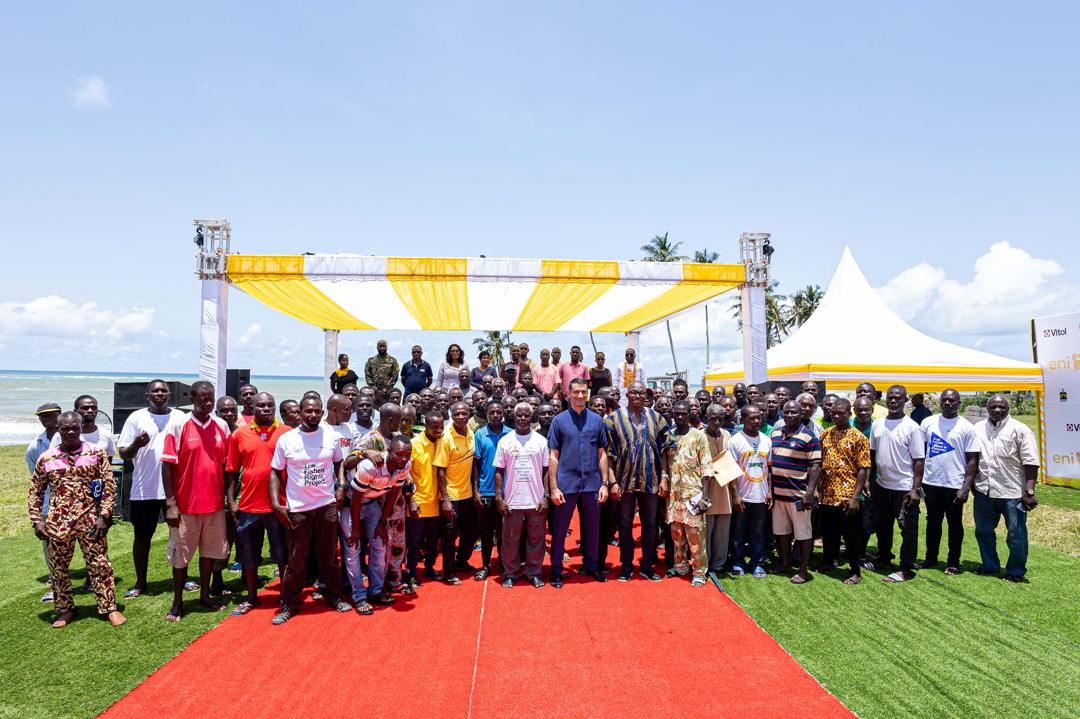
About thousand verified canoe owners across 14 coastal districts and municipal assemblies have received support from Eni Ghana and its partners to bolster local fish supply.
The physical aid package, including high-quality multifilament nets, weaving threads, buoys, lead weights and dragging ropes, which meet the rigorous safety standards set by the Ghana Maritime Authority, will be distributed to verified canoe owners.
Eni Ghana made this known at the official launch of a comprehensive livelihood enhancement programme aimed at revitalising the country’s artisanal canoe fishing sector, in collaboration with its Offshore Cape Three Points (OCTP) partners, Vitol Upstream Ghana Ltd (Vitol) and the Ghana National Petroleum Corporation (GNPC).
The programme targets a wide geographical area, including districts such as Jomoro, Ellembelle, Nzema East, and Ahanta West.
Coverage extends to major hubs and municipalities like Sekondi-Takoradi, Shama, Effutu, Cape Coast, and several Gomoa and Mfantseman areas, ensuring a broad impact across the coastal belt.
By focusing on these specific regions, the intervention seeks to directly enhance employment opportunities and improve local fish supply.
The initiative would also address systemic challenges faced by local fisherfolk, such as the use of aging nets and obsolete engines, and tackle the issue of unsafe towing equipment, which has historically posed significant risks to those working in the artisanal sector.
The programme aligns with Eni’s global commitment to sustainable development and adherence to the International Finance Corporation (IFC) Environmental and Social Performance Standards.
It also supports Ghana’s Petroleum Regulations concerning Local Content and Local Participation.
Maurizio Pinna, Managing Director of Eni Ghana, emphasised that the programme was designed to strengthen canoe-based fishing by providing modern equipment while simultaneously enhancing safety protocols at sea.
“Through this initiative, we are committed to reinforcing awareness on marine biodiversity conservation and provide training in sustainable fishing practices, safety and business management,” Mr Pinna said.
He affirmed the commitment of Eni Ghana and its partners to reinforcing awareness on marine biodiversity conservation, through specialised training in sustainable fishing practices, maritime safety, and essential business management skills to ensure long-term viability.
Eni’s involvement in Ghana dates to 2009, primarily focusing on offshore hydrocarbon exploration and production, maintaining an equity production of approximately 40,000 barrels of oil equivalent per day within the Ghanaian energy sector.
As the operator of the OCTP project, Eni holds a 44.4% share in the venture, working together with Vitol, which holds a 35.6% stake, and the Ghana National Petroleum Corporation, that maintains a 20% interest in the partnership.
The joint venture’s portfolio extends far to a variety of social investment initiatives including programmes focused on economic diversification and professional training for local communities.