Barely four months after Damang Gold Mine Limited (DGML) took over the operation of the Damang Mine, signs of a new relationship between the mining company and its host communities are beginning to emerge, with infrastructure works, local employment and structured community engagement taking centre stage.
From the first earthworks for a proposed airstrip at the Huni waste dump to the commencement of work on the Damang-Subri road and preparations for three astroturf facilities, a number of commitments announced at the transition of the mine are already moving into implementation.
At the same time, nearly 400 people from the mine’s catchment communities have entered various stages of DGML’s recruitment process, with 180 already engaged and working and another 220 either progressing through recruitment or awaiting results.
The developments have prompted chiefs, opinion leaders and youth representatives in the Damang catchment to describe the first few months of the indigenous Ghanaian-owned company’s operation as encouraging.
They, however, say the early momentum must be sustained and translated into lasting improvements in livelihoods, infrastructure and local economic5 participation throughout the life of the mine.
From transition to implementation
The Damang mining lease transitioned to DGML on April 18, 2026, marking a significant change in the ownership and management of an operation that has been central to the economic life of the area for more than three decades.
The transition created considerable expectations among host communities, particularly around employment, infrastructure, local business opportunities and their participation in decisions concerning the mine.
Four months on, community leaders say some of those expectations are beginning to receive concrete responses.
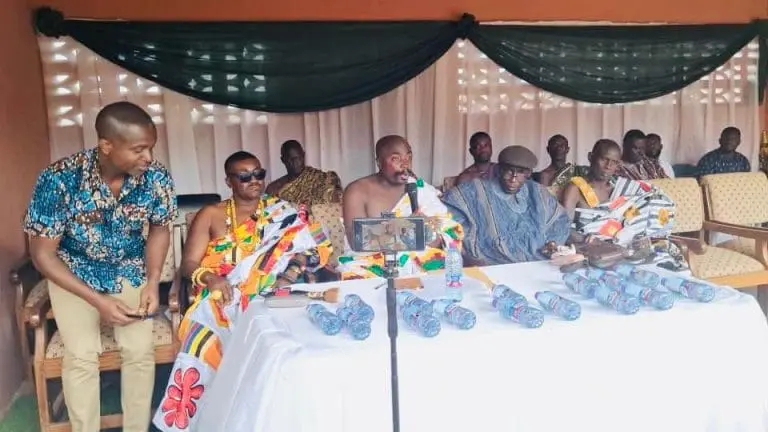
Speaking at a press conference on behalf of the host communities, the Chief of the Bosomtwi Divisional Council, Nana Kwabena Amponsah IV, said the early developments represented positive indications of a more collaborative relationship between the mine and its host communities.
“We have gathered today to publicly acknowledge the positive relationship that has developed between Damang Gold Mine Ltd and its host communities since the company assumed responsibility for the Damang Mine,” he said.
He said the communities had historically sought stronger participation in mining-related decisions, increased employment opportunities for local people, improved infrastructure and a relationship with mining companies based on mutual respect and continuous engagement.
According to him, the early experience under DGML suggested that those objectives could be pursued through dialogue and cooperation.
Airstrip moves beyond announcement
One of the most significant developments is the proposed airstrip at the Huni waste dump.
DGML has confirmed that the facility has been designed and that initial earthworks have begun.
The company has also brought the relevant regulatory and local authorities into the process.
The Ghana Civil Aviation Authority and the Prestea-Huni Valley Municipal Assembly have been invited to the site to inspect the progress of the works.
For the communities, the development is important because the proposed airstrip has moved beyond a project announcement to preliminary physical works and regulatory engagement.
When completed, they believe the facility could improve connectivity, support the mine’s operations, attract investment and create new economic opportunities for businesses and residents in the wider area.
The communities are therefore looking forward to the completion of the regulatory and technical processes required to take the project into full construction.
Damang-Subri road gets moving
Road infrastructure is another area where the communities are seeing early activity.
Work has commenced on the Damang-Subri section of the Damang-Subri-Praso-Cape Coast road.
The fringes of the road have been cleared, while sections between Damang and Subri have been cut and filled with suitable materials.
Culverts have also been constructed at waterlogged sections to facilitate the movement of water, particularly during the rainy season.
The road is regarded by residents as a critical link for the movement of people, goods and services and as an important connection between the mining communities and commercial centres beyond the immediate catchment.
The communities believe improved road infrastructure could reduce transportation difficulties, improve access to markets, schools and health facilities and support businesses operating in the area.
They are therefore calling for sustained collaboration between DGML, the Government and relevant agencies to ensure that the road improvement efforts translate into a durable solution to the longstanding challenges along the corridor.
3 astroturfs planned
The development of sports infrastructure is also forming part of DGML’s early community initiatives.
The company has requested land from Nananom for the construction of standard astroturf parks at Subri, Damang and Huni Valley.
The communities have made land available for the proposed facilities, while a consultant being considered for the project visited the sites in July.
DGML has indicated that the contractor is expected to mobilise a team and commence work by the middle of August.
For the youth, the proposed parks represent more than recreational facilities.
Community leaders believe they could provide platforms for football development, talent identification, youth engagement and community activities while giving young people access to better sporting infrastructure.
The communities are consequently looking forward to seeing the projects move from site assessment and preparatory activities to actual construction.
400 locals in employment pipeline
Perhaps the most immediate benefit being felt by residents is employment.
DGML has reached an agreement with its host communities under which 60 per cent of its employees are expected to come from the local communities, with the remaining 40 per cent sourced externally, including employees’ wards, corporate sources and Ghana at large.
Nearly 400 locals have already entered various stages of the recruitment process.
Of these, 180 candidates have been engaged and are currently working.
Another 135 candidates selected for positions including maintenance, heavy-duty driving, security and general hands are progressing through the final stages of recruitment, including pre-employment medical examinations and induction.
A further 85 candidates have completed interviews and are awaiting their results.
The communities regard the numbers as an important early indication that local people can secure a meaningful share of the economic opportunities generated by the mine.
They also welcomed the involvement of Ghanaian professionals in key positions within the operation, saying it demonstrated the capacity of Ghanaian expertise to contribute to the management and technical operations of a major mining asset.
But the communities want the employment gains to go beyond immediate recruitment.
They are calling for sustained training, skills development, apprenticeships, career progression and technical capacity building to ensure that young people from the catchment acquire skills that remain valuable beyond individual projects or employment cycles.
Local businesses want bigger share
For the communities, local participation should not end at the mine’s payroll.
They want qualified local businesses and contractors to secure a greater share of procurement and contracting opportunities associated with the operation.
Community leaders argue that the benefits of indigenous ownership should be visible throughout the mining value chain — from the employment of Ghanaian workers and professionals to the participation of local suppliers, contractors and enterprises.
They are therefore encouraging DGML to create opportunities for capable local businesses while ensuring that quality, safety and efficiency standards are maintained.
Such an approach, they believe, would allow a greater proportion of the economic value generated by the mine to circulate within the host communities and the wider Ghanaian economy.
Dialogue becomes a defining feature
Beyond the physical projects and jobs, the communities say the emerging pattern of engagement with DGML may prove to be one of the most important developments since the transition.
They say mining operations cannot be sustainable when companies and communities operate at arm’s length.
Nananom and community leaders have consequently welcomed what they describe as increased emphasis on dialogue, mutual respect and structured engagement.
The Social Responsibility Forum and other established engagement structures have provided platforms for discussions on sustainable community relations, employment and economic opportunities and community development, including discussions around the proposed Development Foundation.
The communities said they were particularly encouraged that some of the discussions were being captured in mutually agreed frameworks.
Such arrangements, they believe, could provide greater accountability and ensure that commitments are not dependent solely on individual personalities or changes in management.
Indigenous ownership faces its first test
The early experience at Damang is also emerging as an important test of what indigenous ownership of a major mining operation can mean in practical terms.
For the communities, Ghanaian ownership should go beyond the identity of the concession holder.
They expect it to produce stronger participation by Ghanaian workers, professionals, businesses and host communities, while ensuring that the mineral wealth contributes more visibly to national development.
They consequently commended DGML’s leadership, including its Chief Executive Officer, Ibrahim Mahama, for what they described as a willingness to engage directly with the people living around the mine.
The communities said the experience so far demonstrated that mining companies and host communities could pursue their interests through cooperation rather than confrontation.
That, they believe, could offer lessons for Ghana’s broader mining industry, where disputes between mining companies and host communities have frequently centred on employment, compensation, environmental concerns, infrastructure and community development.
Praise comes with a warning
The communities, however, are not presenting the first four months as evidence that all their problems have been solved.
Their endorsement comes with a clear demand for continuity.
They want DGML to fulfil the commitments made during the transition, maintain transparency and accountability and keep channels of communication open.
They also expect the 60:40 local-to-external employment arrangement to be respected and expanded where appropriate, while local enterprises receive meaningful opportunities to participate in the mine’s supply chain.
The infrastructure commitments, they said, must similarly progress from plans and initial works to completed projects capable of delivering measurable benefits.
For the communities, the transition of the Damang Mine to DGML was not an end in itself. It was the beginning of a new phase whose success will ultimately be judged by what changes residents can see and feel in their everyday lives.
A new measure of success
The emerging picture at Damang is therefore one of cautious optimism.
The airstrip has entered the earthworks stage. Work has started on the Damang-Subri road. Sites have been assessed for three astroturf facilities, with mobilisation expected shortly.
Nearly 400 local people are moving through the employment pipeline, while structured engagement between DGML and the communities is taking shape.
Those developments have given Nananom and residents reason to believe that the transition could produce a different kind of relationship between a mining company and its host communities.
But they also recognise that the real test lies ahead.
The communities want to see projects completed, jobs sustained, local businesses integrated into the supply chain and development commitments translated into measurable improvements.
Nana Amponsah said the communities were prepared to support DGML as long as the relationship remained anchored in mutual respect, transparency, local participation, responsible mining and sustainable development.
“The message from Nananom and the people of the Damang Mine catchment communities today is simple: A new chapter has begun in the relationship between the Damang Mine and its host communities,” he said.
That new chapter, the communities insist, must ultimately be measured not merely in ounces of gold produced or financial returns generated, but in roads built, jobs created, businesses empowered, young people trained and communities transformed.
If the early momentum is sustained, Damang could become a significant demonstration of how indigenous ownership, responsible mining and meaningful host-community participation can work together to produce broader and more lasting benefits from Ghana’s mineral resources.