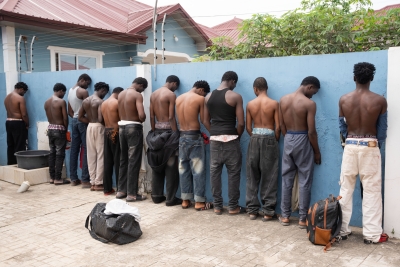
Ghanaian security agencies have arrested 19 people suspected of involvement in transnational online scam operations at Sasaabi, a suburb of Accra, as part of a coordinated international crackdown that has disrupted criminal networks operating across West Africa.
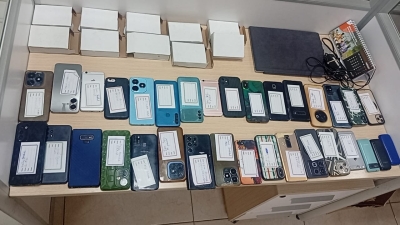
The operation, led by the Cyber Security Authority (CSA), the Criminal Investigation Department (CID) of the Ghana Police Service and the National Security Service, resulted in the seizure of 303 electronic devices and the identification of 117 suspected victims of human trafficking who are awaiting repatriation to Nigeria.
Authorities also identified 89 victims of online scams who reportedly suffered combined losses estimated at $8.3 million.
The arrests formed part of an international “Joint Disruption Week” hosted by the United Kingdom’s National Crime Agency (NCA) in London and involving law enforcement agencies, intelligence services and technology companies from several countries.
Announcing the results, the United States Department of Justice said the week-long initiative produced 28 arrests in Ghana and Nigeria, the seizure of hundreds of electronic devices, the identification of more than $11 million in potentially freezable funds and the removal of more than 3.7 million fraudulent social media accounts, pages and groups targeting victims in the United States, the UK and elsewhere.
The operation, which began during the week of October 6, marked the first coordinated international enforcement effort focused specifically on disrupting scam networks operating in West Africa.
Ghana, Nigeria operations
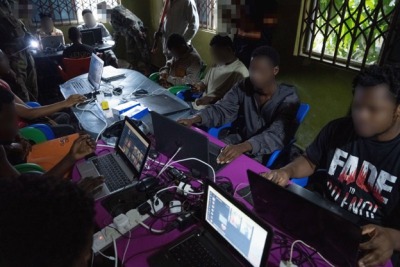
In Ghana, the operation focused on suspected scam centres whose activities allegedly involved online fraud and the exploitation of vulnerable individuals.
The 117 trafficking victims identified at Sasaabi are awaiting repatriation to Nigeria, while the 89 identified scam victims were reportedly defrauded of approximately $8.3 million.
The Ghana operation received support from the NCA, the Federal Bureau of Investigation (FBI) and Nigeria’s Economic and Financial Crimes Commission.
The latest arrests followed enforcement operations conducted at six locations during the final week of September, when authorities reportedly made scores of arrests, identified 34 trafficking victims and seized 129 electronic devices.
In neighbouring Nigeria, authorities arrested nine people and seized 53 electronic devices during the enforcement period.
The combined operations in the two countries accounted for the 28 arrests announced by the US Department of Justice.
The agencies targeted criminal schemes including law enforcement impersonation, digital extortion in which victims are threatened with purported arrest, cryptocurrency investment fraud and other online scams designed to extract money from people across international borders.
One prominent form of cryptocurrency investment fraud, commonly known as “pig butchering”, involves scammers building relationships with victims and persuading them to invest in fraudulent digital asset schemes before disappearing with the funds.
3.7 million accounts taken down
Technology companies participating in the operation removed more than 3.7 million accounts, pages and groups associated with suspected scams and shared intelligence on more than 30 suspected scam centres with law enforcement agencies.
The companies included Meta, Google, Microsoft, Adobe, OpenAI, Binance, Coinbase, Starlink, Chainalysis, Elliptic, TRM Labs, Cyjax, Flashpoint and Silent Push.
According to the Department of Justice, the companies voluntarily took action across their networks to disrupt the infrastructure used by scammers to reach and defraud victims.
Meta played a key coordinating role in encouraging wider participation by private technology companies.
The collaboration also helped investigators identify cryptocurrency-related funds potentially worth more than $11 million that could be frozen, alongside evidence and intelligence supporting arrests and the rescue of trafficking victims.
Assistant Attorney-General A. Tysen Duva of the US Department of Justice’s Criminal Division said the operation demonstrated the effectiveness of cooperation between law enforcement agencies and the private sector in confronting cyber-enabled crime.
He commended the UK’s NCA for hosting the initiative and expressed particular appreciation to law enforcement officers in Ghana and Nigeria who risked their safety to seize evidence and arrest suspects.
“The millions of bogus social media accounts taken down and dozens of arrests that took place as part of Joint Disruption Week are just the beginning,” he said.
US Attorney Jeanine Ferris Pirro, founder of the Scam Center Strike Force, said transnational fraud required coordinated action across jurisdictions because criminal networks operated beyond national borders.
She said her office was working with international partners to pursue cases on both sides of the Atlantic and would deploy its resources wherever transnational criminals targeted innocent people.
Nick Sharp, the NCA’s Deputy Director of Fraud, said cooperation between law enforcement agencies and technology companies had enabled investigators to disrupt a significant group of criminals responsible for widespread financial harm.
He said the agency would continue working with international and private-sector partners to target fraudsters and the infrastructure they relied on, regardless of where they operated.
Billions lost to investment fraud
The operation comes amid growing concern over the scale of online investment fraud, particularly scams involving cryptocurrency.
According to the FBI’s Internet Crime Complaint Center (IC3), investment scams were reported 72,984 times in 2025, with cryptocurrency investment fraud accounting for 72 per cent of that category.
Reported losses from investment scams increased from $3.96 billion in 2023 to $5.8 billion in 2024.
Losses from investment scams involving cryptocurrency rose by 24 per cent in 2025 to more than $7.2 billion.
The Department of Justice cautioned that the figures, which rely substantially on victims reporting incidents to authorities, likely understate the actual scale of the problem because many victims do not report their losses.
It cited a government estimate that the annual value of funds stolen by scam syndicates worldwide approached $64 billion by the end of 2023.
Investigators say scam centres in West Africa share characteristics with criminal operations uncovered in Southeast Asia, where highly organised networks recruit and train workers to use social engineering and coordinated online campaigns to defraud victims globally.
Authorities maintain that disrupting fraudulent accounts and digital infrastructure is important but insufficient without sustained investigations and prosecutions targeting the individuals and organisations behind the schemes.
International cooperation
The Joint Disruption Week brought together the US Department of Justice, the FBI, the US Secret Service, the US Department of the Treasury, Homeland Security Investigations, the Homeland Security Task Force, the UK’s NCA, Nigerian cybercrime agencies, Ghana’s Cyber Security Authority and other international law enforcement partners.
Australia, Canada, India and New Zealand also participated, alongside INTERPOL and additional cybercrime units.
The initiative builds on the US government’s broader efforts to tackle cyber-enabled fraud. On March 6, 2026, US President Donald Trump signed an executive order directing his administration to prioritise cybercrime, fraud and predatory schemes targeting Americans.
The Department of Justice said its Cyber-Enabled Scam Initiative was designed to accelerate investigations and prosecutions involving cryptocurrency fraud, government impersonation, romance and inheritance scams, financially motivated sextortion, lottery fraud and other forms of online exploitation.
The Scam Center Strike Force, launched in November 2025, focuses on cryptocurrency investment fraud, cyber-enabled crime, human trafficking and money laundering linked to scam centres.
The US authorities say the latest operation demonstrates how coordinated law enforcement and private-sector action can disrupt criminal networks, identify victims and trace potentially recoverable proceeds.
For Ghana, the arrests and identification of trafficking victims highlight the intersection between online financial crime and human exploitation, as local security agencies work with international partners to dismantle networks targeting victims across multiple countries.