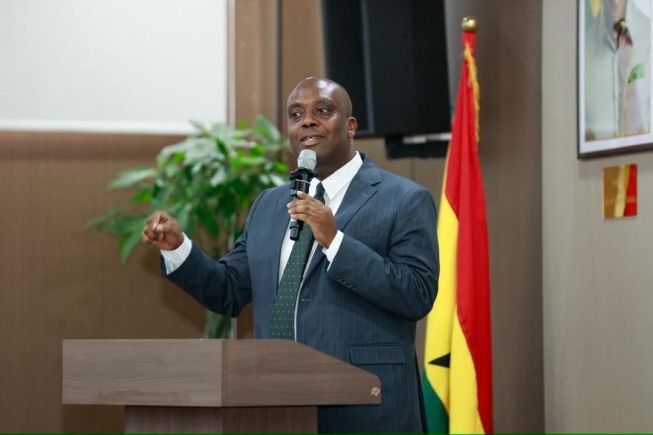
The government has recorded a significant 62.9 percent reduction in financial irregularities across the public sector, surpassing its target of 50 percent, the Deputy Minister for Finance Thomas Ampem Nyarko has announced.
Speaking at the 2025 Auditor-General’s Reports Engagement held in Accra on Monday, the Deputy Minister disclosed that financial irregularities across five key sectors declined from approximately GH¢20.72 billion in 2024 to GH¢7.69 billion in 2025.
“This represents a reduction of approximately GH¢13.03 billion, or 62.9 percent. This is a significant achievement,” he said.
The engagement, held under the theme “Recovering Every Cedi,” brought together Chief Directors, Heads of Institutions, and representatives of the Auditor-General to deliberate on the findings of the 2025 Auditor-General’s Reports.
The Reports cover Ministries, Departments and Agencies (MDAs); Metropolitan, Municipal and District Assemblies (MMDAs); the District Assemblies Common Fund (DACF); Public Boards and State-Owned Enterprises; and Public Universities and Colleges of Education.
Varying performance across sectors
Mr Nyarko noted that while the overall figures were encouraging, they concealed areas where the situation had deteriorated.
Irregularities relating to the District Assemblies Common Fund declined by 39.6 percent, while Public Universities and Colleges of Education recorded a 51.5 percent reduction. Public Boards, Corporations and other Statutory Institutions recorded the most substantial decline of approximately 87.8 percent.
Within the education sector, recoverable irregularities in Public Universities declined by 35.2 percent, while those in Colleges of Education declined by an impressive 95.8 percent.
However, Ministries, Departments and Agencies recorded an increase in irregularities of 156.3 percent, while Metropolitan, Municipal and District Assemblies recorded an increase of 125.6 percent.
“These increases are unacceptable and demand immediate corrective action,” the Deputy Minister warned.
From identification to recovery
Mr Nyarko stressed that identifying irregularities was not the end of the process, emphasising that recovery and accountability must follow.
“For too long, audit findings have sometimes been treated as matters to be noted, discussed and eventually forgotten. That approach must change,” he stated.
He disclosed that the detailed presentation at the engagement would identify affected institutions, companies, individuals and responsible officers, as well as the amounts involved.
Mr Nyarko made it clear that the responsibility for action does not rest with the Auditor-General alone.
“The respective Ministries, Departments, Agencies and other public institutions know the relevant transactions and parties involved. They must therefore take direct responsibility for initiating and pursuing recovery,” he said.
This includes issuing demand notices where appropriate, following up outstanding debts, engaging responsible persons and institutions, and ensuring that recoverable amounts are paid back to the State within the required timelines.
Monitoring and accountability
The Deputy Minister announced that recovery efforts would be monitored and progress reported.
“Where responsible institutions or officers fail to act on recoverable amounts, the appropriate accountability measures will be applied in accordance with the applicable public financial management laws,” he warned.
He emphasised: “Public money must be protected. Money due to the State must be recovered. Those responsible for the loss or misuse of public resources must be held accountable.”
Building a culture of fiscal responsibility
The Deputy Minister noted that the Government’s ultimate objective was to build a public financial management system in which financial irregularities were the exception rather than the norm.
“We must strengthen preventive controls so that irregularities are identified and addressed before they become financial losses,” he said.
He called on all MDAs, MMDAs, State-Owned Enterprises and other public institutions to take the findings of the Auditor-General seriously and act on them.
“Let this engagement mark a decisive shift from audit findings to action, from action to recovery, and from recovery to stronger systems that prevent recurrence. The Ghanaian taxpayer expects nothing less,” he said.
GraphicOnline