President John Dramani Mahama has disclosed that the Human Sexual Rights and Ghanaian Family Values Bill, 2025, will undergo a full review by the Attorney-General and legal advisers at the Presidency before any recommendation is made for presidential assent.
He stressed that although the Bill has been passed by Parliament, it cannot automatically proceed to assent without a detailed legal and constitutional assessment to ensure all requirements have been met.
“This was not a Government Bill. And so we’ll look at it and make sure that everything is in order before the President is advised to assent,” he said.
Private Member’s Bill requires additional scrutiny
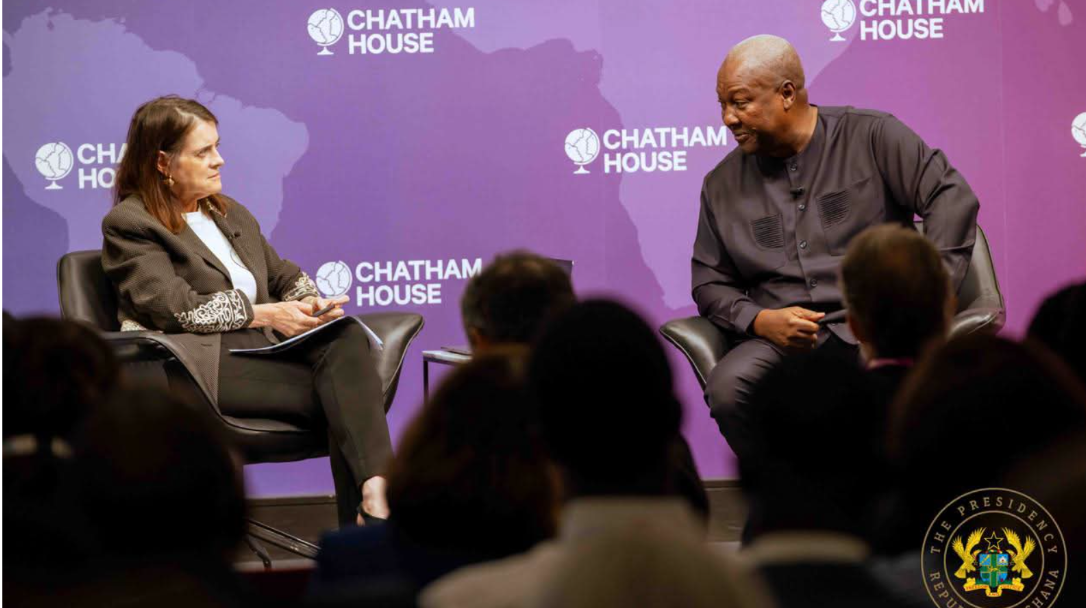
Speaking at Chatham House in London during his official visit to the United Kingdom, the President noted that the Bill, having been introduced as a Private Member’s Bill, requires additional caution in its post-parliamentary review.
He explained that the President is not involved in parliamentary deliberations and therefore depends entirely on legal advice after a Bill is transmitted for assent.
“It must come for assent. And so once the President gets it, you go through it because you’re not part of the discussion in Parliament,” he stated.
He added that where concerns remain unresolved, the Constitution allows the President to return the Bill to Parliament with observations for reconsideration.
Council of state may be involved
President Mahama also indicated that the Council of State may be consulted where necessary as part of the constitutional safeguards governing law-making.
He said Ghana’s constitutional framework ensures that legislation undergoes multiple layers of scrutiny before it becomes law, adding that several issues still need to be addressed.
“And so that’s still quite a way to go before that Bill becomes law,” he noted.
Procedural and constitutional concerns under review
The President said the Bill still faces significant procedural and constitutional hurdles before it can be considered for assent.
He explained that issues relating to quorum requirements, legislative procedure and constitutional compliance must be carefully examined by legal authorities.
According to him, the legislation remains subject to further scrutiny, including the possibility of referral back to Parliament if irregularities are confirmed.
He revealed that preliminary concerns had already been raised about the passage of the Bill, with the Speaker of Parliament taking steps to address some of the issues.
“I just got some communication that the Speaker was reading a statement to address the issue of the lapses in the passage of the Bill,” he said.
Quorum and procedure at centre of review
The President said one of the key issues under consideration is whether Parliament had the required quorum at the time of approval.
He added that broader procedural compliance issues are also being assessed to ensure the legislative process met constitutional standards.
One of Ghana’s most controversial bills
The Human Sexual Rights and Ghanaian Family Values Bill remains one of the most contested pieces of legislation in recent years, attracting strong reactions from political actors, civil society groups and the general public.
Supporters say the Bill protects Ghanaian cultural and family values, while critics argue that some provisions could lead to discrimination and affect professionals such as journalists, lawyers, healthcare workers and academics.
Speaker raises concerns over passage
Speaker of Parliament Alban Bagbin has also expressed concerns about how the Bill was passed, saying he was surprised the House proceeded beyond what he expected to be an initial consideration stage.
He has since summoned leaders of both the Majority and Minority caucuses for consultations aimed at building consensus on the way forward.
According to him, the focus is not only on passage but on ensuring effective implementation and public acceptance.
“This is such a critical deal that we believe there must be consensus,” he said, noting that development partners and the United Nations had engaged Parliament on the Bill.
Minority questions 31 amendments
The New Patriotic Party (NPP) Minority has questioned why the Bill returned to Parliament with 31 amendments after its earlier passage in 2024.
At a press conference, Rev. John Ntim Fordjour, MP for Assin South and sponsor of the Bill, asked: “What changed?”
He argued that the revised legislation contained significant changes, including deletions, substitutions and new clauses that materially altered its legal effect.
Exemptions and scope changes raise debate
The Minority pointed to amendments exempting lawyers, journalists, medical professionals, academics and counsellors from sanctions in certain situations, alongside changes in definitions and criminal classifications.
According to them, these revisions substantially altered the original intent and scope of the Bill.
“If lawyers, journalists, academics, doctors, counsellors, public health workers and privileged communications now require protection, why was the Bill previously presented as if no such protection required attention?” he asked.
Concerns over public trust and transparency
The Minority further argued that the public was initially led to believe the Bill required only presidential assent in its original form, without disclosure of the scale of subsequent amendments.
They also questioned the political narrative surrounding the handling of the Bill under the previous administration, suggesting that public criticism may have been based on incomplete information.
According to them, the developments raise issues of legislative consistency, transparency and public trust.
Legal challenges and civil society concerns
The Bill is also before the Supreme Court, where petitioners are seeking constitutional interpretation on various aspects of its content and passage.
Civil society organisations and human rights groups have warned that some provisions could lead to discrimination or social exclusion, while supporters maintain that the law is necessary to uphold Ghana’s moral and cultural values.
Still a long legislative path ahead
President Mahama’s remarks at Chatham House underscore that the Bill remains far from becoming law, with several legal, constitutional and procedural steps still to be completed.
He reiterated that all safeguards must be observed before any final decision is taken.
“And so that’s still quite a way to go before that Bill becomes law,” he said, highlighting the sensitivity and complexity surrounding one of Ghana’s most debated legislative measures.