The government has initiated a major reform of Ghana’s mining sector with Cabinet’s approval of a comprehensive review of the Minerals and Mining Act, 2006 (Act 703), aimed at strengthening regulation, improving community participation and ensuring that the country derives greater benefits from its mineral resources.
The revised mining legislation has been forwarded to Parliament for consideration as part of broader efforts to reposition the sector as a stronger driver of national development while addressing longstanding challenges including illegal mining, environmental degradation and limited local value addition.
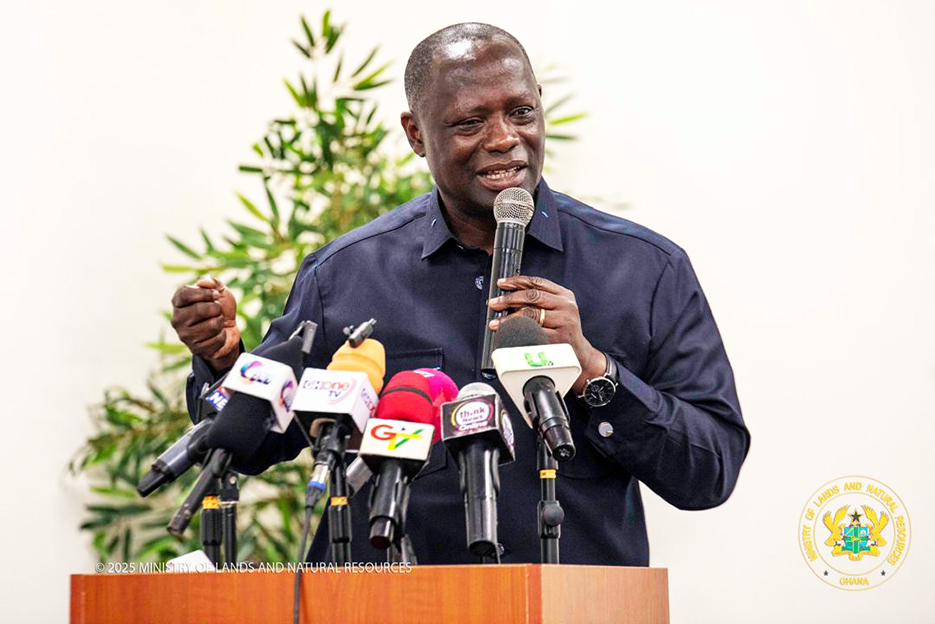
The Minister for Lands and Natural Resources, Emmanuel Armah-Kofi Buah, announced the development during the Government Accountability Series held at the Presidency in Accra, where he outlined his Ministry’s performance in the mining, forestry and lands sectors for the first half of 2026.
He said the review of Act 703, which has guided Ghana’s mining industry for two decades, followed extensive consultations with stakeholders and was designed to create a modern legal framework capable of responding to emerging challenges in the sector.
“The revised Bill provides an updated, coherent and forward-looking legal regime to ensure that mining contributes immensely to national development,” Mr Buah said
New licensing structure and community benefits
Under the proposed amendments, the government plans to introduce district mining committees as the first point of entry for mining licence applications, a move expected to strengthen local participation and improve oversight at the community level.
The revised law will also establish a new medium-scale mining category while replacing the existing reconnaissance licence regime with a single prospecting licence limited to a maximum period of five years.
Mining leases will also be capped at 20 years, with every lease holder required to sign a mandatory community development agreement to ensure mining communities directly benefit from resource extraction activities.
The reforms are expected to address concerns over the relationship between mining companies and host communities, particularly demands for greater investment in infrastructure, social services and livelihood support.
New royalty regime to improve revenue
The Minister further disclosed that Cabinet had approved a revised Minerals and Mining Policy aimed at strengthening local content and increasing domestic participation in the mining value chain.
He said government had also introduced the Minerals and Mining (Royalties) Regulations, 2025 (L.I. 2517), which establishes a sliding-scale royalty system linked to international commodity prices.
According to Mr Buah, the new system provides greater predictability for investors by adjusting royalty payments according to market conditions rather than relying on a fixed rate.
“This self-adjusting mechanism offers greater predictability to investors than a rigid fixed rate vulnerable to low-price cycles,” he explained.
The policy direction is expected to ensure that Ghana earns more from periods of high gold prices while maintaining investor confidence during market downturns.
Crackdown on illegal mining intensifies
The government also reported intensified efforts to combat illegal mining, popularly known as galamsey, through operations conducted by the National Anti-Illegal Mining Operations Secretariat (NAIMOS).
Between January and June 2026, NAIMOS carried out 200 operations across 53 districts in six mining-affected regions, recording an 84.1 per cent success rate.
The operations resulted in the arrest of 207 suspects, including 46 foreign nationals, while authorities seized or destroyed 78 excavators, 2,800 chanfangs and 1,244 makeshift mining structures.
Mr Buah warned that government would continue to take decisive action against activities destroying Ghana’s environment and water resources.
“Our rivers are not for sale. Our forests are not expendable. Our mineral wealth is a sacred national inheritance that we have a duty to protect. The era of impunity is over,” he said.
Land restoration after mining damage
The Lands Minister also highlighted government’s ongoing reclamation efforts to restore lands degraded by mining activities.
He disclosed that 1,535 acres of degraded land in the Ashanti Region had been restored through a partnership with the private sector, with an additional 1,500 acres expected to be reclaimed before the end of the year.
Government is also independently undertaking reclamation of 960 acres of degraded land across the country.
The restoration programme forms part of efforts to repair environmental damage caused by illegal mining, including the destruction of farmlands, forests and water bodies.
Mining sector repositioning
Beyond enforcement and reclamation, the government said the mining reforms are aimed at ensuring that Ghana’s mineral wealth contributes more significantly to economic growth, job creation and community development.
The proposed amendments to Act 703 are expected to redefine the relationship between mining companies, government and host communities while creating stronger safeguards for responsible mineral extraction.
With mining contributing significantly to Ghana’s export earnings and foreign exchange inflows, government believes the reforms will help build a more transparent, sustainable and locally beneficial mining industry.
The Bill now awaits parliamentary scrutiny and approval before becoming law.