The government has officially introduced free special needs education for persons with disabilities, marking a major step towards expanding inclusive and equitable access to education across Ghana.
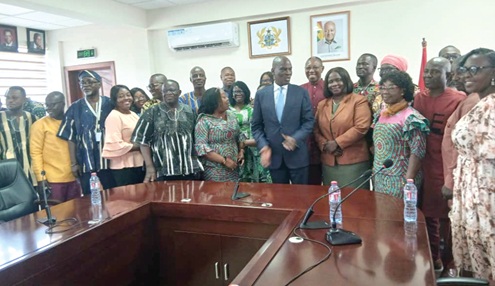
Announcing the policy at its official launch in Accra, the Minister of Education, Haruna Iddrisu, said the initiative is designed to remove financial barriers that have long prevented many persons with disabilities from accessing quality education.
Under the policy, the government will fully fund tuition, accommodation and assistive devices for learners with disabilities at the tertiary level, while the cost of basic and secondary education will continue to be covered by the state.
Mr. Iddrisu explained that Parliament’s amendment of the Ghana Education Trust Fund Act has empowered the Fund to finance the programme on a sustainable basis.
“In the 2026 GETFund allocation formula, GH¢100 million has been earmarked for the implementation of free special needs education for persons with disabilities,” he said.
He added that the amended GETFund Act provides the legal mandate for the Ministry of Education to issue policy directives supporting the initiative.
The Minister described the programme as one of President John Dramani Mahama‘s key social intervention policies aimed at improving opportunities for vulnerable groups and ensuring that no child is denied education because of disability.
Sustained funding
Mr. Iddrisu assured stakeholders that the GH¢100 million allocation would not be a one-off intervention but would be maintained throughout the current administration to guarantee the programme’s sustainability.
“I have directed GETFund to ensure that from 2027 into 2028, and throughout the tenure of President Mahama, this allocation is maintained to support special needs education,” he said.
According to him, the policy reflects the government’s commitment to ensuring that disability does not limit educational opportunities.
“Special needs and disability do not mean limited opportunity. Every child, regardless of ability, background, gender or circumstance, deserves access to quality education,” he stated.
Support for special schools
Ghana currently has 39 public special and integrated schools made up of 29 special boarding schools, seven integrated schools for learners with visual impairment and three integrated schools for learners with hearing impairment. Together, these institutions serve approximately 9,000 learners, including about 8,800 boarders and 200 day students.
As part of the new policy, GETFund will now absorb the feeding costs for all learners in public special and integrated schools.
Addressing heads of the institutions, the Education Minister assured them that funding delays would become a thing of the past.
“You will no longer have to wait for the release of warrants from the Ministry of Finance before feeding your students,” he said.
He also announced an immediate increase in the daily feeding grant from GH¢8 to GH¢15 to improve the welfare of learners.
Disability groups welcome initiative
The National President of the Ghana Federation of Disability Organisations, Joseph Atsu Homadzi, welcomed the policy, describing it as a historic milestone for disability inclusion in Ghana’s education sector.
Drawing on more than three decades of experience as an educator, he said this was the first time a deliberate national framework had been established to comprehensively promote special needs education.
Mr. Homadzi urged parents of children with disabilities to take advantage of the programme by enrolling their children in school.
“There is no longer any reason for children with disabilities to stay out of school because government has removed the financial barriers,” he said.
He added that Ghana’s development depends on ensuring that all citizens, including persons with disabilities, have equal access to education and opportunities to realise their full potential.