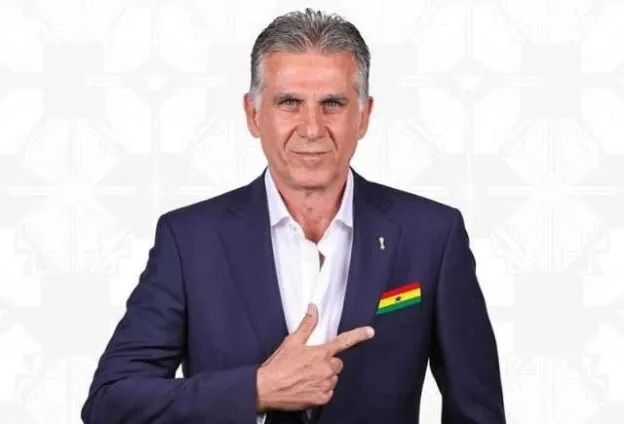
Ghana’s senior national team has entered a decisive new chapter following the appointment of Carlos Queiroz as head coach of the Black Stars, with the experienced Portuguese tactician expressing confidence that success is within reach—provided there is unity and unwavering support from all stakeholders.
Speaking at his official unveiling in Accra on Thursday, April 23, the 73-year-old coach delivered a message that blended optimism with urgency, calling for a collective national effort to revive the fortunes of the team ahead of the 2026 FIFA World Cup.
“I trust, and I believe that, with the support of my staff, the support of the Board, support of the press, support of the friends and the fans—ultimately, one Ghana, united with cohesion with the whole of the nation—I believe we can do it.
We can bring success,” he said, striking a tone that underscored both his experience and the magnitude of the task ahead. “Let us do it together,” he added.
His appointment by the Ghana Football Association comes at a critical moment for Ghanaian football, with the national team seeking stability and renewed direction after a difficult run of results.
The Black Stars are heading into the World Cup on the back of four consecutive defeats under former coach Otto Addo, a situation that has heightened pressure on the new technical leadership to quickly restore confidence and competitiveness.
Queiroz is no stranger to high-stakes football environments. His résumé spans some of the most prominent teams and competitions in the world, including stints with Real Madrid and Manchester United, as well as national teams such as Portugal national football team and Iran national football team.
His World Cup pedigree is particularly notable: he guided South Africa to qualification for the 2002 tournament, led Portugal to the knockout stage in 2010, and managed Iran at both the 2014 and 2018 editions.
Beyond these achievements, he has also coached in Egypt, Oman, Japan and Qatar, bringing a wealth of cross-cultural and tactical experience that Ghana hopes will translate into results on the global stage.
Despite his extensive background, Queiroz acknowledged that the assignment with Ghana represents one of the most demanding challenges of his career.
“This is my biggest challenge after working with eight national teams,” he admitted, while quickly adding that he is “ready to deliver.”
The urgency of his mission cannot be overstated. With the World Cup set to kick off on June 11, 2026, in Canada, Mexico and the United States, Queiroz has less than 50 days to assess his squad, implement his philosophy and prepare the team for a demanding group stage campaign.
Ghana has been drawn in Group L alongside formidable opponents—England national football team, Croatia national football team and Panama national football team—a lineup that leaves little margin for error.
Central to Queiroz’s early message is the principle of meritocracy. In a football culture where debates often arise over player selection, particularly between foreign-based professionals and local talent, the new coach made it clear that no position in the team is guaranteed.
“Nobody owns the national team shirt. That must be clear,” he stated firmly.
“The players dream to represent the country, and it is our job to give them a fair and right opportunity. My job is to be sure that the ones who wear the shirt are those who deserve to be there.”
This stance is expected to reignite competition within the squad, particularly for players in the domestic league who have historically struggled to secure regular call-ups.
In recent months, Benjamin Asare of Accra Hearts of Oak has been one of the few locally based players to maintain a consistent presence in the national team setup.
Queiroz’s openness to selecting home-based players signals a potential shift toward a more inclusive approach, one that could strengthen the connection between the national team and the domestic league while expanding the pool of available talent.
On the tactical front, the Portuguese coach moved quickly to address perceptions about his style of play.
Often associated with disciplined, defensive football, Queiroz rejected the notion that his teams are defined by a single approach, instead emphasising results above all else.
“I am a winning coach. I don’t understand that thing of defend or attack,” he said. “When we don’t have the ball, we have to fight together, sacrifice, suffer to recover the ball as fast as possible in order to build up opportunities and score.”
“At the end, in Ghana and the rest of the world, there is only one reason in football—to win,” he added, encapsulating a philosophy rooted in pragmatism and competitive efficiency.
His immediate task will be to stabilise a team that has shown vulnerability in recent outings, while also building cohesion within a squad drawn from diverse leagues and playing styles.
The challenge is compounded by the short-term nature of his contract—a four-month deal that runs through the World Cup—placing intense pressure on him to deliver results within a limited timeframe.
Beyond tactics and player selection, Queiroz’s emphasis on unity reflects a broader understanding of the Ghanaian football landscape.
The Black Stars are more than just a team; they are a symbol of national pride, capable of uniting millions of fans across the country and the diaspora.
However, that same passion can also translate into heightened scrutiny, particularly from the media and supporters, whose expectations remain high despite recent disappointments.
By calling for support from all quarters—including the press—Queiroz appears keenly aware that success will depend not only on what happens on the pitch but also on the environment surrounding the team.
The coming weeks will therefore be crucial. With a June 1 deadline to submit his final squad for the World Cup, Queiroz must quickly identify the right blend of experience, form and tactical suitability.
Training sessions, friendly matches and internal assessments will all play a role in shaping the final list of players entrusted with representing Ghana on the global stage.
For now, his message is clear: unity, discipline and belief will be the foundation of any success the Black Stars hope to achieve.
Whether that vision translates into tangible results at the World Cup remains to be seen. But with a seasoned coach at the helm and a renewed call for national cohesion, Ghana’s campaign is set to unfold under a banner of cautious optimism—and a shared determination to restore the team’s competitive edge on football’s biggest stage.