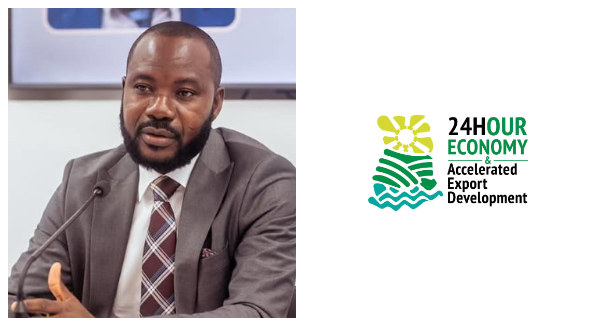
A Senior Lecturer at the University of Ghana and Executive Director of the Centre for Policy Scrutiny, Dr Adu Owusu Sarkodie, has criticised the government’s implementation of the 24-hour economy policy, describing it as a major departure from the vision outlined in the policy document.
Dr Sarkodie argued that while the government’s 287-page 24-hour economy document contains extensive research and a comprehensive assessment of Ghana’s economic challenges, the actions being taken on the ground do not reflect the proposals and objectives contained in the document.
The 24-hour economy policy is a flagship programme of the government aimed at transforming Ghana’s economy by encouraging round-the-clock production and service delivery, with targeted investments in key sectors to boost productivity, create jobs and reduce reliance on imports.
Speaking on The Big Issue on Channel One TV on Saturday, July 25, 2026, Dr Sarkodie acknowledged the quality of the policy document but questioned the extent to which its recommendations were being translated into practical measures.
“When you read the 24-hour economy document, about 287 pages, we have done a thorough review of the document. What you see in that document are brilliant ideas. In fact, I have not read any government document that is so well-researched,” he said.
“But where is the implementation? And so when you promise 1-3-3, and when you go to the document, 1-3-3 appears only once on page 18, only once out of 287 pages,” he added.
The “1-3-3” agenda, which has been associated with the government’s economic transformation strategy, is expected to drive increased production, industrial expansion and job creation under the 24-hour economy framework.
However, Dr Sarkodie questioned whether the government’s current approach was properly sequenced, particularly its focus on developing 24-hour economy markets before sufficiently expanding domestic production capacity.
He argued that building markets without first strengthening local industries could leave the country dependent on imported goods to fill those spaces.
“The narration has always been economic transformation, economic transformation, and that the economic transformation is the process and the 1-3-3 shift is a destination. And therefore, we should finish the process before the destination,” he said.
“But why are you building markets? Why are you building a 24-hour economy market? Because when you build markets, and you have not transformed and produced, what you are going to sell there are still imported commodities,” he added.
The policy analyst stressed that the government must ensure that implementation closely follows the objectives and recommendations contained in the official 24-hour economy document to achieve the intended economic transformation.
“What is being promised, what is contained in the document, and what is being done are completely different things. And I don’t think that it is good for us. I think the government should do well,” Dr Sarkodie said.
His comments add to ongoing discussions over the government’s flagship economic initiative, with stakeholders debating the pace, direction and practical impact of the 24-hour economy programme.