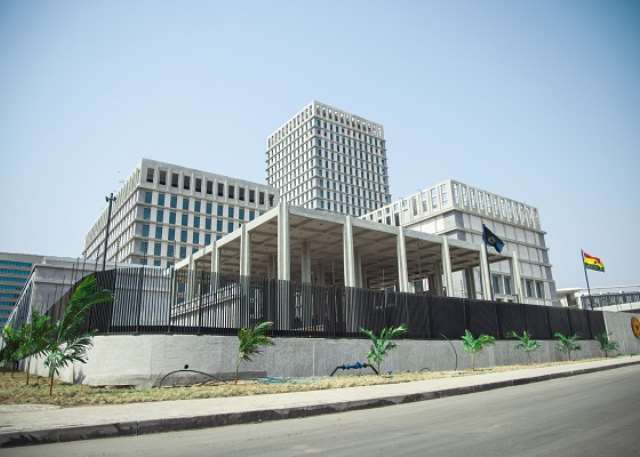
The Bank of Ghana (BoG) has firmly dismissed media reports suggesting that it is considering the sale of its newly commissioned headquarters in Accra, describing the claims as false, misleading and potentially harmful to confidence in the country’s financial system.
In a statement issued on Tuesday, June 2, 2026, the Central Bank sought to set the record straight amid growing public discussion over the future of the landmark facility, popularly known as “The Bank Square,” which was completed at a total cost of $261.8 million.
According to the Bank, there are no plans whatsoever to sell the state-of-the-art headquarters, which was commissioned less than two years ago and currently serves as the operational hub of Ghana’s central banking system.
“The Bank is not considering, discussing or planning the sale of its new headquarters,” the statement stressed.
It explained that the facility was specifically developed to strengthen the Bank’s operational effectiveness and improve its ability to discharge its constitutional and statutory responsibilities.
“The facility, which was commissioned to support the Bank’s operations and enhance efficiency in the discharge of its statutory mandate, remains a critical asset of the Bank,” the statement added.
The Central Bank further warned that the circulation of unverified reports regarding the property could undermine public confidence in Ghana’s financial sector and create unnecessary uncertainty within the market.
Largest office development in Ghana
The clarification comes against the backdrop of continuing public interest in the new headquarters, which has remained one of the most discussed public infrastructure projects in recent years due to its size, cost and strategic importance.
The Bank Square stands as the largest office development in Ghana and represents a major transformation in the physical infrastructure of the country’s financial sector.
The facility replaced the Bank’s former headquarters, a structure that had served Ghana’s central bank for approximately 67 years.
Situated in the heart of Accra at West Ridge, the solar-powered complex occupies approximately 150,000 square metres and was designed to meet the growing operational demands of a modern central bank in an increasingly complex financial environment.
The facility can accommodate up to 2,500 employees and integrates multiple operational units that were previously spread across different locations.
Bank officials have argued that the consolidation of operations is expected to improve efficiency, policy coordination and institutional effectiveness.
The headquarters consists of several major components, including rooftop terraces, conventional office spaces, an auditorium, medical facilities, prayer rooms, parking terminals and various support infrastructure designed to facilitate seamless operations.
Four key architectural elements define the facility’s design.
These are the Amenity Pavilion, the Urban Block, the Podium and the Tower.
Together, these components reflect the evolving role of the Bank of Ghana as it responds to rapid changes in both domestic and international financial markets.
The imposing structure was designed by internationally acclaimed Ghanaian architect Sir David Adjaye, whose portfolio includes several globally recognised public buildings and cultural landmarks.
Evolution of the design
The journey towards the completion of the headquarters involved significant modifications to the original concept.
Initial plans proposed a 25-storey tower with a gross floor area of approximately 73,000 square metres, alongside a four-storey parking facility, two basement levels and an auditorium.
However, the design underwent several revisions to satisfy regulatory requirements and address the operational needs of the Central Bank.
These adjustments substantially increased the scope of the project, resulting in a gross floor area exceeding 107,000 square metres.
The completed facility eventually took shape as three primary structures comprising a 20-storey Tower Block, an eight-storey Urban Block and a six-storey Amenities Block.
Additional infrastructure included a five-level underground parking facility, energy generation and management systems, treatment plants, security installations and other ancillary structures.
Project cost reaches $261.8m
The total project cost eventually reached $261.8 million, specifically $261,773,268.53.
Information previously provided by the Bank to Parliament revealed that by February 2025, the Government had paid approximately $230 million towards the project, leaving an outstanding balance of about $31.8 million yet to be settled.
One of the most significant aspects of the project has been the escalation in costs over the course of construction.
According to details submitted to Parliament, the project was initially valued at $81.8 million when the contract was awarded in 2019.
Subsequent reviews and modifications, however, pushed the cost first to $121.1 million, then to $222.8 million, before ultimately reaching $261.8 million upon completion in 2024.
The successive revisions generated considerable public debate and attracted scrutiny from policymakers and economic analysts, particularly during a period when Ghana was facing significant fiscal and economic challenges.
Current officials of the Bank have acknowledged that the rising costs raised legitimate concerns and have indicated support for a detailed examination of the project.
Construction cost and square metre rate
The construction component alone accounted for $222.8 million of the total expenditure.
Based on the final floor area, the construction cost translated into approximately $2,068 per square metre.
Beyond the physical structure itself, an additional $38.9 million was spent on specialised systems and services necessary for a modern central banking headquarters.
Consultancy fees
Consultancy services accounted for $3.45 million.
Out of this amount, more than $3.17 million had been paid, leaving an outstanding balance of approximately $278,000.
Taxes and levies associated with consultancy services amounted to more than $675,000.
ICT infrastructure
The installation of Information and Communication Technology systems and network infrastructure cost approximately $8.6 million.
By February 2025, about $6.7 million had been paid, leaving an outstanding balance of nearly $1.93 million.
Taxes and levies related to this component exceeded $1.4 million.
Integrated electronic security system
Security represented another major area of expenditure.
The Integrated Electronic Security System was contracted at a cost of approximately $15.8 million.
Payments amounting to over $11 million had been made to Goldkey Properties Limited and OSTEC Limited Joint Venture, while approximately $4.8 million remained outstanding.
Taxes and levies paid on the security component amounted to more than $2.4 million.
Furniture and interior finishing
Furniture and interior finishing works cost approximately $11.1 million.
Of this amount, more than $7 million had been paid to Goldkey Properties Limited and NOLLE Design Limited Joint Venture, leaving an outstanding balance of approximately $4.06 million.
Taxes and levies paid on furniture and finishing components exceeded $1.5 million.
Taxes and levies exceed $48m
Overall, taxes and levies associated with the entire project reached approximately $48.3 million, highlighting the substantial fiscal contributions generated during the execution of the development.
Green building credentials
The headquarters was designed to meet international sustainability standards and incorporates a range of environmentally friendly features.
These include energy-efficient systems, water conservation mechanisms, recycling initiatives and waste management solutions aimed at reducing the facility’s environmental footprint.
The project achieved the Excellence in Design for Greater Efficiencies (EDGE) green building standard and has already received preliminary EDGE Advanced certification, making it one of the most environmentally sustainable large-scale office developments in Ghana.
Commissioning and occupation
The new headquarters was officially commissioned in November 2024 by former President Nana Addo Dankwa Akufo-Addo.
Since then, staff of the Bank of Ghana have fully occupied the facility and are conducting operations from the new complex.
The Bank has also disclosed that its Board of Directors intends to undertake a comprehensive value-for-money audit of the project once the new board is sworn into office.
The audit is expected to examine procurement processes, project management decisions, cost escalations and overall value delivered by the investment.
Why the new headquarters was built
The decision to construct the new headquarters was informed largely by concerns over the condition of the Bank’s former offices.
A structural integrity assessment conducted in 2019 reportedly concluded that the old headquarters, originally constructed in the 1950s, was no longer suitable for the operational requirements of a modern central bank.
The findings highlighted concerns regarding safety, security and functionality, prompting the Bank to pursue the construction of a new purpose-built facility.
The project was executed by Goldkey Properties Limited through a restricted tender process approved by the Public Procurement Authority.
Bank officials have consistently maintained that the new headquarters was necessary to address long-standing operational challenges and provide infrastructure capable of supporting the institution’s expanding responsibilities.
No plans to dispose of strategic asset
As public debate over the project continues, the Bank’s latest statement seeks to dispel speculation regarding the future of the facility and reaffirm its commitment to utilizing the headquarters as a long-term strategic asset.