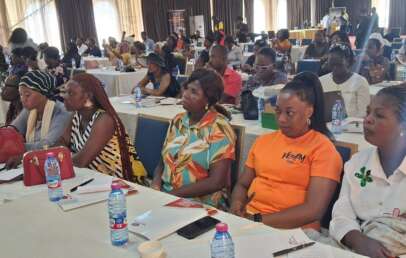
Business leaders, marketers and technology experts at the 2026 Digital Transformation Conference in Accra delivered a common message to corporate Ghana: businesses that fail to embrace digital transformation, data analytics and artificial intelligence risk losing relevance in an increasingly technology-driven economy.
Across presentations, speakers consistently stressed that the future of business competitiveness would no longer depend merely on having digital platforms, but on how effectively organisations use technology, customer insights and personalised engagement to build trust, deepen relationships and deliver value in real time.
The conference, organised by MTN Ghana under the theme, “Pioneering the Future and Embracing Digital Transformation for Marketing Excellence,” brought together executives, marketers, media practitioners, technology professionals and industry stakeholders to examine how digital innovation is reshaping consumer behaviour, brand engagement and business growth.
Speakers argued that rapid advances in artificial intelligence, automation and data analytics are fundamentally transforming how consumers discover products, interact with brands and make purchasing decisions, forcing businesses to rethink traditional marketing models.
Digital transformation now unavoidable
Opening the conference, Chief Digital Officer of MTN Ghana, Ibrahim Misto, described the gathering as a platform for practical discussions on how Ghanaian businesses can remain competitive within a rapidly evolving digital economy.
According to him, marketing today operates in an environment vastly different from just a few years ago as technological advancement continues at unprecedented speed while customer expectations continue to rise.
Mr Misto observed that the emergence of artificial intelligence and digital platforms is changing how consumers engage businesses and consume information.
He stated that Ghana’s marketing industry now faces a defining moment in determining how technology, intelligence and data can be used to build trusted, relevant and sustainable brands.
“The central question confronting businesses today is how technology, intelligence and data can be harnessed to build brands that are trusted, relevant and sustainable,” he said.
Mr Misto described Ghana as a young, mobile-first and highly creative market, making digital transformation even more critical for businesses seeking growth and long-term relevance.
He noted that MTN’s daily interaction with millions of Ghanaians places the company at the centre of how people communicate, consume content and build communities.
According to him, this creates a responsibility for MTN to support the wider business ecosystem in adapting to digital transformation.
He explained that the conference was intentionally designed to encourage practical discussions around real-world experiences, successful digital strategies and the challenges confronting businesses in the modern economy.
Mr Misto expressed optimism that participants would leave the conference with actionable ideas and a stronger conviction about embracing innovation.
Data-driven advertising transforming marketing
Manager for Digital Commercialisation at MTN Ghana, Kelvin Ashie, focused his presentation on how data-driven advertising is reshaping customer engagement through the MTN Ads platform.
He explained that modern marketing is increasingly dependent on the ability of businesses to understand customer behaviour and deliver highly targeted communication.
According to him, every customer on the network represents unique interests, lifestyles and purchasing patterns that businesses can use to engage more meaningfully with audiences.
“We achieve this by applying data and insights to help brands reach the right audience. With MTN Ads, communication is driven through a highly targeted approach,” he stated.
Mr Ashie explained that MTN Ads uses behavioural analytics to identify different customer segments, including new subscribers, frequent travellers and consumers searching for affordable products and services.
He said such insights enable businesses to tailor campaigns that resonate with specific audiences instead of relying on broad, untargeted advertising.
He further disclosed that the platform analyses mobility and movement patterns to determine the best timing, channels and locations for message delivery.
According to him, businesses must ensure their messaging remains timely, personalised and relevant in order to sustain engagement in an increasingly crowded digital marketplace.
Mr Ashie noted that MTN Ads has already partnered several brands across Ghana and Africa to strengthen customer engagement and improve digital marketing outcomes.
He said the company’s long-term objective is to build a platform that enables businesses to stand out in highly competitive markets through smarter digital communication strategies.
Artificial intelligence and customer retention
Business Development Manager for Chenosis at MTN, Joshua Chijioke, highlighted the growing role of artificial intelligence and customer data in improving customer retention and reducing churn.
He explained that businesses can now analyse customer behaviour and network activity to identify users who may be at risk of abandoning products or services.
According to him, delays in customer adoption of features or declining usage patterns can serve as early warning signs, allowing businesses to intervene through personalised campaigns and direct engagement.
Mr Chijioke stressed that data analytics now gives organisations the ability to identify behavioural patterns, customer profiles and account activity with far greater accuracy.
He however warned that poor data management continues to undermine the effectiveness of many digital campaigns.
According to him, some businesses still send promotional messages to inactive users or customers whose phone numbers may have been reassigned.
Such practices, he noted, reduce campaign efficiency and damage customer relationships.
“Data is the foundation of success in the era of artificial intelligence,” he stressed.
Mr Chijioke said quality customer data enables businesses to target audiences more precisely, personalise communication and improve engagement outcomes.
He further highlighted the capabilities of Chenosis in helping organisations customise communication and improve customer targeting strategies.
Businesses urged to move beyond theory
Chief Enterprise Business Officer at MTN Ghana, Angela Mensah-Poku, challenged businesses to move beyond discussing digital transformation to implementing bold policies and practical action.
According to her, the debate over whether digital transformation is necessary has already ended.
“The focus now should be on why the pace of change remains slow,” she stated.
She observed that although many African companies recognise the importance of digital transformation, they continue to hesitate despite numerous success stories globally.
Miss Mensah-Poku argued that many organisations fail because they do not adequately reimagine modern consumer experiences and the possibilities created by innovative technologies.
She stated that marketing mastery today is significantly different from what existed a decade ago.
“Marketing mastery requires more surgical, customised and transparent methods,” she said.
She stressed the need for businesses to become deliberate about innovation and future-focused growth rather than passively observing technological change.
Miss Mensah-Poku cautioned companies against becoming only “partially digital,” warning that businesses unwilling to commit fully to digital transformation risk losing competitiveness in a technology-driven world.
Trust remains central in digital age
National Vice-President of the Chartered Institute of Marketing, Ghana, Ama Amoah, shifted attention to the growing importance of trust and human connection within digital transformation.
While acknowledging the transformative power of artificial intelligence, automation and analytics, she cautioned that technology alone cannot guarantee business success.
“The real winners in this era will not be the ones with the fastest processors, but the ones with the strongest and most bankable promises,” she stated.
Miss Amoah observed that while digital technologies have strengthened connectivity between brands and customers, they have also created concerns surrounding data privacy, fraud and excessive automation of customer service.
“In Ghana, trust is relational. It is not just about the terms and conditions on a website. It is about the feeling that if something goes wrong, there is a human being behind the screen who cares,” she explained.
She urged businesses to balance technological advancement with human-centred service delivery.
According to her, companies must prioritise responsible customer data usage, clear communication and accessible human support systems.
She stressed that automation should never completely replace emotional connection and trust between businesses and customers.
Future belongs to adaptive brands
Chief Executive Officer of Dentsu Ghana, Andrew Ackah, reinforced the importance of deeper customer relationships in the digital economy.
Delivering the keynote address on the topic, “Digital Transformation within the Customer Marketing Space: Adapt Faster, Connect Deeper,” he said companies must resist the temptation to view customers merely as data points despite advances in technology.
According to him, every customer profile represents a real person seeking trust, reliability, convenience and value.
Mr Ackah noted that although technology continues to evolve rapidly, the core emotional needs driving consumers remain unchanged.
He explained that businesses now operate in a consumer-led era where customers increasingly control interactions with brands.
The traditional corporate-controlled customer journey, he said, has given way to a more fluid and responsive digital environment.
Mr Ackah urged businesses to move beyond simply maintaining online presence toward achieving “digital excellence,” where brands respond intelligently and meaningfully to customer needs.
He warned that the future would favour organisations capable of adapting quickly while simultaneously building deeper trust with consumers.
For many participants at the conference, the overriding message remained clear: digital transformation is no longer optional for businesses seeking survival and growth in Ghana’s evolving economy.