A private citizen, Samson Asaki Awingobit, has petitioned President John Dramani Mahama over the siting of the US$1.3 billion Sentuo Airport Garden City Project in Accra, calling for an immediate and comprehensive national-security assessment of the development before further construction proceeds.
Mr Awingobit, in a petition addressed to the President, said his concern was not opposition to foreign investment, Chinese investment or the Sentuo Group’s activities in Ghana, but the strategic location, scale and configuration of the project and its proximity to sensitive military, defence and aviation installations.
The petition follows the ceremonial sod-cutting for the project by President Mahama on September 15, 2026.
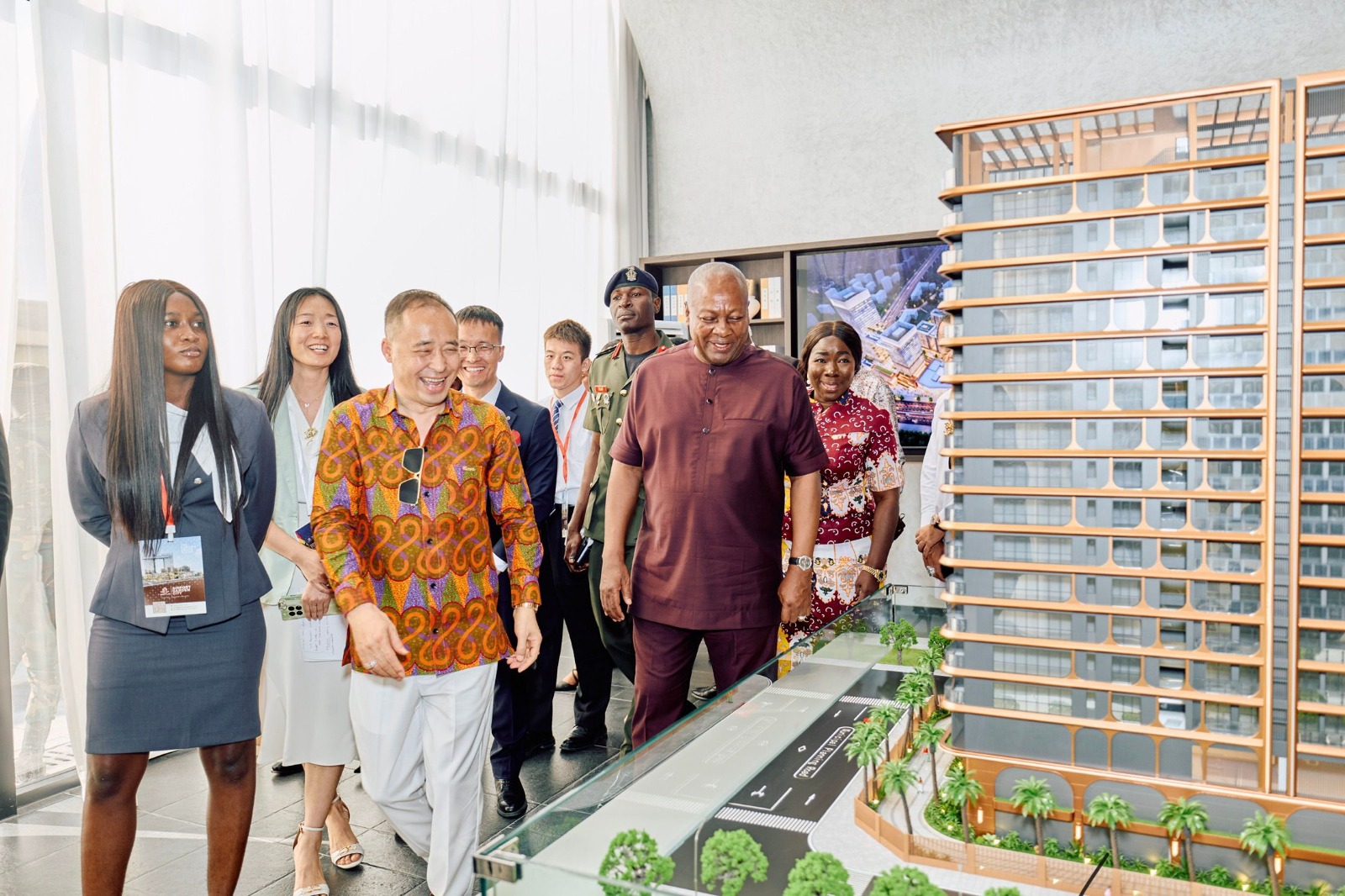
According to the petitioner, the development, being undertaken by Sentuo Group at 10 Giffard Road, Airport Residential Area, Accra, is expected to comprise approximately 582 premium apartments, a 600-room hotel, a 2,500-capacity conference facility, healthcare facilities, a shopping mall, landscaped gardens, parking facilities and other commercial and leisure amenities.
Mr Awingobit said while the investment could contribute to job creation and the expansion of Ghana’s hospitality, residential and commercial infrastructure, its location warranted scrutiny beyond the ordinary planning and commercial considerations applicable to conventional real-estate developments.
He has therefore asked the President to direct an independent multi-agency security assessment to determine whether the project, in its proposed form, could pose risks to Ghana’s national security.
Location raises security concerns
The petitioner said the location of the development required particular attention because of its association with the military-security landscape of Accra.
He cited documentation on the Accra East Corridor which identifies Giffard Road as running from the 37 Military Hospital across the El-Wak area, Burma Camp and towards the eastern part of Accra, with the Burma Camp and Air Force Base areas identified as military zones.
According to him, the geographical relationship between the proposed development and these strategic facilities should compel the government to undertake a comprehensive assessment of the project, particularly because of the size and height of the structures contemplated.
He stressed that the project was not simply a small residential or commercial development, but a major urban complex combining residential accommodation, a large hotel, conference facilities, healthcare services, retail facilities and other commercial uses.
Such a development, he argued, could present security considerations different from those associated with an ordinary residential or commercial property because of its size, occupancy levels, technological infrastructure, security systems and potential vantage points.
The petitioner said the government should establish whether the completed structures could provide direct or indirect visual, technological or physical access advantages over sensitive government and military facilities.
Call for multi-agency security assessment
At the centre of the petition is a demand for clarity on whether Ghana’s relevant security and aviation institutions have already assessed the proposed development.
Mr Awingobit asked whether the Ghana Armed Forces, Ministry of Defence, national security architecture, Ghana Police Service, Ghana Civil Aviation Authority and other relevant security agencies had conducted a comprehensive assessment and formally certified that the location, design, height, technological infrastructure, access arrangements and operational model of the project posed no unacceptable risk to national security.
He said if such an assessment had already been conducted, the public should have confidence that the relevant security authorities had considered the potential implications.
However, if no such assessment had been conducted, he urged the government to undertake one before construction reached a stage at which meaningful modifications would become difficult or prohibitively expensive.
The petitioner said the assessment should examine not only the physical structures but also the project’s technological and operational systems.
Who will control surveillance systems?
Mr Awingobit also raised questions about the security architecture that would govern the completed development.
Given that the complex is expected to accommodate hundreds of residents, a major hotel, conference facilities and commercial establishments, he said sophisticated surveillance, access-control, communications infrastructure and security-control rooms would inevitably form part of the development.
He therefore wants the authorities to determine who would control the central security and surveillance systems, who would have access to security-control rooms, who would operate CCTV monitoring infrastructure and where surveillance data would be stored.
The petition also calls for clarity on who would have administrative access to the systems, what categories of foreign nationals would have access to restricted areas and what cybersecurity protocols would govern the development.
Mr Awingobit further wants to know whether Ghanaian security agencies would have statutory or operational oversight of the security arrangements and what mechanisms would be put in place to prevent unauthorised surveillance of nearby government, military or aviation installations.
He also proposed that security personnel employed by the private development should be subject to appropriate vetting by Ghanaian security agencies.
The petitioner emphasised that the questions were not directed at any particular nationality.
He said they were issues that should arise whenever a major private development was located close to strategic national assets.
International examples cited
To support his call for heightened due diligence, Mr Awingobit referred to examples from other jurisdictions involving commercial and residential properties that were subsequently associated with alleged organised cybercrime, fraud or money laundering.
He cited an investigation by the Organized Crime and Corruption Reporting Project (OCCRP) into property ownership in Dubai.
According to the petition, the investigation found that three Chinese nationals connected to a Singapore money-laundering case had acquired at least 22 properties valued at approximately US$28 million.
The petitioner also referred to OCCRP reporting on Chinese national Daren Li, who, according to the petition, was sentenced in absentia in the United States over his alleged role in a cryptocurrency investment conspiracy involving the laundering of more than US$73 million and who owned a residential villa in Dubai.
Mr Awingobit, however, explicitly stated that such cases should not be interpreted as evidence that Chinese-owned property was inherently a security threat.
Rather, he said they demonstrated the importance of ownership checks, beneficial-ownership verification, tenant screening, financial due diligence and security oversight where large private developments were established.
Cambodia example
The petitioner also cited developments in Cambodia as another example of the need for governments to ensure that large commercial and residential properties are not automatically assumed to be used only for their stated purposes.
He referred to a May 2026 operation by Cambodian authorities at two buildings at the Prince Plaza Centre in Phnom Penh, which he said were linked to the business empire of Chinese businessman Chen Zhi.
According to the petition, authorities detained 104 people, including 82 Chinese nationals, amid allegations of online-scam activity and seized hundreds of mobile phones and computers.
Mr Awingobit also cited a separate May 2026 operation at Ying Huang Casino in Preah Sihanouk Province, where four Chinese nationals were referred to court over allegations including operating a technology-based online scam centre and money laundering.
The petition said 60 other Chinese nationals were transferred for deportation procedures and that authorities seized 925 computers from the premises.
It also said the casino’s operating licence was subsequently revoked.
The petitioner further referred to an April 2026 operation in which Cambodian authorities detained 218 foreign nationals at a condominium unit within the Phnom Penh Galaxy Garden complex over an alleged technology-based fraud operation.
According to the petition, 93 of those detained were Chinese nationals.
Mr Awingobit again stressed that these examples did not constitute evidence against Chinese investment generally.
Instead, he said they demonstrated the need for robust due diligence, beneficial-ownership checks, tenant screening, cybersecurity controls, law-enforcement access and continuous security oversight in major private developments.
Concern over potential access to sensitive installations
The petitioner said Ghana must adopt a preventive approach to national security rather than wait until a security incident occurred before taking action.
He expressed concern that individuals with hostile intentions towards Ghana could potentially acquire, rent or otherwise obtain legitimate access to apartments or commercial facilities within a large development.
He said the concern could become more significant if such individuals were able to operate from elevated buildings with views towards sensitive government, defence or aviation infrastructure.
Mr Awingobit was careful to state that he was not suggesting that such a situation would occur at the Sentuo development.
Rather, he said Ghanaian security authorities should assess whether such scenarios were reasonably foreseeable and determine what preventive safeguards might be necessary.
Airport proximity another consideration
The proximity of the project to Kotoka International Airport also features prominently in the petition.
Mr Awingobit said the location created another dimension that should be examined as part of the national-security assessment.
He argued that if an individual using a property within the development were subsequently identified as posing a national-security threat, the proximity of the development to Ghana’s principal international airport could potentially become a factor in that person’s ability to leave the country rapidly.
Again, he described this as a scenario requiring assessment rather than an assertion that such an event would occur.
He urged the authorities to determine whether appropriate safeguards could be introduced to address any risks identified.
Security should form part of project planning
Mr Awingobit also called for national security considerations to form part of the broader coordination of development within the Airport enclave.
He referred to the President’s emphasis during the sod-cutting ceremony on coordinated development of the area and argued that such coordination should go beyond roads, commerce, architecture and urban aesthetics.
According to him, it should also incorporate national security, defence, aviation security, cybersecurity, counter-intelligence, emergency response, immigration controls, financial intelligence and foreign-investment due diligence.
He said security considerations should not be treated as an issue to be addressed after the development had been completed.
A development of the magnitude contemplated by the Sentuo Airport Garden City Project, he argued, should have its security implications examined before the structures became difficult or expensive to modify.
10-point action plan proposed
Mr Awingobit has put forward a 10-point request to President Mahama.
First, he is calling for the immediate suspension of further construction activity on the Sentuo Airport Garden City Project pending a comprehensive national-security assessment by the appropriate Ghanaian security and defence institutions.
Second, he wants an independent multi-agency security assessment involving, at a minimum, the Ministry of Defence, Ghana Armed Forces, National Security, Ghana Police Service, Ghana Civil Aviation Authority, Ghana Airports Company Limited and other relevant state institutions.
Third, he wants a comprehensive strategic land-use review to determine whether the proposed height, density, orientation and location of the development are compatible with the security requirements of neighbouring defence, government and aviation installations.
Fourth, he is seeking a counter-surveillance assessment to establish whether the proposed structures could provide visual, electronic or technological access to sensitive national installations.
Fifth, he wants clear security-control arrangements for the completed development, including the vetting of security personnel, access to surveillance systems, ownership and control of CCTV infrastructure, data storage, cybersecurity and cooperation with Ghanaian security agencies.
Sixth, the petitioner is calling for enhanced beneficial-ownership and source-of-funds due diligence on the project and all relevant corporate entities associated with the development, in accordance with Ghanaian law.
Seventh, he wants the proposed residential and commercial tenancy arrangements reviewed, particularly the mechanisms for identifying and vetting occupants, corporate tenants and other users of strategically sensitive facilities.
Eighth, he wants the authorities to determine whether modifications to the project’s design, height, orientation or restricted zones are necessary to protect neighbouring national-security assets.
Ninth, he is asking that Ghanaian security agencies retain appropriate oversight of security arrangements within the complex after completion.
Finally, he wants the findings of the security review made available to appropriate Parliamentary oversight institutions, subject to legitimate confidentiality requirements relating to national-security information.
‘This is not a petition against Chinese investment’
Mr Awingobit devoted a section of his petition to emphasising that his concerns should not be interpreted as opposition to China or Chinese investment.
He stated that the petition was not anti-China, anti-investment or an objection to foreign direct investment, and was not intended to undermine the legitimate business interests of Sentuo Group.
He acknowledged the importance of foreign investment to Ghana’s economic development, particularly in creating jobs, expanding productive capacity and supporting infrastructure development.
However, he argued that economic development should be accompanied by appropriate national-security safeguards.
He therefore framed his concern around location, strategic proximity, security architecture and Ghana’s long-term national interest, rather than the nationality of the investors.
He further suggested that the government’s emphasis on local participation in the project could be extended to security and strategic oversight.
‘Take a second look’
In his concluding appeal, Mr Awingobit said the issue before the government was not whether Ghana should welcome a US$1.3 billion investment.
He said the investment was welcome but argued that the central question was whether the particular development, at its particular location, scale and configuration, had undergone sufficient national-security scrutiny before becoming irreversible.
He warned that once hundreds of apartments, a major hotel and other commercial facilities had been completed, it could become extremely difficult and costly for the government to correct any security problem arising from the original location or design.
“It is therefore better to ask the difficult questions now than to regret failing to ask them later,” he said in the petition.
He consequently urged President Mahama to take a second look at the location and strategic implications of the Sentuo Airport Garden City Project and direct an immediate and comprehensive national-security assessment before further construction proceeds.
Mr Awingobit said he was not asking the government to reject investment, but was appealing to it to ensure that no investment, regardless of its size, compromised the security of the Republic of Ghana.
He said the protection of Ghana’s sovereignty, territorial integrity, strategic installations and national interests should remain paramount.
The petition was copied to the Chief of Staff at the Office of the President, Minister for Defence, Minister for the Interior, National Security Coordinator, Chief of the Defence Staff, Inspector-General of Police, Director-General of the Ghana Civil Aviation Authority, Managing Director of Ghana Airports Company Limited, as well as the chairpersons of the Parliamentary Committees on Defence and Interior, Lands, Natural Resources and Forestry, and National Security.
The petition was signed by Mr Awingobit, who gave his location as Ashaiman, Accra, and provided a telephone contact for correspondence.