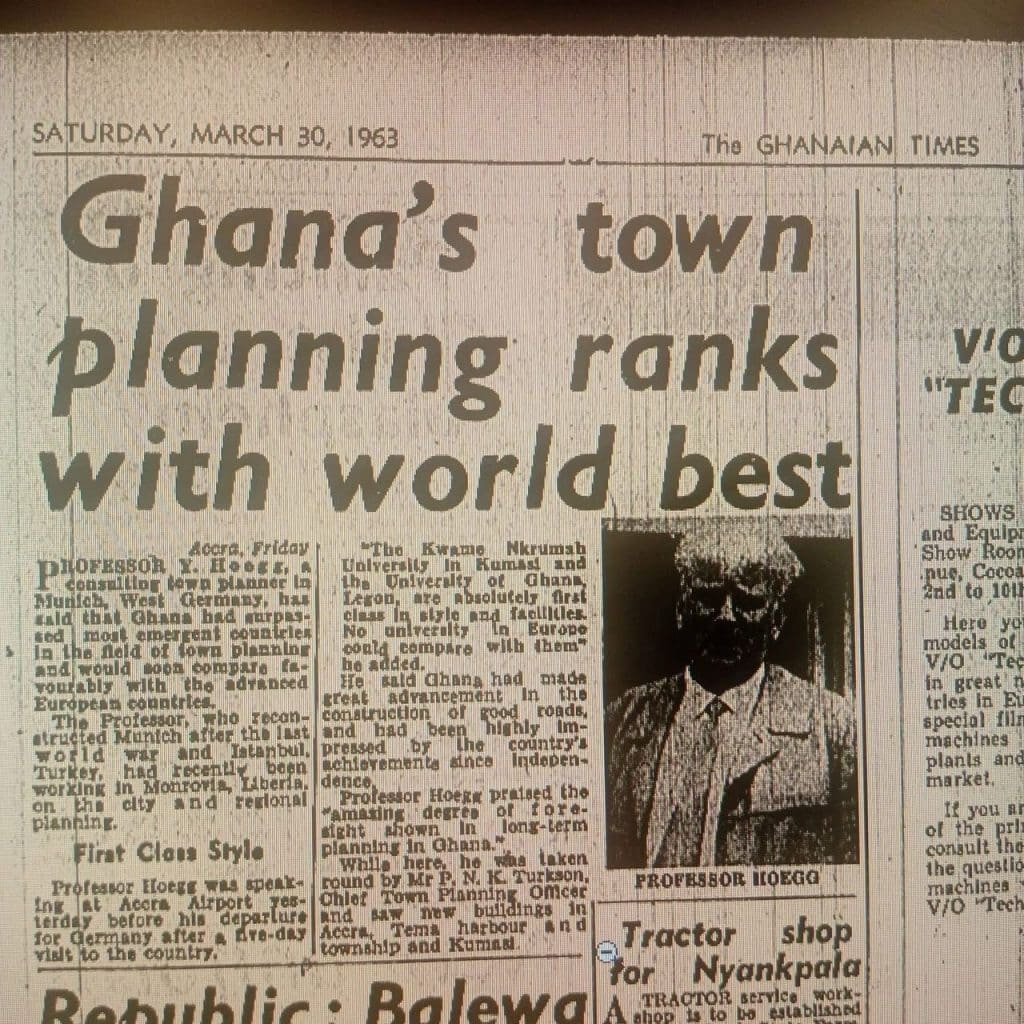
The above picture tells the story of Ghana’s glory days as far back as 1963. Those were the days when we first identified lands, planned, built, and then inhabited them.
Today, we find the land, build hastily, and inhabit them with glee before we think of planning!
That’s one of the reasons for which we have little rains and big floods on our hands.
In Ghana, as soon as the clouds gather, people have their hearts in their mouths.
Their fright levels rise because the worst will happen.
However, in countries like Israel, when it rains, they are happy because they have an extensive flood water run-off harvesting system.
Today, they have moved from a water scarce nation to a water surplus one.
Clearly, we know that we have accommodation deficit as a nation.
Yet, we always find a way to talk around it and then go and find some rest while the masses suffer.
When are we going to be bold enough to confront that monster head on?
The truth is, while the masses scramble and compete for where to lay their heads, landlords profiteer over their woes and trample on tenants’ rights.
Rent agents also join the fray to cash out.
Then comes the facade of affordable housing.
This concept is supposed to use state funds to put up structures that will be sold to the average Joe at a cost they can afford, to be paid for, over a period of time.
Unfortunately, the so-called affordable housing units get sold to the affluent and powerful even before the projects are completed.
They obviously don’t live in them.
They rent them out at cut throat rates to the masses. In the unlikely event that some units remain, the average man is unable to afford them.
So, in simple terms, affordable housing is not affordable to those it was actually meant for.
We are also aware of the issues of indiscipline, where people build indiscriminately in forbidden areas. We have looked on for a long time, and now the matter seems to be getting out of hands, that’s if it hasn’t already gotten out of hands?
Add to that is also the official complicity of those corrupt men and women clothed with the authority to issue permits for buildings.
They brazingly aid wrong doers and walk with the firm assurance that nothing will happen to them. Indeed, in most cases, nothing does!
I remember talking about the now demolished famous “cake house” at Osu as far back as 2015 on Community Connect on 3FM 92.7 when Nene Azu was my producer. The Assembly at the time told the owners of the facility that they had to go to court to get an order to demolish that building. They thought they didn’t have an order for that, so they didn’t budge.
Today, that same cake house is in the news for being demolished by the Assembly at no cost to the family, as though nobody had been worried about the danger it had always possed. The action is belated, but I am sure the people around that area are elated that finally, they can sleep in peace.
We know our drains are heavily silted and that the ‘touch and go’ national sanitation days are not holistic enough to deal decisively with the issue. For instance, how does silt enter the drains? Where does it come from? Is it because aside the indiscipline of tossing rubbish into the drains each time it rains, some persons also add sand? Or is it because most of the inner roads are not tarred, and so the rain water and sand are washed into the drains when it rains?
In the past, we had areas that used to be buffer zones. The essence of these green areas was to receive rain water, ‘manage’ them by slowing down the flow and sifting sand from water and retaining some of the water so that what eventually ends up in the sea is a considerable amount of water and nothing else! Today, those buffer zones have been built upon, so where does the sand and water go? Could that be the reason we always see dredging of the Odaw River?
I have also seen the energy and gusto with which assemblies and the regional ministers in regions affected by the floods are moving to demolish buildings constructed in water ways, ramsar sites, demarcated or earmarked streets, etc. While it appears good, it also looks like a knee-jerk reaction to a problem that has always been known.
For example, how many times have we not spent state resources, time, and energy demolishing such structures? What do we do in the aftermath? Do we set parameters to preclude people from encroaching in the future? The answer is an obvious NO! The next logical question is: WHY?
Innocent people; both young and old, have lost all their belongings, savings, and valuables to these floods because of a few greedy and indisciplined folks. We have looked on as a nation, while they filled rivers and redirected same into people’s homes just so they could build and live comfortably.
I can only imagine the amount of money we have spent so far on these demolitions vis: fuel for the bulldozers, allowances for operators and task force, transportation, feeding and refreshment, and even consultancy.
We are doing all these at the expense of the state. The question now remains: Why can’t we surcharge those who have perpetuated such illegality of building at places precluded from human accommodation to serve as a deterent to others who may be thinking along those lines?
Ghana is fast becoming a glass and concrete jungle. Homes and office owners want to pave everywhere and have glass everywhere.
How does rain water sip into the earth in such a universal situation?
Is it time to follow the German example of “rain tax” popularly known as Regenwassergebühr where a municipal fee is charged to property owners based on the amount of impermeable or sealed surface area on their land—such as roofs, driveways, and patios?
Are our assemblies able to incentivise property owners who choose to leave a green area on their property with permits or property rate rebates?
Is Ghana also able to follow the Rwandan example of banning plastics?
The use of polythene bags has become the order of the day.
In fact, it has become so incessant that if you choose to buy from three vendors sitting in close proximity, you are sure to take home three or more plastic bags.
Where do those bags end up? In the gutters?
On the beaches? In the ocean? Your guess is better than mine.
We can stop these floods if we are deliberate enough, and I know that when we put our minds to it, we shall overcome!
By Johnnie Hughes