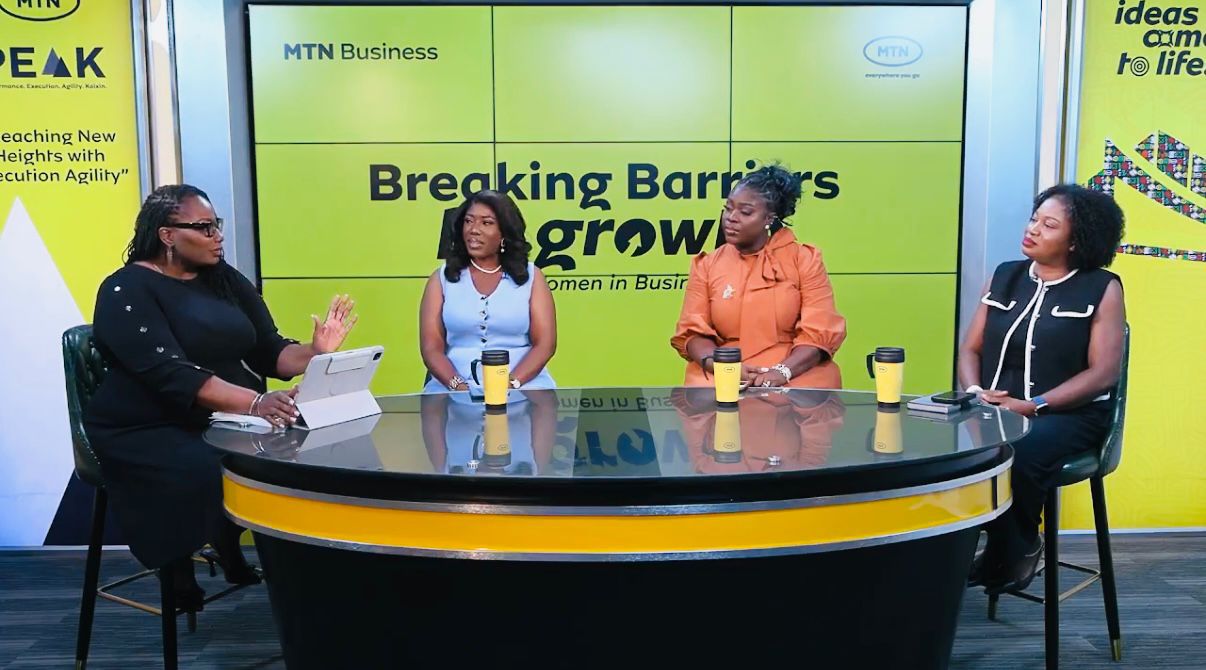
A common thread of resilience, structure, and strategic growth ran through discussions at the MTN SME Accelerate Women in Business Webinar, as speakers repeatedly stressed that building sustainable enterprises requires more than passion—it demands discipline, adaptability, collaboration, and a clear long-term vision.
The virtual event, organised by MTN Ghana under the theme “Breaking Barriers to Growth for Women in Business,” brought together entrepreneurs, financial experts, and industry leaders to explore practical pathways for scaling women-led businesses in an increasingly competitive and digital economy.
Across the board, speakers highlighted structural challenges, the importance of financial discipline, and the need for women entrepreneurs to leverage networks, technology, and mentorship to unlock growth.
Structural challenges limiting women-owned businesses
The Head of Women Banking at Stanbic Bank Ghana, Marian Amartey, identified three major constraints that continue to hold back women-led enterprises—time limitations, weak operational systems, and restricted market access.
According to her, many women entrepreneurs operate under intense pressure as they juggle business responsibilities with family and social obligations, making effective time management a critical yet often overlooked factor in business growth.
She explained that without deliberate planning and prioritisation, businesses struggle to scale beyond a certain level.
Ms Amartey further pointed out that although many women venture into business based on skills or emerging opportunities, they frequently fail to establish robust financial and operational structures.
This, she noted, undermines long-term sustainability and limits their ability to attract funding or expand operations.
On market access, she emphasised that while many women produce high-quality goods and services, they often lack the networks and visibility required to break into larger, more lucrative markets.
This gap, she said, continues to restrict growth potential for many promising enterprises.
Digital visibility now critical for business credibility
A key message from Ms Amartey was the growing importance of digital presence in today’s business environment.
She noted that financial institutions increasingly rely on online platforms to assess the credibility and viability of businesses.
“Sometimes, even to validate what you are doing, banks go to your social media platforms. If you don’t put yourself out there, you give us limited information to work with,” she said.
She cautioned that simply being active online is not enough, urging entrepreneurs to use digital tools strategically to build brand credibility, engage customers, and expand their reach.
Social media, she stressed, should be treated as a business asset rather than a casual communication tool.
Beyond digital engagement, Ms Amartey encouraged women entrepreneurs to embrace collaboration and partnerships.
She advised against the tendency to manage every aspect of a business alone, noting that growth requires delegating specialised tasks to professionals with the right expertise.
“You cannot do everything alone. Focus on your core business and bring in people with the expertise to support your growth,” she added.
Financial discipline key to unlocking funding
Ms Amartey also provided insight into what financial institutions look for when assessing businesses for support.
She highlighted proper financial record-keeping, clearly defined growth plans, and sustainable revenue models as critical requirements.
She stressed the importance of separating personal finances from business accounts and maintaining accurate transaction records, warning that poor financial discipline often leads to repayment challenges and reduced access to credit.
She also pointed to specialised support programmes such as Obaasima, which are designed to guide women entrepreneurs from the early stages of business registration to becoming investment-ready.
Real-world lessons from entrepreneurship journey
Offering a practical perspective, Christiana Dankwah, Founder and CEO of Foodbank Catering Services and KULA Bistro, shared her transition from corporate work in Parliament to full-time entrepreneurship.
She recounted how early challenges in recovering credit during her buy-and-sell ventures influenced her decision to pivot into the food business.
By adopting a daily lunch model targeted at offices, she ensured immediate payments and steady cash flow, a move that significantly improved financial stability.
According to her, financial realities—rather than passion alone—often shape business direction.
She emphasised that entrepreneurship requires continuous effort, resilience, and the willingness to adapt in response to challenges.
Ms Dankwah stressed that growth is rarely achieved in isolation. She encouraged entrepreneurs to actively seek mentorship, build networks, and learn from experienced professionals rather than attempting to navigate the business landscape alone.
She also highlighted the importance of hands-on learning, noting that working within established businesses helps aspiring entrepreneurs understand the true cost of operations—including rent, utilities, logistics, and maintenance—factors that are often underestimated when calculating profitability.
Importantly, she cautioned against relying on praise from friends and family as a measure of success, stressing that honest market feedback is essential for building a sustainable and competitive brand.
Persistence, reinvestment, and transparency
Ms Dankwah further underscored the need for continuous reinvestment and improvement.
She noted that successful entrepreneurs are those who consistently refine their processes, adapt to changing conditions, and invest back into their businesses rather than relying on past achievements.
She also highlighted the role of storytelling in business, particularly on social media.
According to her, entrepreneurs should present not only their successes but also the realities behind their journeys.
“Sometimes, what you see on social media is not the full picture. Behind every product is hard work, improvisation, and persistence,” she indicated.
She emphasised that setbacks such as delays, resource constraints, and unexpected challenges are inevitable, and only those with strong mental resilience are able to overcome them.
According to her, consistency, adaptability, and resilience are the defining traits that separate thriving businesses from those that struggle to survive.
Branding, mindset, and humility
Adding another dimension to the discussion, Victoria Lebene Osafowaa-Nkansah, CEO of The Skin Pop Shop and Vicky’s Recipe, highlighted the importance of personal branding and mindset in business success.
She explained that entrepreneurs must clearly define their brand positioning and remain consistent in how they present themselves, particularly when transitioning from other careers into business.
According to her, social media should serve as a platform for storytelling and building trust, rather than merely posting content without strategy or direction.
Beyond branding, she stressed the importance of humility and continuous learning.
She warned that complacency can be a major barrier to growth, as it limits the ability to receive feedback and improve.
“Stay humble… don’t be too comfortable, because when you are comfortable you refuse to listen, you refuse to learn, you refuse to grow,” she said.
She noted that openness to correction, resilience, and a willingness to evolve are critical qualities that distinguish successful entrepreneurs from those who struggle to grow.
A collective call for strategic growth
The webinar ultimately reinforced a shared message: that sustainable business growth for women requires a deliberate combination of structure, strategy, and mindset.
From financial discipline and digital visibility to resilience, collaboration, and continuous learning, speakers emphasised that overcoming barriers demands both internal transformation and external support systems.
Through initiatives such as the MTN SME Accelerate programme, stakeholders are seeking to equip women entrepreneurs with the tools, knowledge, and networks needed to navigate challenges and scale their businesses effectively.
As discussions at the webinar made clear, the future of women-led enterprises in Ghana will depend not only on access to opportunities, but on how effectively entrepreneurs position themselves to seize them.