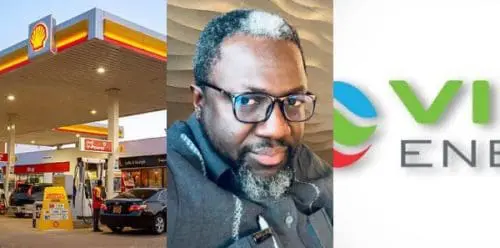
Vivo Energy Ghana Limited, operators of the Shell brand in Ghana, is locked in a fierce legal battle at the High Court in Accra with businessman Edmund Barwuah, who is seeking GH₵2.5 million in special damages over claims that fuel sold to him at the Atimpoku Shell Fuel Station was contaminated with water, leading to the destruction of his vehicle’s engine and substantial business losses.
Beyond the monetary claim, the plaintiff is also asking the court to compel Vivo Energy to replace his 2017 Ford Explorer with a similar vehicle of the same specification, as well as award damages for loss of use of the vehicle from August 28, 2022, until the date the replacement is provided.
The case, which has drawn significant public interest due to its implications for consumer safety and fuel quality assurance, has taken a dramatic turn following admissions made in open court by a defence witness under intense cross-examination.
Defence witness admits fuel was mixed with water
In a pivotal moment during proceedings before the High Court, John Delase-Michael, a retailer at the Atimpoku Shell Fuel Station and the first defence witness for Vivo Energy, admitted under cross-examination that petrol sold to the plaintiff was indeed contaminated with water.
“After I had dispensed the fuel into the container (from Plaintiff’s car), it happened that it was mixed with some water,” the witness told the court.
This admission came as lawyers for Mr Barwuah subjected the witness to sustained cross-examination aimed at establishing not only contamination but also alleged recklessness and failure to adhere to safety and quality control procedures.
The incident
According to the plaintiff’s statement of claim, the incident occurred on August 28, 2022, when Mr Barwuah stopped at the Atimpoku Shell Fuel Station, near the Adomi Bridge in the Eastern Region, to purchase petrol for his 2017 Ford Explorer.
Unbeknownst to him, the petrol being sold at the station had been contaminated with water.
The plaintiff was among several customers who purchased the compromised fuel on that day.
Shortly after leaving the station and driving approximately one kilometre, the plaintiff’s vehicle began to jolt and stutter violently before the engine abruptly shut down in the middle of the road while the car was still in motion.
Shock, fear and near-disaster on the road
In his pleadings, Mr Barwuah described the terrifying moments that followed the engine failure, stating that he and his friend, John Michael Appiah-Acheampong, were plunged into shock, fear and panic.
He told the court that he had never experienced such violent mechanical failure in his vehicle before and feared that the sudden loss of engine power could have resulted in a serious accident, injuries, or even loss of life.
“The real possibility of an accident happening and the resultant injury or possible death the situation had exposed them to additionally heightened their fear,” the suit states.
Alleged prior knowledge
A central pillar of the plaintiff’s case is the assertion that the filling station continued to sell the contaminated fuel even after the station master had been informed of the problem about an hour earlier.
Mr Barwuah contends that this conduct amounted to a reckless disregard for human life and property, not only affecting him but endangering the general public.
He argues that Vivo Energy, through its agents at the station, knew the fuel was contaminated with water and deliberately chose to continue sales for financial gain.
National Petroleum Authority steps in
The contamination incident eventually led to the closure of the Atimpoku Shell Fuel Station by the National Petroleum Authority (NPA), following reports from affected customers.
In a subsequent public statement, Vivo Energy acknowledged the incident and explained that heavy rainfall in the area had caused water to leak into the underground fuel tank at the station.
The company apologised to customers affected by the contamination.
Cross-examination reveals initial denial and hesitation
During cross-examination led by counsel for the plaintiff, John Jaja, under the direction of lead counsel Dela Blagogee of Blagogee, Blacksword and Co. Law Chambers, the defence witness was questioned about his conduct when the plaintiff returned to the station after experiencing engine trouble.
Counsel put it to the witness that when Mr Barwuah and his friend first reported the contamination, the witness disputed their claim that the fuel contained water.
It was further put to him that when the plaintiff requested that fuel be dispensed into a container to verify the presence of water, the witness initially hesitated.
The witness confirmed this, explaining that dispensing fuel into containers was generally discouraged due to safety concerns.
“I initially did not agree to do so because the filling station did not approve of us doing that, with reasons that dispensing fuel into containers could cause fire outbreaks and other accidents,” he told the court.
Pressure mounts, truth emerges
The witness admitted that after sustained pressure from the plaintiff and his friend, he eventually dispensed the fuel into a container, revealing the presence of water.
Counsel for the plaintiff suggested that the hesitation was not about safety but because the witness already knew the fuel was contaminated and did not want the truth exposed.
While denying prior knowledge, the witness insisted that this was the first time such an incident had occurred at the station.
“This was the first time something of that sort had happened at our workplace,” he said.
Safety protocols questioned in court
Counsel further questioned whether Vivo Energy’s alleged safety and operational protocols could be abandoned simply because a customer applied pressure.
In response, the witness stated that he acted to avoid suspicion and public unrest.
“My lord, at that time, I had no choice because if I had refused, it would have looked as if I was hiding something from the public,” he said.
However, when pressed, the witness admitted that there was no formal record before the court showing that customers were violent or that a commotion was imminent.
He also confirmed that none of the affected customers returned to the station wielding weapons or attempting to attack staff.
Station closure and fuel removal
Following the incident, the Atimpoku Shell Fuel Station temporarily ceased operations.
The witness told the court that the station resumed operations in February 2023.
He further disclosed that after the incident, persons were sent to drain the remaining fuel from the underground tanks.
“At that time, the remaining fuel was 4,000 litres,” he said, adding that the contaminated fuel was taken away.
Claims of financial loss and missed business opportunity
In addition to the damage to his vehicle, Mr Barwuah claims that the incident caused him to miss a scheduled business meeting, resulting in the loss of a business opportunity valued at GH₵2.5 million.
He argues that Vivo Energy’s actions placed profit above human life and exposed him and his companion to unacceptable danger.
Court adjourns for further cross-examination
The case is being presided over by Justice Isaac Addo, who has adjourned proceedings to January 30 for further cross-examination of the defence witness.
As the trial continues, the admissions made under oath and the unfolding details of the August 2022 contamination incident are expected to play a critical role in determining liability, damages, and the broader question of accountability within Ghana’s downstream petroleum sector.
The outcome of the case could set a significant precedent on corporate responsibility, consumer protection, and fuel quality assurance in the country.