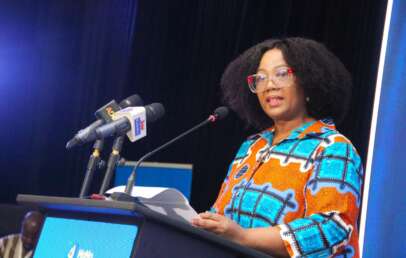
Ghana’s economic recovery can only be sustained if trust, capital and stability are treated as interconnected pillars of development, the Second Deputy Governor of the Bank of Ghana (BoG), Mrs. Matilda Asante-Asiedu, has stated.
Delivering the keynote address at The Money Summit 2026 in Accra on the theme, “Building Trust, Capital, and Stability for Ghana’s Economic Future,” she said the country had made significant progress in restoring macroeconomic stability but maintaining those gains would require collective effort from government, businesses, financial institutions and investors.
According to her, trust, capital and stability are not separate policy objectives but a single system that drives sustainable economic growth.
“From where I sit, these three are not separate goals. They are one system, and they only work well together,” she said.
Trust is the foundation
Mrs. Asante-Asiedu described trust as the foundation of every financial system because finance itself is built on promises.
“A deposit is a promise. A loan is a promise. A currency is a promise,” she noted.
She explained that investors are attracted to economies where institutions are reliable, regulations are predictable and governance systems inspire confidence.
“Trust is what turns a good year into a credible decade,” she said.
According to her, strong trust lowers uncertainty, encourages investment and creates the conditions needed for long-term economic expansion.
Capital follows trust
The Deputy Governor said capital naturally flows into economies where trust exists.
She explained that confidence reduces risk premiums, lowers borrowing costs and encourages investors to commit funds to long-term productive ventures.
“When trust is present, the risk premium falls, the cost of capital reduces, and money becomes patient,” she stated.
Despite recent improvements, she observed that private-sector credit in Ghana remains below 10 percent of GDP, limiting growth opportunities for businesses.
“A stable economy that does not lend to its farmers and firms has only done half the job,” she said.
She urged businesses and industry associations to strengthen accountability and governance standards, noting that trust directly influences lending rates and access to finance.
Stability sustains growth
Mrs. Asante-Asiedu said macroeconomic stability remains the glue that holds trust and capital together.
She identified low inflation, a stable exchange rate and strong foreign exchange reserves as critical requirements for sustaining investor confidence.
“Remove stability, and trust evaporates, and capital takes flight, as we have painfully learnt from our past,” she warned.
Summarising the relationship among the three pillars, she said:
“Trust lowers the cost of capital; capital funds growth; growth sustains stability; and stability, in turn, deepens trust.”
She added that expectations play a powerful role in economic outcomes, stressing that confidence in the future often helps create positive economic results.
“In the end, our most important product is not a policy rate. It is a confident tomorrow,” she said.
BoG’s commitments
Mrs. Asante-Asiedu outlined several measures the Bank of Ghana is implementing to preserve economic stability and support growth.
Maintaining Price Stability
She reaffirmed the central bank’s commitment to keeping inflation under control and protecting macroeconomic stability.
According to her, low inflation translates into lower interest rates, making credit more affordable for businesses.
“Low inflation locks in low interest rates, and low interest rates allow businesses to borrow at a lower cost, invest, expand and keep their operations running,” she said.
Building stronger reserves
The Deputy Governor disclosed that BoG would continue strengthening Ghana’s external reserve position.
She said the Bank is working toward maintaining reserves equivalent to at least six months of import cover while advancing the Ghana Gold Reserve Accumulation Programme (GANRAP) toward a medium-term target of 15 months of import cover.
“These buffers will help the economy absorb shocks without panic,” she noted.
She added that the reserves have already helped Ghana withstand recent oil market volatility and geopolitical tensions while supporting the stability of the cedi.
Warning against currency speculation
Mrs. Asante-Asiedu cautioned businesses, investors and financial institutions against speculative activity in the foreign exchange market.
She noted that many who hoarded foreign currency and bet against the cedi during the recent recovery period suffered losses as the currency recorded one of the strongest recoveries globally in 2025.
“The fundamentals of this economy do not reward speculation against our currency,” she said.
She urged banks, importers, exporters and investors to transact based on genuine business needs rather than fear-driven expectations.
Strengthening banks and expanding credit
The Deputy Governor said BoG has made significant progress in recapitalising banks following the Domestic Debt Exchange Programme.
She disclosed that reforms are expected to reduce non-performing loans to 15 percent by the end of 2026 and 10 percent by 2027.
According to her, a stronger banking sector will free up capital and enable greater lending to productive sectors such as agriculture, manufacturing and small businesses.
“A healthier banking system channels far more credit into the productive sectors of our economy,” she said.
Mobilising domestic capital
Mrs. Asante-Asiedu also highlighted efforts to mobilise long-term domestic savings from pensions, capital markets and remittances for productive investment.
She said BoG is coordinating a financial-sector-wide strategy to channel these resources into projects that support sustainable growth and job creation.
A shared responsibility
Concluding her address, the Deputy Governor stressed that sustaining Ghana’s economic recovery is a shared responsibility.
“We have secured stability. Our charge now is to sustain it — and that is not the Bank of Ghana’s burden to carry alone,” she said.
She urged businesses, investors, financial institutions and citizens to play their respective roles in building a stronger economy founded on trust, capital and stability.
“The Bank of Ghana will play its part without hesitation. This morning, I invite each of you to do same.”