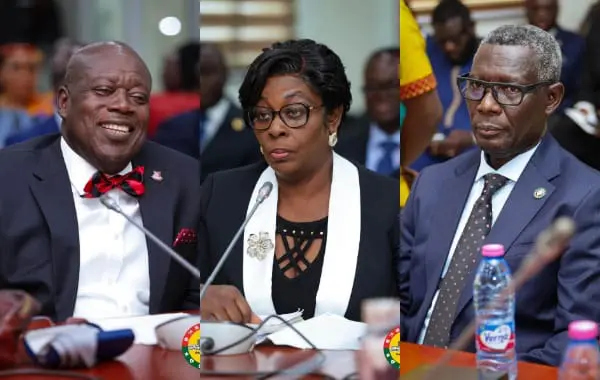
Parliament’s Appointments Committee has recommended the approval of three nominees for appointment to the Supreme Court despite a dramatic boycott of their vetting by the New Patriotic Party (NPP) Minority Caucus over what it described as an unduly compressed process.
The nominees—Justice Sophia Rosetta Bernasko-Essah, Justice Edward Amoako Asante and private legal practitioner Anthony Forson Jnr.—were vetted on Thursday, August 27, after the Minority walked out of the proceedings following the rejection of its preliminary objection to the timetable.
Their approval by Parliament would increase the number of justices on Ghana’s apex court from 18 to 21.
The recommendation has, however, been overshadowed by the procedural dispute, with the Minority arguing that the speed of the process has denied Parliament and the public adequate opportunity to scrutinise the nominees.
Minority walks out
The controversy erupted at the beginning of the sitting when Minority Leader Alexander Afenyo-Markin raised an objection to the committee proceeding with the vetting.
Mr Afenyo-Markin said the nominations did not involve the replacement of vacant positions and, therefore, questioned why Parliament was being required to process them within the five-day emergency recall period.
He argued that the three nominees were being considered to expand the membership of the Supreme Court rather than replace judges who had retired, died or been removed from office.
The Minority Leader also pointed out that the nominations had only been referred to Parliament at the beginning of the emergency sitting and that the public had not been afforded the customary period to submit memoranda on the nominees.
He stressed that the objection was not about the competence, experience or suitability of the three nominees but about the procedure and timeframe adopted by Parliament.
“These nominations came to the House on Monday. Let us reason together and let us be seen as being consistent with our political views,” he said.
“If you want to follow the precedent, please suspend today’s sitting, properly put out the advert as you requested when you were in opposition, and let us wait for the 14 days,” he added.
Mr Afenyo-Markin challenged the Majority to demonstrate how delaying the process would adversely affect the State, the Judiciary or litigants.
Chairman rejects objection
Chairman of the Appointments Committee, Bernard Ahiafor, rejected the Minority’s objection and ruled that the committee had a mandate to proceed with the vetting.
Mr Ahiafor described the grounds advanced by the Minority as “flimsy,” “hollow” and “baseless,” insisting that the committee could not vary a decision already taken by the full House.
“If you are aggrieved by the decision of the House, the method available for you to reverse that decision is contained in our own Standing Orders,” he said.
“I will not preside over this committee and purport to vary the orders or directions or decisions taken at the plenary by the entire House.”
“It is not done in any democracy, and I will not be the first to introduce it in Ghana’s democracy,” he added.
The ruling prompted the Minority members, led by Mr Afenyo-Markin, to leave the sitting.
The Majority side subsequently continued with the vetting and considered the qualifications and experience of the three nominees.
Experienced nominees
Justice Sophia Rosetta Bernasko-Essah is a Justice of the Court of Appeal with extensive experience in Ghana’s judicial system.
Justice Edward Amoako Asante, also a Court of Appeal Justice, brings significant regional judicial experience. He served as President of the ECOWAS Court of Justice for three terms, spanning six years, and was involved in cases relating to human rights and international law.
Mr Anthony Forson Jnr., a private legal practitioner, is a former President of the Ghana Bar Association and has had a lengthy career in legal practice.
The nominations were made by President John Dramani Mahama in consultation with the Judicial Council, in accordance with the constitutional procedure for appointing Supreme Court judges.
The Council of State subsequently informed the President that it considered the three nominees qualified and suitable for appointment.
Emergency recall fuels dispute
The disagreement is rooted in Parliament’s emergency recall from August 24 to August 28.
Speaker Alban Kingsford Bagbin said the recall was necessitated by a request from President Mahama to consider urgent matters, including two ministerial nominations, the three Supreme Court appointments and the Banks and Specialised Deposit-Taking Institutions (Amendment) Bill.
The Speaker referred the judicial nominations to the Appointments Committee with instructions to consider them and report to the House within the recall period.
The Minority, however, maintained that the emergency nature of the sitting should not be allowed to compromise the depth of parliamentary scrutiny normally associated with appointments to the country’s highest court.
Approval now goes to Parliament
The committee’s recommendation clears the way for the three nominees to be presented to the full House for consideration.
If approved by Parliament, the nominees will take the required oaths before assuming their positions on the Supreme Court.
The episode has nevertheless exposed a sharp political disagreement over the balance between parliamentary efficiency and thorough scrutiny of judicial appointments.
While the Majority has proceeded on the basis of the mandate given to the committee during the emergency recall, the Minority insists that the compressed timetable undermines the opportunity for meaningful public and parliamentary examination.
The dispute is therefore likely to remain part of the debate surrounding the appointments even as the nominees move closer to joining Ghana’s highest court.