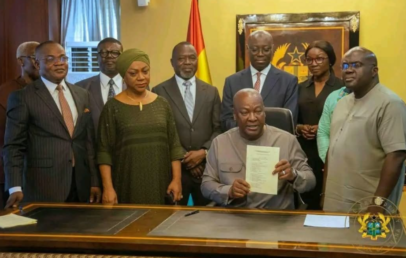
The Minister of Lands and Natural Resources, Emmanuel Armah-Kofi Buah, has assured the investors and mining industry players that government has no intentions nor developed a policy to nationalise the mining sector.
The Minister made these remarks at the opening ceremony of the 19th West Africa Mining and Power Expo (WAMPEX) which is currently ongoing in Accra.
“To our partners and our investors, I wish to reaffirm that Ghana remains committed to providing a stable, predictable, physical and legal certainty, and transparent environment for investors. So, forget about all the noise you’re hearing. You are hearing it from me. That is government policy. That is what we are focused on.”
According to the Minister, West Africa has the potential to turn its mineral wealth into industrial growth, jobs and long-term prosperity.
To actualise the theme of this year’s expo, ‘How Can Responsible Mining and Power Accelerate West Africa’s Sustainable Development?,’ the Minister called on industry players to focus on the implementation of local actions like policy alignment, investment, innovation and regional cooperation to produce measurable results for our people and economies.
He acknowledged that the huge mineral resource base of the sub-region has made West Africa an attractive destination, drawing significant interest from international mining companies and foreign governments.
The Minister stated that Ghana’s goal, is not just to remain the leading producer of gold on the continent, but to redefine what success in mining really means.
He said, “ we are moving from a resource-rich economy to a value-driven economy in which success be measured, not only by what we extract, but by how mining supports industrialisation, creates jobs, funds local participation and improves the lives of our citizens, within an environmentally, socially and development standard that is top notch.”
Ghana he said, is no longer merely interested in retaining it’s place as main gold producer, but is now focused on taking deliberate steps to add value to her resources.
“On the emerging minerals front, Ghana is committed to ensuring that it’s mineral resources are not merely exported, but transformed. It is obvious that anyone who wants to talk about lithium should also be interested in talking about how the batteries can be produced here.”
He noted also the mining and energy are connected, and must therefore be treated as one strategic agenda, which is why Ghana is pursuing a coordinated strategy that integrates mining development with our energy.”
The CEO of the Ghana chamber of Mines, Dr Ing. Kenneth Ashighbey, in his address said West Africa is no longer simply a resource destination.
The region, he said, is now an investment frontier that must deliver value, certainty and sustainable returns.
To this end, he indicated that, “responsible mining reduces risk, reliable power increases profitability, competitiveness and profitability.”
He indicated that Ghana is taking deliberate steps to strengthen the fundamental rules of its mining sector at a time when global capital is seeking critical minerals, stable jurisdictions, and ESG-compliant opportunities, noting that investment follows policy certainty, regulatory clarity, competitive returns, and manageable risks.
Ing. Ashigbey said that through reforms like the Critical Minerals Strategy, and initiatives such as GoldBod, and the Bank of Ghana’s Domestic Gold Purchase Programme, Ghana is strengthening value addition, supporting macroeconomic stability, and positioning itself more competitively within global supply chains, while also sending a clear signal that it remains committed to meeting investor expectations.
He echoed calls previously made by the president and sector managers, stating that “the future of mining in West Africa will not be defined solely by extraction. It will be defined by who adds value, who controls supply chains, who processes and refines minerals, and who can provide reliable, affordable power to support industrial growth. Mining and energy must therefore be seen as one integrated investment ecosystem.”
Reliable and competitive power remains central to this agenda. Without it, industrialisation and value addition will be constrained. That is why conversations on energy transition, grid stability, and private sector participation are essential to the future of mining in our region,” he concluded.
The President of the Ghana Chamber of Mines, Michael Edem Akafia, stated that theme of the exhibition, ‘How Can Responsible Mining and Power Accelerate West Africa’s Sustainable Development?’ speaks to the economic and investment priorities of the sub-region, challenging us to not only discuss opportunities, but also translate these opportunities into bankable projects, stronger partnerships and measurable development and transformational outcomes.
He noted that the region has a significant opportunity to attract investment, deepen value addition, strengthen industrialisation and enhance its competitiveness in the global market amid rising global demands for critical minerals.
He also stressed on the centrality of responsible mining and sustainable power development to the region’s growth agenda and strategy.
This he said, “requires stable policy frameworks,transparent regulations, efficient permitting systems, reliable infrastructure and incentive models capable of attracting and mobilising long-term capital, while delivering value to both communities and countries.”