
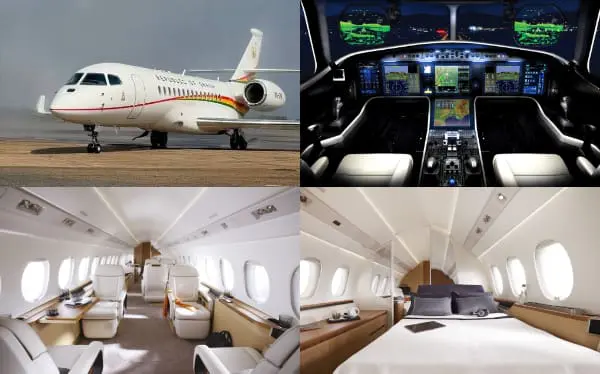
Ghana’s new Falcon 6X is designed to make a long flight feel less like a stretch of time spent in transit and more like a quiet, spacious environment where passengers can work, meet, dine and rest.
Built by France’s Dassault Aviation, it replaces the 16-year-old Falcon 900EX, which had faced maintenance problems. Parliament approved a US$60 million purchase agreement between the Ministry of Defence and Dassault Aviation on December 4, 2025.
Lawmakers also approved a separate €125 million agreement with Airbus Helicopters SAS for one H160 and three H175 helicopters for the Ghana Air Force.
Room to move, work and rest
The Falcon 6X cabin is among the tallest and widest in business aviation.
It measures 6 feet 6 inches high, 8 feet 6 inches wide and 40 feet 4 inches long, with a wider aisle and an open layout that gives passengers room to move.
Its interior can be arranged in three living areas for work, dining and rest.
Depending on the configuration, the aircraft can carry 12 to 16 passengers.
Club seats can convert into flat beds, while the mid-cabin can be used for meetings or meals.
At the rear, a private lounge can offer a secluded place to rest. An adjustable divider and berthable seats allow the space to change from a meeting area during the day to a sleeping area at night.
Light is part of the cabin’s design. Thirty large windows and a skylight above the galley brighten the interior and open it to panoramic views.
A fully equipped galley, private lavatory and baggage compartment accessible during flight add to the practical comforts of longer journeys.
A quieter, more connected journey
The cabin is designed to keep ambient sound below 50 decibels. At a cruising altitude of 41,000 feet, its pressurisation system maintains a cabin altitude of about 3,950 feet, helping reduce the physical strain often associated with high-altitude travel.
The aircraft’s air system is designed to refresh cabin air rapidly, with HEPA filtration claimed to capture 99.97 per cent of airborne particles.
Passengers can adjust lighting, temperature and window shades through Dassault’s Ambiance cabin management system.
Satellite connectivity can support email, video calls, large file transfers and streaming, depending on the network and onboard configuration.
Dassault’s FalconConnect service combines connectivity, flight planning and technical support through one system.
The aircraft has a maximum range of 5,500 nautical miles (10,186 kilometres) and a maximum operating speed of Mach 0.90.
It can also fly at Mach 0.85 for nonstop journeys of up to 5,100 nautical miles (9,445 kilometres), and has a maximum certified altitude of 51,000 feet.
Its digital flight-control system is designed to support pilots with flight-envelope protection.
Dassault describes its PW800 engines as offering lower fuel burn, emissions and noise than the previous generation, and as compatible with sustainable aviation fuel.
The promise is of a long journey made more comfortable: space to move, privacy to rest, connectivity to work and the range to reduce the need for refuelling stops.
Yet in Ghana, presidential aircraft have been judged by comfort or performance alone.
Their purchase and use have repeatedly become part of a wider political debate about cost, safety, national security and consistency.
From the DH125 to the Falcon 900
Ghana’s presidential aviation history reaches back to 1962, when President Kwame Nkrumah acquired a DH125.
In 1976, General I.K. Acheampong added a Dutch-made Fokker 28, later nicknamed the “Flying Coffin.”
In 1998, the Jerry John Rawlings administration acquired a Gulfstream GIII.
The purchase became controversial after John Agyekum Kufuor succeeded Rawlings and declined to use the aircraft, questioning the circumstances of its acquisition.
The account says the purchase had not received parliamentary approval and had reportedly been shrouded in secrecy.
Kufuor’s government sold the Gulfstream in 2006 and ordered a Falcon 900 EX-Easy in 2008.
Delivered in 2010, the aircraft became Ghana’s official presidential jet, with capacity for 12 passengers.
The purchase also exposed a recurring political divide.
The National Democratic Congress (NDC), then in opposition, had criticised plans to buy a new presidential aircraft.
When the Falcon was delivered during the John Evans Atta Mills administration, the new government inaugurated it.
Then Defence Minister the lateLt. Gen. J.H. Smith argued that the aircraft should be seen as a national asset rather than a partisan project.
Commercial flights, private charters and changing arguments
President Mills was known for choosing commercial flights, but the account describes the decision as creating logistical and safety concerns.
His communications director, Koku Anyidoho, later said the approach had created serious logistical problems and increased risks, including the need for at least one emergency charter from the United States to Venezuela.
The Mills administration later procured an Embraer aircraft from Brazil.
President John Mahama also faced travel challenges, with reports that he and then-Vice-President Mahama had narrowly avoided fatal aviation incidents because of inadequate domestic air arrangements.
When President Nana Akufo-Addo later chartered private jets for some long-haul journeys, citing the Falcon’s range, technical challemges and passenger limitations, the NDC criticised the practice.
Then-Minority Leader Haruna Iddrisu and Foreign Affairs Committee ranking member Samuel Okudzeto Ablakwa described the charters as luxurious and unjustified, according to the account.
The opposition also stalled a government plan to acquire another presidential jet.
That position came under scrutiny in 2025, when Vice-President Professor Jane Naana Opoku-Agyemang returned from the United Kingdom aboard a private aircraft after a medical emergency.
The use of the charter reignited debate over the NDC’s earlier criticism of private jet travel.
In Parliament, then-Defence Minister the late Dr Edward Omane Boamah said the Falcon 900 had been grounded in France since March 11, 2025, for extensive maintenance after serious corrosion was found in key systems.
He argued that the issue involved national security, sovereignty and responsible maintenance of state assets.
The political dispute has therefore followed a pattern: opposition parties have criticised the cost or perceived extravagance of presidential aircraft, while governments have defended dedicated or chartered flights on grounds of safety, capacity, maintenance and the demands of official travel.
The account argues that the NDC’s positions—from opposing the Falcon’s purchase to inaugurating it, and from criticising charters to defending one in 2025—have invited accusations of inconsistency.
It also records that concerns about the ageing Falcon’s capacity and condition were not limited to one administration.
A national asset under public scrutiny
The Falcon 6X’s arrival marks a new chapter in that history, but the debate is unlikely to end with a newer aircraft.
The central question remains how Ghana can provide safe, reliable and cost-effective travel for its leaders while maintaining transparency over procurement, upkeep and use.
The aircraft offers a cabin designed for comfort and productivity across long distances.
Its public value, however, will also be judged by how responsibly it is managed—and whether future discussions about presidential travel can focus on national needs rather than shifting partisan positions.
The supplied text also proposes a broader, long-term approach: a modern, multipurpose aircraft able to serve presidential and Air Force needs, alongside clear policies for maintenance, chartering and public accountability.
That conversation, like the history of Ghana’s presidential jets, is part of the journey the Falcon 6X now joins.
By Elvis Darko

