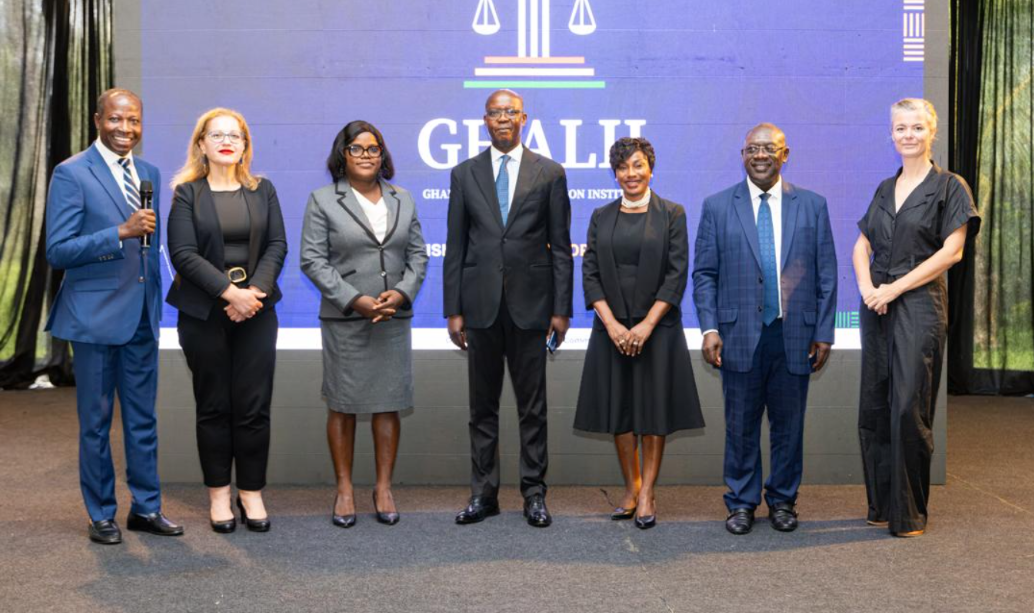
The rebranding of the Ghana Legal Information Institute (GhaLII) and the official launch of its upgraded digital platform, MyGhaLII, has been described as a transformative milestone for Ghana’s legal system, with stakeholders underscoring its impact on democracy, legal education, and the administration of justice.
The event, held in Accra on Thursday, June 25, 2026, formed the closing ceremony of Legal Days and brought together representatives from Parliament, the Judiciary, the Ghana Bar Association (GBA), the Ghana School of Law, and development partners including GIZ, Laws.Africa, and AfricanLII.
Speakers consistently agreed that expanding access to legal information is critical to strengthening the rule of law, improving transparency, and bridging the gap between legal institutions and the public.
Opening the institutional reflections, First Deputy Speaker of Parliament and Member of Parliament for Akatsi South, Bernard Ahiafor, reaffirmed Parliament’s commitment to widening public access to Ghana’s legal and legislative records.
He described the rebranding of GhaLII and the introduction of MyGhaLII as “a major milestone for democracy, transparency, and the rule of law,” stressing that access to legal information underpins every functioning democratic system.
He noted that citizens, judges, lawyers, businesses, and civil society organisations all depend on accurate legal information to perform their duties effectively, warning that limited access weakens accountability and public participation.
Ahiafor explained that Parliament sits at the centre of Ghana’s legal architecture, not only responsible for passing laws but also for preserving legislative history.
He detailed Parliament’s extensive archives, including Acts of Parliament, Bills, Hansards, Legislative Instruments, Constitutional Instruments, committee reports, and parliamentary papers, noting that these records capture both the content of the law and the intent behind it.
According to him, understanding legislative debates and policy considerations is essential for accurate interpretation and accountability in governance.
He further described the digitisation of records dating back to 1957 as a “landmark achievement,” removing long-standing barriers posed by physical archives and outdated formats.
With key legislative documents now digitised, he said MyGhaLII would make legal research faster, more reliable, and more accessible to both professionals and the public.
He added that improved access would empower civil society organisations, enhance legal certainty, and deepen public trust in state institutions.
Representing the Ghana Bar Association, Vice President Victoria Barth described MyGhaLII as a “transformational” tool that will reshape legal practice in Ghana.
She emphasised that access to law is not a convenience but the foundation of competent legal work and public confidence in justice delivery.
Barth explained that lawyers often spend significant time verifying legal authorities or confirming whether laws remain in force, a challenge the platform is designed to address.
She said MyGhaLII goes beyond traditional databases by introducing workflow-based tools such as private research folders, case tracking alerts, saved search updates, and legislative version tracking.
These features, she said, shift legal work from simple searching to structured, continuous research environments.
She stressed the importance of equal access to legal resources, noting that digital platforms help reduce disparities between well-resourced firms and practitioners in rural or underserved areas.
Barth also cautioned that while artificial intelligence is increasingly used in legal research, responsibility for legal output must remain with lawyers, stating that accountability cannot be delegated to software.
She further urged African legal institutions to take ownership of their legal data to ensure that local jurisprudence is properly represented, warning against overreliance on foreign datasets.
Linking legal access to economic development, she said platforms like MyGhaLII are essential for the success of the African Continental Free Trade Area by reducing legal uncertainty and supporting cross-border trade and investment.
Director of Legal Education and Ghana School of Law Director, Prof. Raymond A. Atuguba, described MyGhaLII as a foundational resource for legal training.
He argued that access to law is the starting point of legal education, which requires students to engage directly with constitutions, statutes, judgments, and treaties.
He outlined five key ways open legal access transforms legal education: shifting learning from memorisation to analysis, democratising classroom knowledge, levelling geographic and economic disparities, improving efficiency and precision in legal training and judicial work, and preserving national legal heritage by preventing deterioration of historical documents.
Prof. Atuguba stressed that GhaLII should serve not only as a public access platform but also as a teaching and research partner.
He expressed strong support for long-term collaboration among stakeholders including Parliament, the Judiciary, the Bar, AfricanLII, Laws.Africa, and GIZ, emphasising that sustainability is key to serving future generations of legal professionals.
Across all interventions, speakers agreed that MyGhaLII represents more than a digital upgrade.
It is a structural reform in how legal information is created, preserved, and accessed in Ghana.
The launch ended with renewed commitments to collaboration, expansion of digital access, and strengthening of a modern, transparent, and accessible legal system.