Angela Mensah-Poku, Chief Enterprise Business Officer of MTN Ghana, has called for urgent and sustained investment in Africa’s digital infrastructure, warning that the continent cannot achieve a truly integrated digital economy without strong payment systems, data centres and settlement frameworks.
She stressed that while African countries have embraced the vision of a single digital market, the infrastructure needed to support seamless trade and financial transactions across the continent remains inadequate.
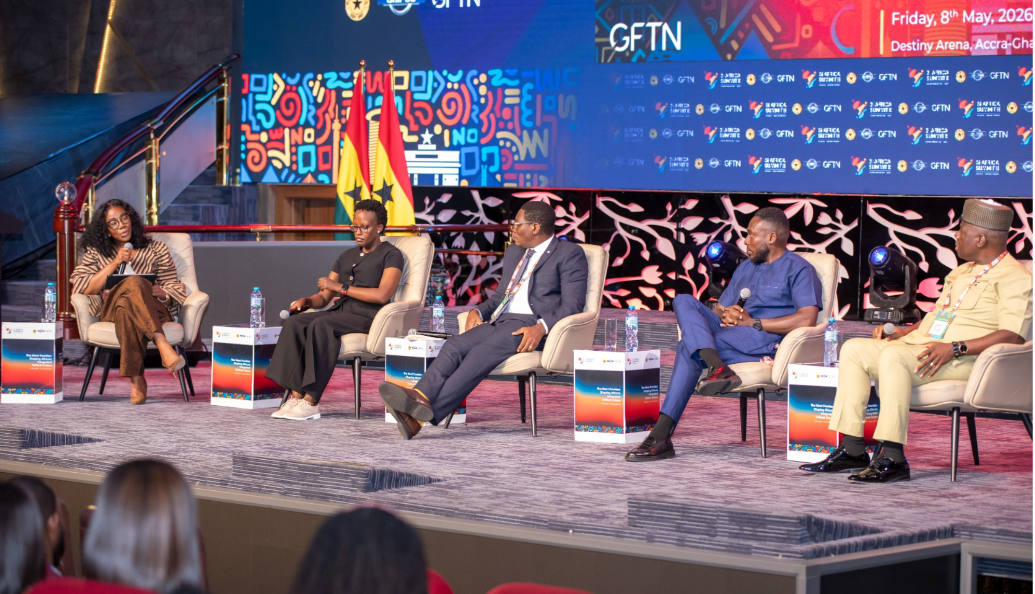
Panel discussion at 3i Africa summit
Ms Mensah-Poku made the remarks while moderating a high-level panel discussion at the 3i Africa Summit in Accra on Friday, on the topic: “The Integration Engine: Who Builds the Plumbing for Africa’s Digital Economy.”
The session focused on the challenge of scaling digital systems across Africa’s 54 countries, 42 currencies and fragmented payment systems, many of which still route transactions through banks outside the continent.
“Policy exists, but the infrastructure doesn’t”
Setting the tone for the discussion, Ms Mensah-Poku said Africa already had the political will and policy framework required for integration, but lacked the infrastructure to support the vision.
“We know that there is political will. We know and we all believe in the single vision of an African digital market worth over $450 billion. It’s real,” she stated.
“But there is a problem. Cross-border payments still cost up to 10 per cent more than if you’re in Europe. Most of the money still routes outside of Africa and also we need 700 data centres and we haven’t built them yet,” she added.
She explained that while several digital trade protocols and frameworks had been adopted across the continent, implementation remained slow because the underlying infrastructure was still underdeveloped.
Focus on the “Plumbing” of the Digital Economy
“The framework exists. The policy exists, but the plumbing doesn’t,” she stressed.
“That is why we are here to talk about this today. Not the grand vision. We have heard this speech. We are getting into the essential bit, the bit that actually talks about building infrastructure,” she added.
According to her, Africa’s digital future depends on invisible but critical systems that support payments, connectivity and trust.
“It is the infrastructure that holds everything together—the payment rails, the settlement systems, the data architecture, the policy levers and critically who pays for it all and what happens when we get it wrong, who is left out,” she stated.
Experts weigh in on interoperability and inclusion
The panel brought together key players in Africa’s digital finance and payment ecosystem, including Gakii Mwongera, Mobile Financial Service Director at Ericsson; Dr Stephen Ambore, Policy Director at Women’s World Banking; Kwamena Afful, Founding Director of Pave Financial; and Premier Olwoh, Managing Director of Nigeria Inter-Bank Settlement System Plc.
Ms Mensah-Poku guided discussions around interoperability, settlement systems, infrastructure financing and regulation, as well as how African countries can build systems that serve both formal and informal sectors.
Call for human-centred digital systems
Speaking on interoperability, Ms Mwongera stressed the need for infrastructure that responds to the needs of ordinary Africans, particularly women and people in informal economies.
She noted that 48% of women in sub-Saharan Africa remain unbanked and warned against focusing only on institutional systems without considering human impact.
“That human aspect is what we need to strengthen in this conversation going forward,” she said.
She also called for practical implementation across the continent.
“We need to launch, prove and track,” she added.
Evidence-based policy and settlement challenges
Dr Ambore emphasised the importance of evidence-based advocacy to convince political leaders to support infrastructure integration.
He identified settlement systems as one of the biggest barriers to Africa’s digital economy.
“Once a standard for settlement across the continent is established, the integration of Africa’s digital economy will become significantly more feasible,” he said.
Building trust in interoperable systems
Mr Afful noted that although technological infrastructure for interoperability is gradually being developed, trust remains a major challenge.
According to him, both regulators and users need time to build confidence in emerging systems.
“It’s going to take time to get confidence in it. It’s going to take time to educate regulators to be comfortable with it,” he stated.
Who should fund Africa’s digital infrastructure?
A major point of debate was infrastructure financing and responsibility for funding Africa’s digital systems.
Mr Olwoh argued strongly that governments must take the lead due to the strategic importance of digital infrastructure to national development.
“If I’m the president of a country today, I’ll fund it and I’ll tell you why,” he said.
“You need to have that infrastructure to be able to capture data and to be able to plan. It’s not something I want to put in the hand of a PPP. At the end of the day, PPP ultimately is built for profit,” he added.
He maintained that the benefits of such infrastructure to governments and central banks were too significant to be left solely to private investors.
Summit emphasises urgency of digital transformation
The discussion formed part of broader conversations at the summit on accelerating digital transformation, expanding financial inclusion and strengthening cross-border trade across Africa.
Held from May 6 to May 8, 2026 in Accra, the 3i Africa Summit brought together policymakers, regulators, fintech leaders, investors and technology firms from across Africa and beyond.
The event was organised through a partnership involving the Bank of Ghana, Ghana Interbank Payment and Settlement Systems (GhIPSS) and the Global Finance and Technology Network, with a shared focus on digital payments, interoperability and Africa’s integrated fintech future.