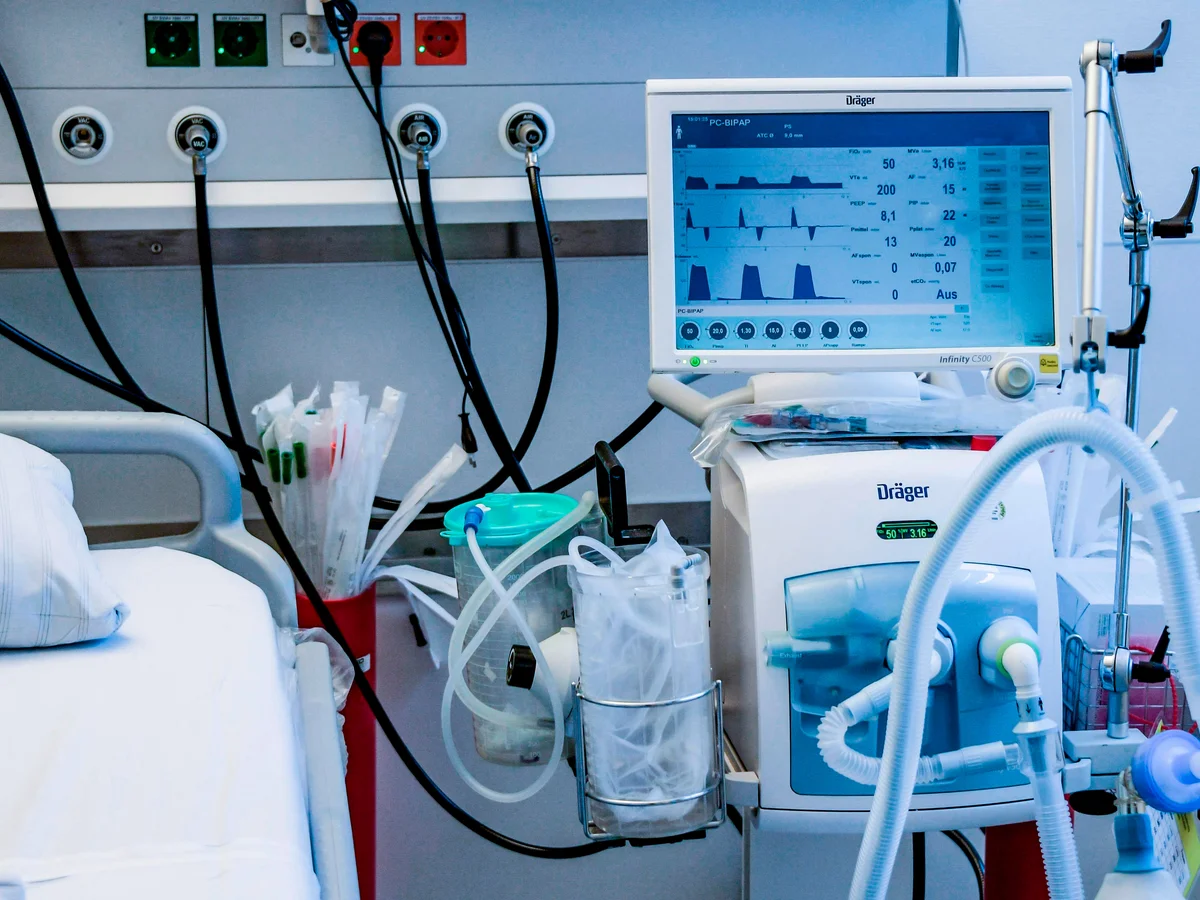
The Korle Bu Teaching Hospital, Ghana’s premier referral facility, is grappling with a severe shortage of life-saving medical equipment, raising urgent concerns about the country’s ability to manage critical medical emergencies and save patients in life-threatening conditions.
Investigations have revealed that the hospital’s Accident and Emergency (A&E) Unit together with its Medical and Surgical Intensive Care Units (ICUs) currently operate with only 10 functioning ventilators serving a combined 62-bed capacity.
Korle Bu is a 2,400-bed facility but currently has less than 50 ventilators.
The situation, according to health professionals at the facility, has created a dangerous strain on emergency care delivery and is forcing medical teams to make difficult decisions about which critically ill patients receive life-support treatment.
3 Ventilators for 50-Bed Accident and Emergency Unit
At the hospital’s 50-bed Accident and Emergency Unit, only three ventilators are currently functioning.
In practical terms, this means that although dozens of critically ill or injured patients can be admitted during emergencies, only three patients at any given time can receive mechanical breathing support if their condition deteriorates.
For a referral hospital responsible for handling severe trauma cases, road accident victims, stroke patients, respiratory failures and other life-threatening emergencies from across the country, the shortage poses a major threat to survival outcomes.
Health professionals describe the situation as emotionally draining and operationally crippling.
According to staff who spoke on condition of anonymity for fear of victimisation, doctors and nurses are often left helpless when multiple patients simultaneously require ventilatory support.
The sources stressed that the crisis is not due to negligence or incompetence by medical personnel, but rather a systemic shortage of equipment and weak maintenance systems.
3 ventilators for 5-bed Medical ICU
The crisis is equally severe at the Medical Intensive Care Unit.
Although the unit has a five-bed capacity, only three ventilators are operational. Since virtually every patient admitted to the ICU requires continuous breathing assistance, only three beds can effectively be used.
This means two ICU beds, despite being physically available, cannot function for their intended purpose because there are no working ventilators attached to them.
4 ventilators for 7-bed Surgical ICU
The situation is similar at the Surgical ICU where only four of the seven ventilators are functioning
As a result, three ICU beds remain practically unusable, further reducing the hospital’s capacity to care for critically ill patients.
Medical experts warn that the shortage significantly increases the risk of avoidable deaths, especially during periods of high patient admissions or multiple emergencies.
Health workers battling frustration and depression
Health workers say the persistent shortage of critical equipment is taking a psychological toll on frontline staff.
According to sources within the units, many clinicians are battling frustration, emotional exhaustion and depression as they struggle daily to manage critically ill patients with inadequate resources.
They explained that it becomes particularly distressing when doctors know a patient’s chances of survival could improve with ventilatory support, but are unable to provide it because no machine is available.
The health workers say the situation often leaves families devastated while medical teams carry the emotional burden of circumstances beyond their control.
Ventilators critical to saving lives
Ventilators are among the most important medical devices in emergency and critical care medicine.
They assist patients who are unable to breathe adequately on their own due to severe trauma, respiratory failure, stroke complications, infections, surgeries or organ failure.
Without timely access to ventilatory support, oxygen supply to vital organs drops rapidly, increasing the likelihood of brain damage, organ failure or death.
Medical professionals explain that in many emergency situations, ventilators buy crucial time for doctors to stabilise patients and begin treatment.
However, where ventilators are unavailable, survival chances reduce significantly, particularly for patients requiring immediate respiratory support.
Ghana’s broader hospital infrastructure deficit
The crisis at Korle Bu also reflects broader structural weaknesses within Ghana’s healthcare system.
Ghana currently records approximately 0.9 hospital beds per 1,000 people, far below the World Health Organization’s recommended minimum threshold of two beds per 1,000 population and significantly lower than the upper benchmark of five beds.
Health analysts describe the figure as deeply inadequate for a growing population facing rising healthcare demands.
Across many major hospitals, overcrowded wards, patients lying on floors and overstretched emergency departments have become increasingly common.
Experts warn that inadequate bed capacity combined with shortages in critical care equipment such as ventilators creates dangerous bottlenecks in healthcare delivery.
Beds alone cannot solve the crisis
Although authorities have initiated efforts to ease pressure on the hospital system, including the procurement and distribution of 200 new hospital beds across departments, health professionals insist that beds alone are not enough.
They argue that additional beds without corresponding investment in ventilators, oxygen systems, trained personnel and equipment maintenance will do little to improve critical care outcomes.
Plans are reportedly underway to acquire more beds in the future, but clinicians say urgent investment is needed in intensive care infrastructure and biomedical maintenance systems.
Public health experts caution that unless significant interventions are made, Ghana’s health system could face even greater pressure as population growth, urbanisation and disease burdens continue to increase.
A national emergency requiring immediate attention
For many observers, the situation at Korle Bu has become symbolic of the wider challenges confronting Ghana’s healthcare system.
As the nation’s leading referral hospital continues to receive critically ill patients from across the country, concerns are growing that access to life-saving care is increasingly being determined by equipment availability rather than medical expertise alone.
Healthcare professionals warn that unless urgent action is taken to expand critical care infrastructure and restore essential equipment, more lives could be placed at risk.
At present, survival for some patients at Ghana’s premier referral hospital may depend not only on how quickly they arrive or the skill of the medical team, but on whether a ventilator is available when they need it most.