The International Monetary Fund (IMF) has warned that unresolved fiscal risks linked to state-owned enterprises (SOEs), quasi-fiscal activities and commodity price volatility could undermine Ghana’s hard-won economic recovery despite the country’s successful exit from its US$3 billion loan-supported programme with the Fund.
The IMF cautioned that while Ghana had restored a significant degree of macroeconomic stability after three years of painful fiscal adjustment and austerity measures, major vulnerabilities remained capable of reversing recent gains if not carefully managed.
Top among the identified risks were contingent liabilities from state-owned enterprises and fiscal activities occurring outside the central government budget, which the Fund said had historically contributed significantly to Ghana’s debt accumulation.
The IMF also highlighted global commodity price volatility, particularly fluctuations in gold prices, as a major threat to the country’s economic stability given Ghana’s increasing dependence on gold exports to support foreign exchange inflows and reserves.
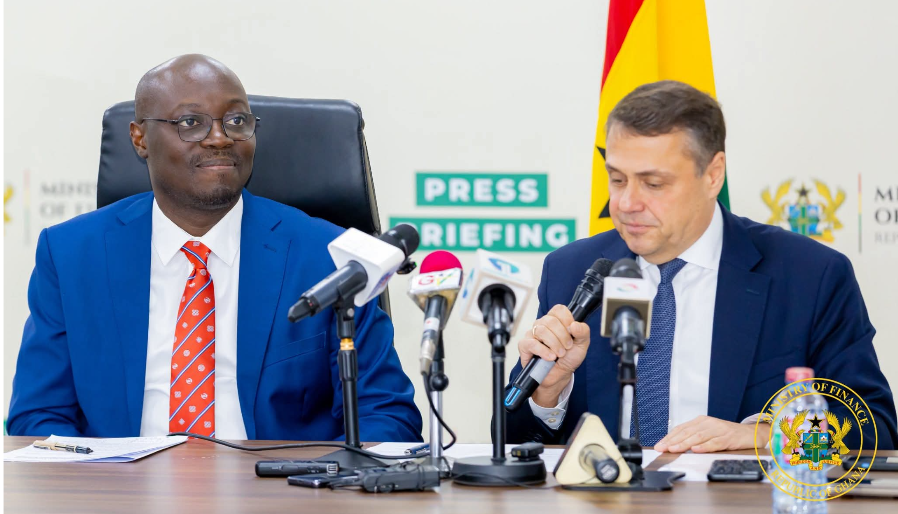
The concerns were raised by Mr Ruben Atoyan, IMF Mission Chief for Ghana and Division Chief in the IMF’s Africa Department, during a joint press conference in Accra between officials of the Ministry of Finance and the IMF staff mission team.
The briefing followed the completion of the IMF’s 2026 Article IV Consultation with Ghana, the Staff-Level Agreement on the sixth review under the Extended Credit Facility (ECF) arrangement and discussions on a new 36-month non-financial Policy Coordination Instrument (PCI) programme.
Mr Atoyan said the materialisation of fiscal risks outside the central government framework could generate major economic shocks if left unchecked.
“Contingent liabilities from state-owned enterprises have historically been the predominant factor driving Ghana’s debt trajectory,” he stated.
He explained that the IMF’s new engagement with Ghana under the Policy Coordination Instrument would focus heavily on strengthening fiscal institutions and ensuring that SOEs do not create fresh financial burdens on the state during future economic shocks.
“The focus there is not only adjustment, but also on strengthening domestic institutions to ensure that no contingent liabilities are created outside of the central government,” he said.
Mr Atoyan further warned that uncertainties in the global geopolitical environment could trigger volatility in commodity prices, particularly gold prices, which currently remain central to Ghana’s external sector recovery and reserve accumulation efforts.
According to him, Ghana must take advantage of the current favourable terms of trade and strong gold export earnings to build stronger fiscal and foreign reserve buffers capable of cushioning the economy against future external shocks.
He urged the government to pursue prudent spending controls, especially in relation to state-owned enterprises, while continuing efforts to strengthen macroeconomic resilience.
“The goal is to insulate the economy from future shocks if and when they materialise,” he stressed.
Despite the risks, the IMF acknowledged that Ghana had made significant progress under the three-year Extended Credit Facility programme.
Ghana officially exited the US$3 billion IMF-supported programme on Friday, May 15, 2026, after implementing a series of fiscal consolidation and economic reforms aimed at restoring macroeconomic stability, rebuilding investor confidence and stabilising the debt situation.
According to the IMF, the programme has helped create conditions for renewed investor interest in Ghana’s economy.
Mr Atoyan revealed that the Fund had recently received numerous requests from international investors seeking meetings and discussions about Ghana’s economic prospects and investment opportunities.
“We do see a lot of interest in exposure to Ghana and that the IMF has been bombarded by requests from investors to meet and talk about Ghana going forward,” he said.
The renewed investor optimism comes as Ghana continues to recover from one of its worst economic crises in decades, which triggered debt restructuring, severe inflationary pressures, currency depreciation and fiscal distress.
With the stabilisation phase now largely completed, government says attention will shift toward economic growth, job creation and long-term resilience.
The Minister of Finance, Cassiel Ato Baah Forson, said the government’s next priority would be implementing a new flagship economic initiative known as “the new economy,” aimed at stimulating growth sectors and expanding employment opportunities.
According to him, the government intends to build on the stability achieved under the IMF programme to create a more resilient and inclusive economy.
“Be assured that from stability, we’ll build resilience, and from resilience, we’ll build an economy that will benefit the masses, and that is exactly where we are going,” the Finance Minister stated.
The new Policy Coordination Instrument arrangement with the IMF is expected to provide technical policy support and monitoring without direct financial assistance, allowing Ghana to continue implementing reforms while maintaining investor confidence and macroeconomic discipline.
Economic analysts say the transition from a financing programme to a policy coordination framework signals improving confidence in Ghana’s economic management, although they caution that sustaining stability will depend heavily on fiscal discipline, stronger institutions and effective management of external risks.