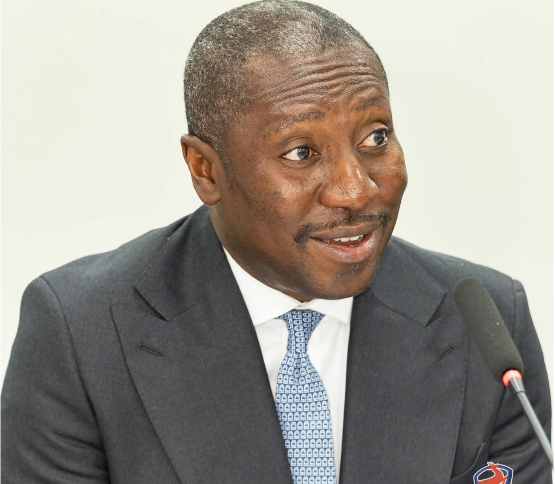
Minority Leader and Member of Parliament for Effutu, Alexander Kwamena Afenyo-Markin, has launched a scathing attack on the arrest, prosecution and continued detention of Bono Regional Chairman of the New Patriotic Party (NPP), Kwame Baffoe, popularly known as Abronye DC, describing the actions as a dangerous abuse of constitutional rights and a calculated attempt to silence political dissent.
Addressing a press conference at the NPP headquarters in Asylum Down, Accra, on Sunday, May 17, 2026, the Minority Leader condemned the Circuit Court’s decision to deny bail to Abronye DC, calling the ruling a “constitutional disgrace” that undermines the very foundations of Ghana’s democracy and rule of law.
According to Afenyo-Markin, the court’s reasoning effectively criminalised free expression and punished a citizen not for any proven offence, but for fears about what he might allegedly say in future.
“In other words, the state asked a court to imprison a man before any finding of guilt because he might speak again. And the court agreed,” he stated.
“A citizen imprisoned not for what he did, but for what he might say. That is not the law. That is censorship from the bench,” he added.
The Minority Leader argued that the decision violated Articles 14 and 19 of the 1992 Constitution, which guarantee personal liberty and the presumption of innocence.
He insisted that the bail application filed on behalf of Abronye DC was firmly grounded in law, noting that the accused was facing misdemeanor charges, had a fixed place of residence and presented credible sureties before the court.
However, he said the prosecution opposed bail on grounds that Abronye DC could commit similar offences if released, a justification Afenyo-Markin described as alarming and unconstitutional.
“When a court denies bail not to serve justice, but to serve silence, it has administered political censorship from the bench,” he stressed.
Afenyo-Markin further questioned the legality of Abronye DC’s continued detention at the Bureau of National Investigations (BNI), arguing that the use of a national security facility for a matter involving political speech amounted to intimidation and abuse of state power.
He disclosed that the case stemmed from a social media video in which Abronye DC allegedly criticised a Circuit Court judge, insisting that such comments fall within constitutionally protected free speech.
The Minority Leader also raised concerns over what he described as serious procedural irregularities surrounding the remand process, claiming that days after the court’s ruling, no signed and certified remand order had allegedly been produced.
“On what legal basis did the Ghana Police Service take Mr. Abronye into custody and convey him to the BNI? On what legal basis did the BNI accept him and hold him?” he questioned.
According to him, any failure to properly document the remand order would render the detention unlawful and in direct violation of Article 14 of the Constitution.
Afenyo-Markin warned that the developments pointed to what he described as an “unholy collaboration” between the Executive, investigative agencies and sections of the judiciary aimed at intimidating opposition voices under the administration of President John Dramani Mahama.
“This is what Dr. Bawumia has rightly described as an unholy collaboration between the Executive, state investigative agencies and some elements within the judiciary aimed at silencing the NPP. He is right. The pattern is undeniable,” he declared.
The Minority Leader argued that although Ghana repealed criminal libel and sedition laws in 2001 under former President John Agyekum Kufuor, the current administration appeared determined to recreate the same atmosphere of fear and intimidation through other legal provisions.
He claimed that the use of Sections 207 and 208 of the Criminal Offences Act against opposition figures was effectively a return of criminal libel under a different label.
“The charges against Abronye DC, Baba Amando, David Essandoh and others are, in substance and effect, criminal libel prosecutions. The only difference is the label on the charge sheet,” he said.
Afenyo-Markin cautioned that Ghana risked sliding back into what many once described as a “culture of silence” if state institutions continued to be used to intimidate political opponents and suppress critical speech.
He called on the judiciary to defend its independence and resist political pressure, insisting that the courts must remain the final safeguard for citizens’ freedoms rather than instruments for silencing dissent.
“The people of Ghana look to the courts as the last line of defence when the Executive overreaches. That trust is earned by the fearless and impartial application of constitutional principle,” he stated.
The Minority Leader further appealed to civil society organisations, the media and the legal fraternity to closely monitor the case and speak out against what he described as growing political persecution.
He concluded by demanding the immediate release of Abronye DC and warning that the erosion of constitutional freedoms posed a serious threat to Ghana’s democratic credentials.
“This reasoning is a constitutional disgrace. It is irreconcilable with the Constitution. A judge who denies bail because an accused may express political opinions has not administered justice,” he stated.