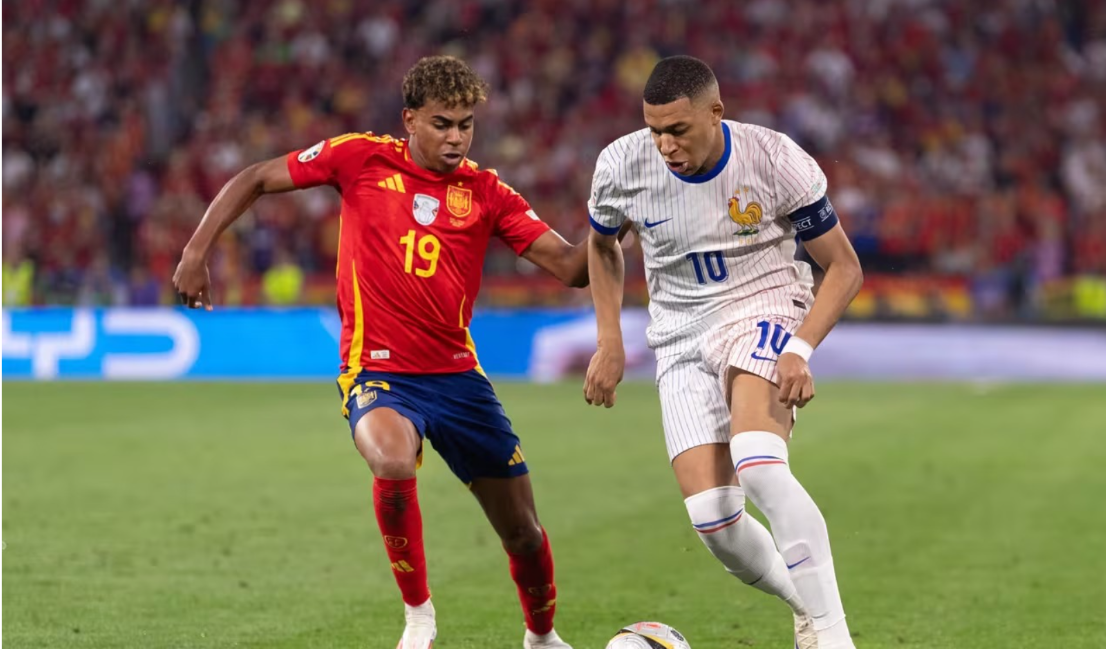
When France faced Spain in the UEFA EURO 2024 semi-finals in Munich, it felt like a changing of the guard. Les Bleus had reached the previous two FIFA World Cup finals, winning Russia 2018, while La Roja were closing in on their first major trophy in 12 years.
France briefly threatened an upset when Randal Kolo Muani opened the scoring in the ninth minute but Spain’s superiority soon told as superb goals from Lamine Yamal and Dani Olmo turned the match around before the half-hour mark.
While that victory in Bavaria heralded two years of near-total Spanish dominance in Europe, it also marked the start of a new chapter for Les Bleus – one that would take almost 20 months to bear fruit on the pitch.
“They played well and we weren’t good enough,” Kylian Mbappe said afterwards.
“They outplayed us. They’re through to the final and we’ve been knocked out – that’s the reality of football. […] We have to move on.”
Didier Deschamps took responsibility for the defeat. He said: “The onus is on me. We reached the semi-finals and came up against a Spain side of this quality. We needed to be at our best, but today we were slightly below that level. I’m not going to make excuses.”
Manu Kone, Desire Doue and Michael Olise were among those who impressed under Thierry Henry, helping France claim the silver medal after a 5-3 extra-time defeat by familiar foes Spain in the final.
As established figures such as Antoine Griezmann, Olivier Giroud, Benjamin Pavard and Kingsley Coman gradually stepped away from international football, Deschamps began a new – and final – cycle built largely around the generation shaped by that Olympic campaign.
The rebuild began against Italy on 6 September 2024, when France suffered a 3-1 UEFA Nations League defeat.
Deschamps introduced two significant changes: a gradual shift from the 4-3-3 formation used at UEFA EURO 2024 to a more attack-minded 4-2-3-1, and the inclusion of Olise, the recent Bayern Munich signing who would come to symbolise France’s renewal.
“Moving to Bayern helped him toughen up. It took him a little time to settle in,” Deschamps acknowledged last October, reflecting on the playmaker’s first year at senior international level.
“He’s quite shy and reserved, which is probably partly down to the language barrier. He’s more comfortable in English than French, although he’s making an effort to improve his French. Everyone has a different personality. The most important thing is what he can do on the pitch; he’s not someone who craves attention.”
At UEFA EURO 2024, France had been content to concede possession to Spain – an invitation La Roja were only too happy to accept.
With Les Bleus struggling for goals, having scored only twice from open play throughout the tournament, their rapid transitions and direct approach failed to produce the desired result, despite them creating more chances.
As Deschamps continued to rebuild, France crossed paths with Spain again in the UEFA Nations League semi-finals in June 2025. In a chaotic encounter that ended in a 5-4 defeat for the French, Les Bleus showed a different side from the one seen in Munich. That was largely down to the new 4-2-3-1 formation, which brought Ousmane Dembele, Olise and Doue together behind Mbappe for the first time – the same attacking quartet expected to start at Dallas Stadium on Tuesday.
Yet the first signs of the side now competing at the FIFA World Cup 2026™ were visible that night: Les Bleus had 24 shots to La Roja’s 16 and gradually regained control of possession. Deschamps had also been forced to field an experimental back line, a far cry from the settled quartet that has emerged during this edition of the FIFA World Cup.
Two years on from Munich, France face Spain with renewed defensive confidence after conceding just once in their last five matches.
“There were plenty of positives. It wasn’t all bad, particularly in the opening 20 minutes, when we controlled the game very well,” Deschamps reflected afterwards.
“We created plenty of chances – more than our opponents – but they were far more clinical during the two ten-minute spells when our level dropped. Despite the scoreline, we stuck to our game plan. […] I have a young team, and this experience will serve us well.”
A year later, France’s rebuild is clearly taking shape. Since the start of this year’s global showpiece, France have struck the right balance in a more ambitious system, with the entire team contributing as a collective unit.
The duo of Doue and Dembele have brought Paris Saint-Germain’s winning momentum and Luis Enrique’s culture of self-improvement into the tournament.
Olise is now fully integrated, providing vital balance and regularly covering more ground than most of his France team-mates. Mbappe, meanwhile, is working harder than ever off the ball, particularly when pressing the opposition’s build-up.
Compared with UEFA EURO 2024 and their nine-goal thriller with Spain in 2025, what stands out most is the collective composure Les Bleus have developed since.
Against Paraguay in the round of 16 and Morocco in the quarter-finals, France remained patient before breaking through after half-time – a sign of their growing confidence and tactical versatility. Two years after the balance of power shifted in Munich, France face Spain again determined to swing it back their way.
fifa.com