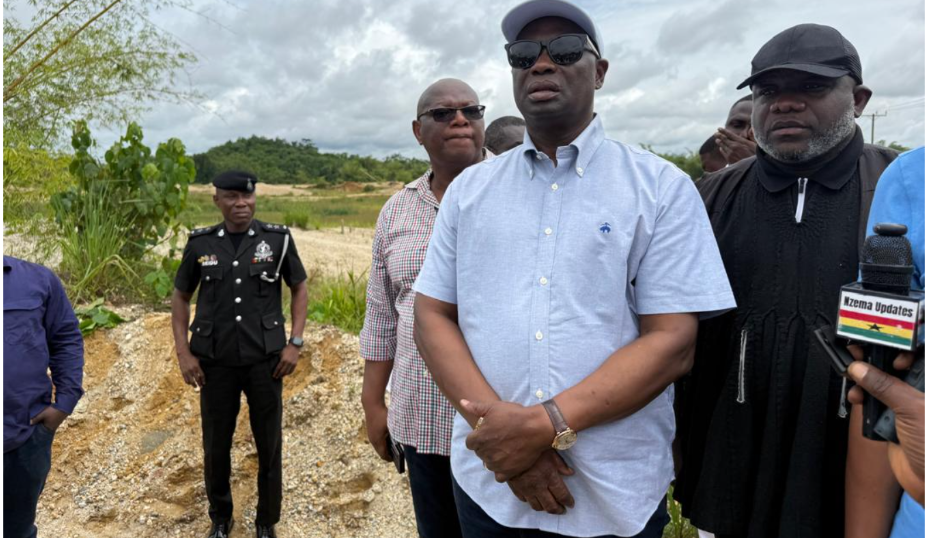
About 800 acres of heavily degraded land along the River Subri in Nkroful in the Western Region have been earmarked for full-scale restoration as government intensifies efforts to reclaim lands destroyed by illegal mining activities, popularly known as galamsey.
The latest intervention forms part of a broader nationwide environmental recovery programme being spearheaded under the administration of President John Dramani Mahama to reverse years of ecological destruction caused by illegal mining across forest reserves, river bodies, and farming communities.
The reclamation project in Nkroful, the birthplace of Ghana’s first President, Dr Kwame Nkrumah, is expected to involve large-scale reforestation, sealing of dangerous abandoned mining pits, detoxification of polluted lands, and long-term ecological rehabilitation.
Government officials say the initiative represents one of the most aggressive land restoration campaigns in recent years as authorities seek to restore public confidence in the fight against illegal mining while rebuilding damaged ecosystems.
Dangerous pits threaten communities
The 800-acre stretch along the River Subri has suffered years of unregulated mining activities that left behind vast open pits, many filled with rainwater and posing serious dangers to surrounding communities.
Residents say the abandoned pits have become death traps, particularly for children.
Nkroful Agriculture Senior High School remains one of the worst affected institutions in the area.
Only months ago, a student of the school reportedly drowned in one of the abandoned mining pits located behind the school campus, highlighting the growing human cost of environmental degradation.
Minister for Lands and Natural Resources, Emmanuel Armah-Kofi Buah, described the situation as deeply emotional and personal during the official handover of the degraded land for restoration works.
“My own school is affected by illegal mining activities, and it’s sad. When I go there sometimes I feel like crying. This is a school that made me literate,” he stated.
Communities including Nkroful, Bokazo and Anwia have all suffered extensive land destruction due to illegal mining operations.
Govt launches large-scale ecological recovery
Under the reclamation programme, thousands of cassia and teak seedlings are expected to be planted across the degraded landscape to stabilise soils, restore biodiversity and gradually return the land to productive use.
Environmental experts selected cassia and teak because of their rapid growth characteristics and strong soil recovery properties.
Government has handed over the site to RM Ecorestore Ghana Limited, which will oversee the restoration and reforestation exercise.
Speaking during the groundbreaking ceremony, Mr Armah-Kofi Buah reaffirmed government’s commitment to environmental stewardship and sustainable land management.
“The Mahama administration is determined to reverse the damage caused by years of irresponsible mining, especially in our forest reserves and farming communities,” he stressed.
According to the Minister, the intervention falls under two major flagship environmental initiatives being pursued by government — the Tree for Life Programme and the Blue Water Programme.
Since assuming office, President Mahama has repeatedly signalled that environmental restoration and protection of water bodies would remain central to his administration’s governance agenda.
Restoration to create jobs
Beyond ecological recovery, officials say the reclamation programme is also expected to generate significant employment opportunities for residents within affected communities.
The project will create direct jobs in seedling production, tree planting, plantation management, water management, and long-term forestry maintenance.
Authorities believe this could provide alternative livelihoods for some residents whose economic activities were disrupted by illegal mining operations.
The restoration exercise itself will be carried out in phases.
According to officials of Ecorestore Ghana Limited, the first stage will involve backfilling dangerous pits and reshaping the destroyed land.
Lead Operational Director of Ecorestore Ghana Limited, Nana Kyeame Ampratwum, explained that water management would become a major component of the restoration process.
This will involve de-ponding, dewatering, and proper water channelling systems across the damaged sites.
“We will then check the turbidity level of the soil. If there is mercury or any other contaminant in the soil, we will remove it,” he explained.
He added that the reclamation effort would also help improve the quality of the River Subri, which has suffered severe pollution from years of illegal mining activities.
Private sector partnership easing state burden
The restoration project is being funded by Zijin Golden Ridge Limited, a large-scale mining company operating in Akyem.
Officials say the arrangement will significantly reduce the financial burden on government while accelerating land recovery efforts nationwide.
The partnership was brokered by the Minister for Lands and Natural Resources and is expected to save the state millions of cedis in reclamation costs.
Nana Ampratwum commended the government for prioritising environmental restoration and praised the Minister’s direct involvement in the initiative.
“The Minister has shown hands-on leadership and commitment to seeing the project through,” he stated.
Similar projects already showing results
Government officials say the Nkroful intervention builds on earlier successful reclamation projects in other parts of the country.
A similar restoration programme at Nyankumase in the Amansie South District of the Ashanti Region has already transformed previously abandoned mine lands into thriving cassia and teak plantations.
The National Alternative Employment and Livelihood Programme (NAELP) also reported reclaiming more than 1,000 hectares of galamsey-degraded land in the Western North Region in 2023.
In February 2026, the Ministry of Lands and Natural Resources further announced the successful reclamation of 320 hectares of degraded land at Manso Nyankomanse in the Ashanti Region.
The project covered 240 hectares at Nyankomanse and another 80 hectares at Asare.
Huge national reclamation burden remains
Despite ongoing interventions, officials acknowledge that Ghana still faces a massive environmental restoration challenge.
Current estimates indicate that the country’s reclamation obligations range between 5,500 hectares and 9,000 hectares of degraded land nationwide.
Environmental advocacy groups warn that the financial cost of restoring destroyed lands could be enormous.
The Media Coalition Against Illegal Mining has estimated that reclaiming just 3,000 hectares of degraded land could cost approximately US$120 million, based on average reclamation costs of about US$40,000 per hectare.
Officials say the scale of destruction underscores the urgent need for stronger enforcement against illegal mining activities while accelerating rehabilitation projects across the country.
Government insists that no land destroyed by illegal mining should be abandoned permanently, stressing that all degraded areas must eventually be restored into productive ecological and economic assets for future generations.