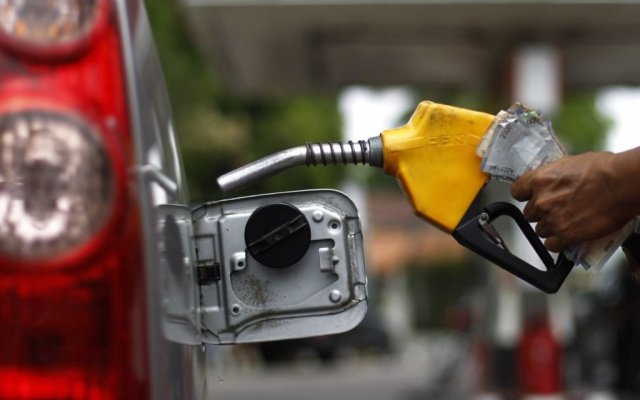
The government has announced a temporary intervention to absorb GH¢2.00 per litre on diesel and GH¢0.36 per litre on petrol, effective April 16, 2026, in a bid to shield Ghanaians from the full impact of rising global crude oil prices triggered by the ongoing Israel-US war against Iran.
The measure, approved by Cabinet and announced by Felix Kwakye Ofosu, Spokesperson to the President and Minister for Government Communications, will remain in force for one month, during which the government will closely monitor global oil market developments.
The intervention comes after crude oil prices surged from $63 per barrel on February 26, 2026, to a peak of $102 last Monday on the WTI Futures, following the closure of the Strait of Hormuz, through which approximately 20 per cent of global crude oil supply passes.
“Since the beginning of the conflict, there has been significant restriction. This has led to an increase in crude oil prices and a significant increase in insurance premiums and other such costs. That is what has accounted for the increases we have seen in the last two pricing weeks,” Mr Kwakye Ofosu explained.
Three-pronged approach to cushion consumers
The announcement follows a Cabinet meeting chaired by President John Dramani Mahama on April 9, 2026, at the Jubilee House, where three major directives were issued to mitigate the impact of rising fuel prices.
First, Cabinet instructed the Ministers of Finance, Dr Cassiel Ato Forson, and Energy and Green Transition, Dr John Abdulai Jinapor, to take immediate steps to reduce fuel prices through the temporary removal of some taxes and margins within the petroleum price build-up. The adjustments are expected to take effect within the next pricing window.
“This intervention is intended to cushion customers and ease the cost burden on households, transport operators, and businesses,” the government statement read.
Metro Mass buses to be deployed on high-traffic corridors
Second, the Minister of Transport, Joseph Nikpe, has been charged with ensuring the rapid deployment of newly acquired buses for Metro Mass Transit Limited, particularly on high-traffic corridors.
Mr Kwakye Ofosu reminded the public that President Mahama had announced the arrival of the first batch of 100 MMT buses over the weekend, with a second batch of 100 expected in August 2026 and a final batch of 100 in November, bringing the total to 300.
“Currently, we have 100 available, and the Transport Minister has been instructed by Cabinet to ensure expedited deployment of these buses in high traffic corridors to alleviate any difficulties that may have arisen out of the recent price increases,” he said.
Lower fares for Metro Mass
Third, Cabinet directed that both new and existing MMT buses charge transport fares lower than those of private sector operators.
“This is to ensure that Ghanaians are cushioned, especially when we reach peak periods at rush hours,” Mr Kwakye Ofosu added.
Presidential directive on fuel allowances
The Minister also revealed that President Mahama used the Cabinet meeting to remind all ministers, senior government officials, and appointees to adhere strictly to his ban on fuel allowances and the allocation of fuel. No further details were provided on the specific taxes or margins to be removed.
Context of external shocks
Mr Kwakye Ofosu noted that prior to the external shocks from the conflict, the country had enjoyed a very stable economic environment that had significantly cushioned Ghanaians.
Crude oil had been trading in the region of $60 per barrel since January 2026, resulting in lower fuel prices at the pumps. However, following the escalation of the Israel-US war against Iran, which began on February 28, 2026, prices started trending upward, particularly after the closure of the Strait of Hormuz.
After peaking at $102, crude prices trended downwards to $93 last Wednesday upon the announcement of a ceasefire, before rising again to $95 as of yesterday.
On behalf of the government, Mr Kwakye Ofosu assured the public that the measures were designed to prevent further economic fallout and protect Ghanaians from the full impact of external shocks.
“Government remains committed to maintaining price stability, protecting livelihoods, and supporting Ghana’s economic recovery in the face of external shocks,” the statement concluded.
GraphicOnline