In 2012 when Jason Atta Kwei Arday was only 27, he wrote these words to himself: “One day I will work at Oxford or Cambridge”. For somebody who did not speak until he was eleven and could not read or write until he was eighteen, this must have been an arduous task for young Arday.
Even more difficult was the environment he was born and grew up in, being the son of immigrant parents in Clapham, megapolitan London, where being black is anything but colourful, and everything but an advantage.
His parents, Ghanaians of proud Ga heritage, didn’t forget to remind him of his ancestral origins, Ghana, where he is called Atta Kwei.
Cultural warzone
While many kids his age were ticking developmental milestones and showing great promise, Jason had been diagnosed with autism and was missing common milestones.
His girlfriend who would later become his wife and mother of his two kids, Debbie-Ann Mckenzie, taught him phonics and how to read.
They had worked together at a sporting goods store when Jason was only 18.
In 2019, the marriage collapsed due to what is reported to be Jason’s “hyperfixation on his academic career” and constant travels.
It is most ironic that a bookish sociologist who poured all his life into books, would later be treated with disdain by bullish bookfellows.
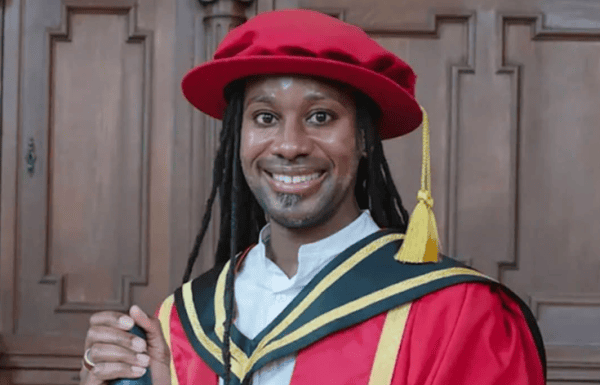
Jason had become the youngest black professor at Cambridge University when he was 37, after completing a PhD at Liverpool John Moores University.
Starting his academic career at Southfield College, he taught at Brunel, St Mary’s, Durham, Glasgow, and also boasted what looked like an impressive record of being an Olympic torchbearer, a marathon runner and a $multimillion fundraiser for charities.
Jason had become a respected voice on race, inclusion, and inequality in the UK, quickly achieving national prominence for his campaign for increased participation in higher education for the British people.
Last week, when Jason was found dead at 41, a popular psychiatrist wrote that “Jason’s was a case of sitting on the hot seat in a cultural warzone”, or “like taking a coveted job in a toxic environment.”
Not for Atta Kwei
Now, let’s hit a pause on Jason and find out about the following names: Anna Lora-Wainwright.
Willian O’Rielly. David Latchman. Ross Holmes. Fiona Lyall. Nicola Morrison. Neil Winn.
Nobody remembers these honorable academics who once upon a time were found to have plagiarised substantial portions of their thesis and research data, including one who actually copied the work of a student he was supervising.
Another was found to have borrowed from familiar sources for nearly 70% of his research portfolio.
Most of them are still reportedly working at the same institutions where their plagiarism was detected.
Generally, the practice is that institutions have learnt to keep it quiet when such scandals erupt, often to save their reputation and protect their funding streams and scholarships.
Not for our Jason. What is common with the names above and the thousands of research papers that are either cited for academic fraud or peer review infractions, is that none of them has Atta Kwei as their middle name.
We have conveniently forgotten the name of the President of an Ivy League university who resigned when he was found to have plagiarized huge data for his PHD research.
When initial plagiarism allegations surfaced about Jason Arday’s PhD work, the institution that granted him the PhD–Liverpool John Moores University–came out to defend him, explaining that while there may be errors in Arday’s work, they did not altogether render the entire work unscholarly or fraudulent. Cambridge, his present employers before his death, had initially stood by him until later opening further investigations when the allegations wouldn’t stop.
In 22 days, the British media published 250 articles about Jason’s plagiarism saga, mostly lampooning him.
Comeuppance
Even when Jason resigned from Cambridge on 5th August, clearly stating in his letter that “the decision should not be interpreted as an acceptance of the narratives that have surrounded” him but of “someone who has reached the limits of what any person should reasonably be expected to endure”, the British media pounded him with an additional 188 articles, to thump down a man who had already agreed to go down.
Not that if he was wrong, he should be made to stand because he is black; what appears wrong about Jason’s case is why a learned society that knows all about mental health, didn’t seem to care about the mental state of the person at the centre of international bullygate: an autistic boy.
I got these facts from Solomon Buchi, a British-Nigerian author who also makes some startling comparisons about how selective the bullish British media could be.
Solomon questions why the British media had suddenly lost their pounding energy “when Rachel Reeves lied on her CV, and when Jonathan Reynolds falsely claimed to be a solicitor”, and why they kept quiet about Prince Adrew’s Epstein files.
Jason’s PHD plagiarism transgressions and the subsequent ‘forgiveness’ by the institution that awarded him the degree, may be compared to a cheating husband who has been forgiven by his wife.
Would the wife take back her forgiveness when she finds out the woman he had cheated with was uglier or more beautiful?
In many cases of academic fraud, the matter would have ended when Liverpool and Cambridge cleared Jason. But the media pounded.
And pounded. And pounded until Jason was hounded to death on August 15 at his Buttersea home.
Now, they get their comeuppance, ‘se asa’; Ghanaian musician Nana Tabiri, will sing for them.
Kwesi Tawiah-Benjamin
Tissues Of The Issues
bigfrontiers@gmail.com
Ottawa, Canada