Ghana’s merchandise exports reached US$22.44 billion in the first eight months of 2026, up from US$17.94 billion over the corresponding period of 2025.
The US$4.50 billion increase represents a 25.1% year-on-year growth in export earnings, with gold accounting for the bulk of the expansion.
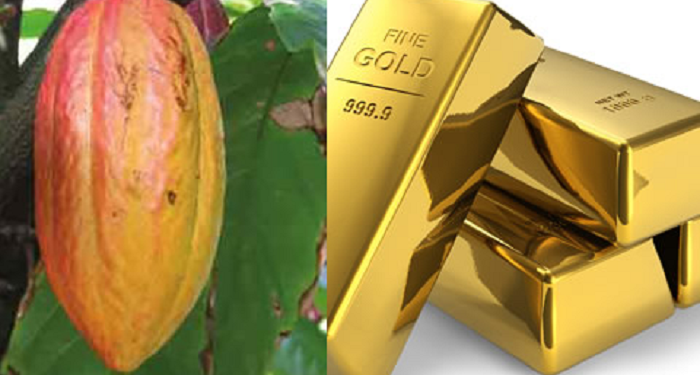
According to the Bank of Ghana’s Summary of Economic and Financial Data released on September 23, 2026, gold exports rose from US$11.18 billion in the first eight months of 2025 to US$14.86 billion in the same period of 2026.
That represents an increase of US$3.68 billion, or 32.9%.
Gold alone accounted for about two-thirds of Ghana’s total merchandise export earnings during the period and contributed roughly 82% of the overall increase in exports.
The performance underscores the importance of gold to Ghana’s external sector, while also highlighting the extent to which the country’s export position remains exposed to developments in the international precious-metals market.
Cocoa and oil exports also record gains
Cocoa exports increased from US$2.47 billion to US$2.76 billion, representing a 12% increase over the period.
The rise in cocoa export receipts came despite a decline in the average realised export price, which fell from US$5,100.5 per tonne in August 2025 to US$4,131.8 per tonne in August 2026.
This suggests that higher export volumes helped offset the decline in prices.
Crude oil exports also recorded strong growth, rising from US$1.83 billion to US$2.42 billion, an increase of 32.9%.
The increase was supported by higher crude oil prices, with Ghana’s average realised export price rising from US$68.9 per barrel to US$86.5 per barrel.
Meanwhile, receipts from other exports declined by 3.0%, from US$2.46 billion to US$2.39 billion.
The performance indicates that the growth in Ghana’s exports was not evenly distributed across all categories, with gold providing the largest contribution.
Imports rise at a slower pace
Ghana’s import bill also increased during the period, although at a slower pace than exports.
Total merchandise imports rose by 20.8%, from US$11.24 billion in the first eight months of 2025 to US$13.59 billion in 2026.
Oil imports recorded the sharpest increase, rising by 47.5% from US$3.25 billion to US$4.80 billion.
The US$1.54 billion increase in oil imports accounted for about 66% of the total growth in the import bill.
Higher international oil prices were a major source of pressure, with Brent crude averaging US$88.1 per barrel in August 2026, compared with US$67.3 per barrel a year earlier.
Non-oil imports increased by 10%, from US$7.99 billion to US$8.79 billion.
Trade surplus widens
The stronger growth in exports relative to imports resulted in a trade surplus of US$8.86 billion in the first eight months of 2026.
This compares with a surplus of US$6.69 billion over the corresponding period of 2025.
As a share of GDP, the trade surplus increased from 5.9% to 6.7%.
The figures show that Ghana generated significantly more foreign exchange from merchandise exports than it spent on merchandise imports during the period.
However, the trade surplus should not be interpreted as an equivalent increase in the Bank of Ghana’s foreign exchange reserves.
Export proceeds can remain within commercial banks or private-sector accounts and may also be used to meet external obligations, including payments for services, income transfers, debt servicing and profit repatriation.
The central bank may also use its reserves to meet public-sector foreign exchange obligations or supply dollars to the domestic market. Changes in asset valuations and movements in earmarked funds can further affect the reported reserve position.
The available data therefore do not provide a complete explanation for changes in reserves or allow the entire movement to be attributed to a single factor.
Reserves and the external position
Gross international reserves stood at US$11.07 billion at the end of August 2026, providing 4.2 months of import cover.
This compares with US$10.92 billion, equivalent to 4.6 months of import cover, in August 2025.
By September 22, 2026, gross international reserves had increased further to US$12.05 billion, providing 4.5 months of import cover.
Net international reserves stood at US$8.69 billion in August 2026, compared with US$8.68 billion a year earlier.
The value of the Bank of Ghana’s gold holdings stood at US$3.57 billion in August 2026, representing 25.2 tonnes.
This was higher in value than the US$3.33 billion recorded in August 2025, although the volume of gold holdings was lower than the 36 tonnes reported a year earlier.
The value of the central bank’s gold holdings had risen from US$3.04 billion in March 2026, while physical holdings increased from 20.8 tonnes to 25.2 tonnes over the same period.
The figures highlight the importance of looking beyond the headline reserve number to the composition, accessibility and liquidity of the assets supporting Ghana’s external position.
Current account surplus widens
The improvement in merchandise trade has also been reflected in Ghana’s broader external accounts.
The current account recorded a surplus of US$5.11 billion, equivalent to 3.8% of GDP, as of June 2026.
This compares with a surplus of US$4.15 billion, or 3.6% of GDP, in June 2025.
Private inward transfers, however, declined from US$3.93 billion to US$3.65 billion over the same period.
The financial account, excluding reserve assets, recorded a surplus of US$6.85 billion as of June 2026, compared with US$2.05 billion a year earlier.
Cedi continues to face pressure
The stronger trade position has not eliminated pressure on the Ghana cedi.
The interbank exchange rate stood at GH¢11.25 to the US dollar at the end of August 2026, representing a year-to-date depreciation of 7.1%.
By September 18, the rate had moved to GH¢11.55 per dollar, taking the year-to-date depreciation to 9.5%.
The figures therefore present a mixed picture of Ghana’s external sector.
On one hand, export earnings have increased significantly, the trade surplus has widened and the current account remains in surplus.
On the other hand, the growth in exports is heavily concentrated in gold, while other export receipts have declined and oil imports have risen sharply.
Gold accounted for about 66% of total exports and roughly 82% of the increase in export earnings during the first eight months of the year.
This concentration means Ghana’s external performance remains sensitive to movements in global commodity markets.
For the gains to become more broad-based and durable, stronger growth in non-traditional exports and greater domestic value addition will be important in expanding the country’s sources of foreign exchange earnings and reducing exposure to commodity price cycles.