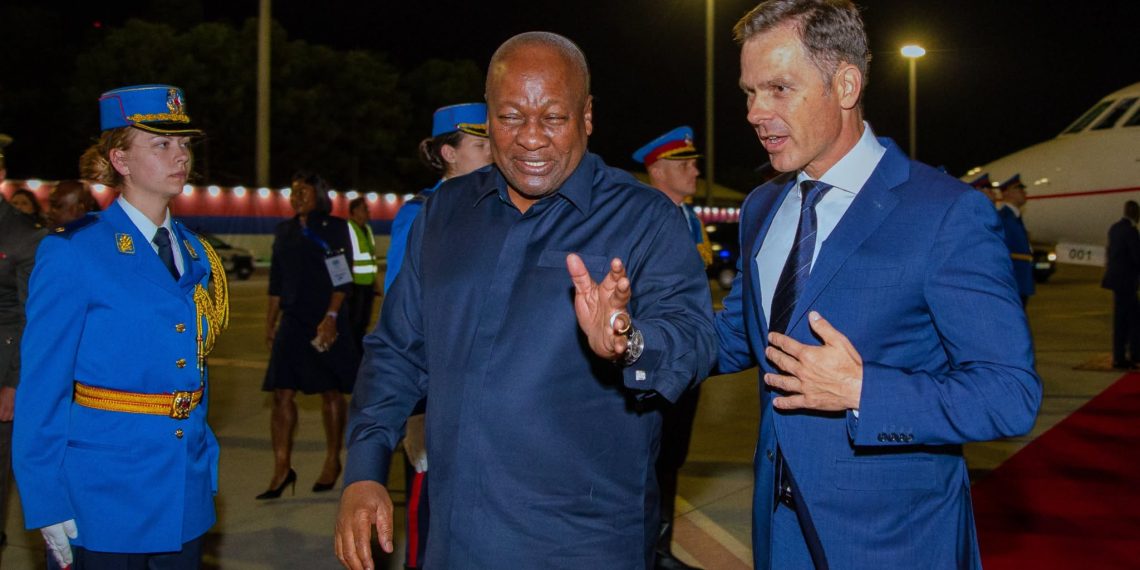
President John Dramani Mahama has arrived in Belgrade, Serbia, to participate in a high-level meeting commemorating the 65th anniversary of the Non-Aligned Movement (NAM).
The meeting is being hosted by Serbian President Aleksandar Vučić and brings together leaders and representatives to reflect on the history, principles and continuing relevance of the movement.
President Mahama’s participation underscores Ghana’s longstanding association with the Non-Aligned Movement and the country’s historical contribution to its formation and development.
Ghana was among the founding members of NAM in 1961, when countries emerging from colonialism and seeking to pursue independent foreign policies came together around the principles of sovereignty, non-interference and peaceful coexistence.
Ghana’s association with the movement is closely linked to the country’s first President, Dr Kwame Nkrumah, who played a prominent role in shaping the vision that ultimately led to the establishment of NAM.
Dr Nkrumah worked alongside other influential leaders of the period, including former Yugoslav President Josip Broz Tito, former Indian Prime Minister Jawaharlal Nehru, former Egyptian President Gamal Abdel Nasser and former Indonesian President Sukarno.
These leaders were instrumental in advancing the idea of a collective platform for countries that did not wish to align themselves with either of the major power blocs during the Cold War.
The movement was formally established in 1961 in Belgrade, making the Serbian capital particularly significant to its history.
The Non-Aligned Movement has evolved since its formation and continues to provide a platform for developing countries to coordinate positions on international political, economic and security matters.
Its founding principles included respect for national sovereignty and territorial integrity, opposition to colonialism and racial discrimination, and the peaceful resolution of international disputes.
The 65th anniversary meeting in Belgrade provides an opportunity for participating countries to reflect on these principles while considering the role of the movement in addressing contemporary global challenges.