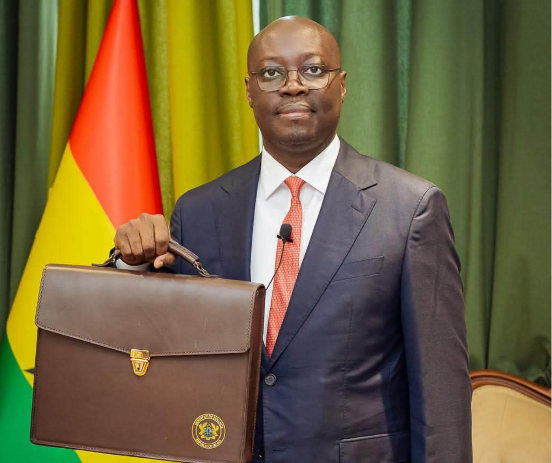
Finance Minister Dr Cassiel Ato Forson has admitted criticisms that the government’s limited spending approach is affecting its ability to inject more resources into the economy to stimulate growth, but blamed the situation on fiscal commitments inherited from the previous New Patriotic Party (NPP) administration under Ghana’s $3 billion International Monetary Fund (IMF) programme.
Dr Forson defended the government’s restrained expenditure policy, arguing that the Mahama administration cannot abandon the fiscal conditions attached to the IMF deal simply because there has been a change in government.
He said the current administration inherited binding commitments made by the Akufo-Addo government when it secured the IMF support package, including a requirement to achieve a primary surplus of 1.5% of Gross Domestic Product (GDP).
Speaking on Joy News’ PM Express shortly after presenting the 2026 Mid-Year Budget Review to Parliament, Dr Forson said the fiscal restrictions were not introduced by the current government but formed part of the agreement signed with the IMF.
“The NPP committed Ghana into an IMF programme, signed an agreement with the IMF and borrowed $3 billion from them, and committed us, this government, that we would do 1.5% of GDP,” he said.
“This was the commitment the NPP made to the IMF, and took the money, of which by the time they were leaving office, they had spent three quarters of the $3 billion,” he added.
The Finance Minister explained that the IMF’s agreement was with the Republic of Ghana rather than any political party, making it the responsibility of the current government to honour the commitments attached to the programme.
“Now, I have come as Minister of Finance. The IMF does not deal with political parties; it deals with governments and countries. I have a responsibility to achieve 1.5% of GDP. Are you telling me that I should default on the promises of which government of Ghana has taken a loan from the IMF? Certainly no,” he stated.
Dr Forson said meeting the fiscal targets had been crucial to Ghana’s successful implementation of the IMF programme and the country’s progress towards exiting the arrangement.
He explained that compliance with the conditions allowed the IMF to certify that Ghana had met the requirements for continued support and eventual completion of the programme.
“I have to make sure that this condition is met, and it is for that reason that the IMF is bold enough to go to their board that Ghana has achieved all the conditionalities for which they loaned us, and so Ghana is actually exiting the IMF programme,” he said.
The Finance Minister expressed confidence that government would surpass the agreed fiscal target, indicating that the current pace of consolidation had created some room for additional spending later in the year.
“This is a commitment that the people of Ghana and the government of Ghana must fulfil, and I can tell you that I am on course to fulfil this,” he said.
“I’ve done 0.9, and so by the end of the year, even if you annualise 0.9 halfway times two, it will be 1.8. It means getting to the end of the year, I will have room to be able to spend 0.3% more, and that is what it means,” he added.
Dr Forson rejected suggestions that the spending restraint was a deliberate policy choice by the Mahama administration, insisting that the ceiling was imposed by the IMF programme.
“This is a commitment. I did not set the target. It was actually a conditionality under the IMF programme,” he stressed.
His comments followed concerns that government’s cautious spending approach could slow economic expansion, with some critics arguing that increased public expenditure was needed to support growth, infrastructure development and job creation.
However, Dr Forson argued that abandoning fiscal discipline would threaten Ghana’s economic recovery and risk returning the country to another financial crisis.
Responding to suggestions that government deserved credit for controlling expenditure, the Finance Minister said increasing spending outside the agreed framework could undermine the gains made under the IMF-supported programme.
“Oh no, but do you want me to spend and derail the IMF programme? Is that what they want me to do?” he questioned.
He warned that breaching the agreement could reverse economic gains and force Ghana back into a crisis similar to the period that led to debt restructuring.
“It is President Akufo-Addo and his government that took Ghana to the IMF and agreed to this conditionality, unless they want me and President Mahama, because it’s President Mahama’s budget, to derail the IMF programme, so that we spend as if there’s no tomorrow, crash the economy again, and go back to economic crisis with a haircut,” Dr Forson said.
The Finance Minister’s remarks highlight the government’s balancing act between maintaining IMF-backed fiscal discipline and responding to demands for increased public investment to accelerate economic growth.