The government’s proposal to reduce the Ghana National Petroleum Corporation’s (GNPC) initial carried interest in petroleum agreements from 15 per cent to 10 per cent has opened a fundamental question about how much of the country’s petroleum wealth it is prepared to secure for the state in its pursuit of foreign investment.
At a time when GNPC is positioning itself to become a technically competitive indigenous oil operator, expanding exploration, developing marginal fields and building the capacity of Ghanaian businesses to participate in the upstream industry, the proposed reduction raises questions about the strategic value the country places on its ownership stake in newly negotiated petroleum agreements.
Why should Ghana surrender five percentage points of its initial carried interest to attract investors? What evidence suggests that reducing the national oil company’s stake will unlock sufficient additional investment to compensate for the state’s smaller ownership position? And what guarantees will ensure that the anticipated investment gains translate into higher production, jobs, technology transfer and greater long-term petroleum revenues for the country?
These are questions that the government must answer as it prepares to overhaul the country’s petroleum fiscal and regulatory framework.
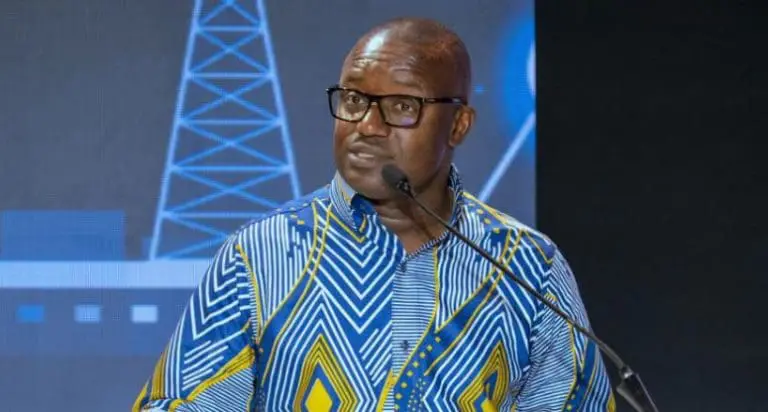
The Minister of Energy and Green Transition, Dr John Abdulai Jinapor, announced the proposed reduction at the 2026 Local Content Conference and Exhibition in Takoradi, describing it as part of a package of reforms intended to make Ghana’s petroleum sector more attractive to investors and revive exploration and production.
The proposal would reduce GNPC’s initial carried interest from 15 per cent to 10 per cent in petroleum agreements, alongside changes to royalty payments, tax arrangements, bonuses, exploration periods and the duration of petroleum agreements.
However, the proposed reduction is particularly consequential because GNPC’s 15 per cent initial participating carried interest is not merely a discretionary concession in an individual contract. It is embedded in Section 10(14) of the Petroleum (Exploration and Production) Act, 2016 (Act 919), which requires petroleum agreements to provide the Corporation with an initial carried interest of at least 15 per cent for exploration and development.
Consequently, the proposed reduction would require legislative amendment. It is not simply an administrative adjustment that the government can implement without changing the existing statutory framework.
Under the carried-interest arrangement, GNPC holds an equity interest in petroleum operations while the private contractor bears the exploration and development costs associated with that interest. The arrangement allows the state to participate in petroleum projects without immediately financing its share of the substantial upfront exploration and development expenditure.
Reducing that interest to 10 per cent would therefore lower the Corporation’s initial ownership position in future petroleum agreements, although the actual financial implications would depend on the terms of individual agreements, the commercial success of discoveries and the volume of production.
Investment argument versus national ownership
Dr Jinapor has defended the proposed reforms on the grounds that Ghana must improve its competitiveness in the global search for petroleum investment, particularly as exploration becomes increasingly expensive and technically challenging.
The government believes that more attractive fiscal terms could encourage international oil companies to commit capital to Ghana’s offshore, ultra-deepwater and frontier acreage, where exploration risks and costs are considerably higher.
In defending the proposed reduction, the Minister has argued that Ghana could derive greater value from a smaller percentage of a much larger petroleum investment than from retaining a higher percentage in a sector that attracts limited capital.
His argument has been captured in his comparison that he would rather have 10 per cent of US$1 billion than 15 per cent of a much smaller investment.
The Energy Year
That argument, however, leaves open the question of how much additional investment the reduction is expected to generate, how quickly the benefits will materialise and whether the increased activity will compensate for the reduced state participation over the lifetime of the petroleum agreements.
The government has yet to provide, in the announcement, a quantified assessment of the additional investments expected specifically from reducing GNPC’s carried interest from 15 per cent to 10 per cent.
Neither has it publicly demonstrated how the proposed reduction compares with alternative incentives that could attract investors without reducing the national oil company’s initial ownership stake.
The government must therefore explain why reducing GNPC’s interest is necessary and whether the same investment objectives could be achieved through a more targeted adjustment of the petroleum fiscal regime.
A contradiction with GNPC’s expansion ambitions?
The proposal also comes at a time when GNPC is outlining an ambitious programme to strengthen its position as an indigenous petroleum operator and expand Ghanaian participation in the upstream industry.
At the same conference, GNPC Chief Executive, Mr Kwame Ntow Amoah, said the Corporation was pursuing a long-term strategy to develop the technical, commercial and institutional capabilities required to take on greater responsibilities in petroleum exploration and production.
“Our long-term ambition remains to transform GNPC from an emerging operator to a world-class operator, technically proficient, commercially competitive and able to manage complex petroleum assets to deliver sustainable value for Ghana,” he said.
He outlined plans to expand the operational role of GNPC Explorco and establish two strategic subsidiaries to handle oil and gas trading and shared services.
The proposed subsidiaries are expected to create opportunities for partnerships with Ghanaian and international investors, with the possibility of eventual stock exchange listings to broaden Ghanaian equity participation.
The question is whether reducing GNPC’s initial carried interest will strengthen or weaken the Corporation’s ability to build the asset base, financial capacity and institutional experience needed to become a world-class operator.
A smaller initial stake does not automatically mean that GNPC will be unable to expand its participation through additional paid interests. However, it makes the terms governing such future participation, including the availability of capital to acquire additional interests, particularly important.
The government must clarify whether the proposed five-percentage-point reduction will be accompanied by arrangements that preserve GNPC’s ability to increase its ownership in commercially viable discoveries and participate meaningfully in subsequent development and production.
One billion barrels of oil, 2.5 trillion cubic feet of gas
GNPC’s expansion plans are not limited to its existing offshore interests.
Mr Ntow Amoah disclosed that the Corporation’s marginal fields development programme was designed to unlock approximately one billion barrels of oil and 2.5 trillion cubic feet of gas through a cluster-based development model.
The approach is intended to improve the commercial viability of discoveries that might otherwise remain undeveloped by bringing together resources and shared infrastructure.
He also announced progress towards drilling the first exploration well in the Voltaian Basin before the end of 2026.
Conductor casings had been transported to the drilling site, while contractual processes were being pursued to enable the mobilisation of Xibu Rig 70559.
The onshore exploration programme is expected not only to assess the Basin’s hydrocarbon potential but also to create opportunities for Ghanaian professionals and businesses to develop expertise in engineering, logistics, project execution and other aspects of petroleum operations.
These initiatives underline the strategic role GNPC is expected to play in expanding the country’s petroleum resource base and building indigenous technical capacity.
Yet, while the Corporation is being encouraged to assume greater operational responsibilities, the government is proposing to reduce its initial ownership entitlement in future petroleum agreements.
That apparent policy tension requires a convincing explanation.
Other concessions for oil companies
The reduction in GNPC’s carried interest is one of several proposed changes that could improve the financial and contractual terms available to petroleum operators.
The government intends to introduce a three-tier sliding-scale royalty regime based on water depth, replacing the existing approach with a structure that takes account of the different costs and risks associated with offshore operations.
It also plans to replace signature bonuses with commerciality bonuses, linking payments more closely to the commercial viability of petroleum discoveries rather than requiring upfront payments when agreements are signed.
Another major proposal is to replace the Additional Oil Entitlement with an R-factor-based Additional Petroleum Tax.
The government is also proposing to extend the tax-loss carry-forward period available to petroleum operators from five to 10 years, allowing companies more time to offset losses against future taxable profits.
Petroleum agreement durations are expected to increase from 25 to 30 years, while exploration periods could be extended and relinquishment requirements made more flexible for frontier and ultra-deepwater blocks.
Taken together, the proposals represent a substantial recalibration of the financial and regulatory terms governing petroleum investment in Ghana.
While the government maintains that the package is necessary to attract fresh capital, the cumulative effect of the concessions on the state’s overall petroleum revenue and ownership position will require careful scrutiny.
The critical issue is whether the expected increase in investment, exploration and production will outweigh the potential reduction in the state’s share of petroleum benefits.
Local content and the value retained in Ghana
The proposed reduction also raises questions about the government’s commitment to deepening local participation in the petroleum industry.
Mr Ntow Amoah said GNPC spent approximately US$3.67 million on locally sourced goods and services in 2025, while its vendor development initiatives engaged about 200 suppliers across 2025 and 2026.
In April 2026, the Corporation organised a procurement sensitisation workshop for 44 vendors to improve their understanding of procurement procedures and the Ghana Electronic Procurement System.
It has also engaged the Association of Ghana Industries to explore financing arrangements with financial institutions to help technically capable Ghanaian contractors overcome challenges involving performance guarantees and equipment financing.
The objective is to enable more indigenous companies to compete for higher-value contracts rather than remain confined to lower-value activities in the petroleum supply chain.
GNPC has also undertaken local content benchmarking missions to Nigeria, Senegal and Angola, alongside reviews of experiences in Norway and Brazil, to inform a more structured approach to local content development across the Corporation and its subsidiaries.
It has further launched its first Graduate Trainee Programme, recruiting 75 graduates for two years of experiential training and mentorship.
These initiatives reflect the Corporation’s stated ambition to retain more technical expertise, procurement opportunities and economic value within Ghana.
But the government must explain how the reduction in GNPC’s carried interest fits into that broader local content strategy, particularly when the national oil company is expected to serve as a major vehicle for indigenous participation.
The accountability test
The government’s case for reducing GNPC’s carried interest ultimately rests on the expectation that more attractive investment conditions will lead to increased exploration, new discoveries, higher production and greater overall economic returns.
That proposition deserves serious consideration, especially given the capital-intensive nature of petroleum exploration and the need to reverse declining production and stimulate new discoveries.
But the government must provide more than the general assurance that a smaller state stake will attract larger investments.
It must disclose the economic modelling underpinning the proposed reduction, the additional investment expected, the anticipated production gains and the projected revenue implications for the state.
It must also explain whether the reduction will apply to all future petroleum agreements, how existing agreements will be treated and what safeguards will preserve GNPC’s ability to acquire additional participating interests.
Above all, the government must demonstrate that the reforms will not weaken the national oil company’s capacity to build an indigenous operating platform and secure a meaningful share of the country’s petroleum wealth.
The central test of the proposed reforms should not simply be how many international oil companies Ghana attracts or how many petroleum agreements it signs.
It should be whether the country secures better long-term returns from its natural resources, strengthens its national oil company, expands local participation and retains a greater proportion of the economic value generated by the industry.
The government has made the case for attracting investment. It must now explain why reducing GNPC’s carried interest is the price Ghana must pay to achieve that objective.