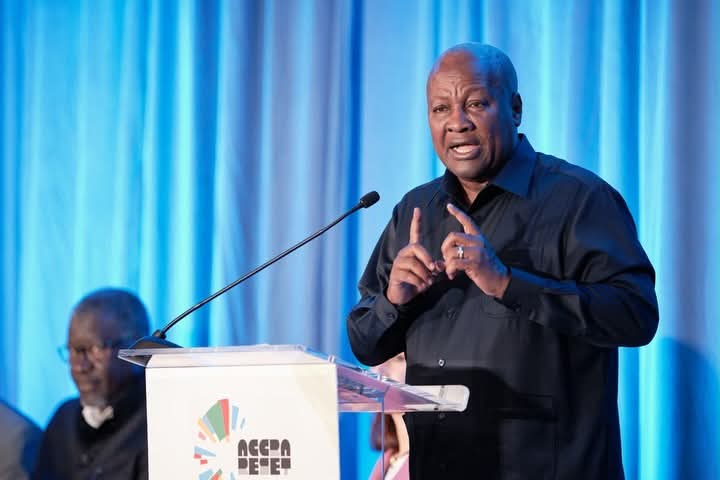
President John Dramani Mahama says the United States has approached Ghana to review a proposed health compact rejected by the government over concerns about national sovereignty, the sharing of sensitive health data and restrictions on the country’s regulatory powers.
He said the US government wanted the two countries to reopen discussions and identify provisions that Ghana considered unacceptable, with the possibility of changing or removing them.
President Mahama disclosed this during a citizens’ engagement in Goaso on the final day of his two-day Resetting Ghana Tour of the Ahafo Region.
“I have spoken about it at the time I was in New York, however they have come again and they want us to sit down and review the agreement, so that things that we are not happy about they would either change them or remove them. So, there is a way for us to sit down with them and have a dialogue on it,” he said.
The President had outlined Ghana’s objections to the proposed agreement during an address at the Council on Foreign Relations in New York on September 25, 2026, explaining why Cabinet decided against accepting the deal.
One of the government’s principal concerns was a requirement for Ghana to share national pathogen profiles and citizens’ private medical records with US authorities.
The government was also uncomfortable with provisions relating to ownership and long-term access to Ghanaian health data, as well as the legal framework governing disputes between the two countries.
President Mahama indicated that the proposed arrangement could leave Ghana with insufficient control over sensitive health information generated within its health system.
He also raised concerns that the agreement would restrict Ghana’s authority to inspect medicines and other medical products brought into the country under the programme.
The government considered these provisions unacceptable because they could compromise Ghana’s control over its health information, regulatory decisions and national health priorities.
Negotiations between the two countries began in November 2025. The proposed agreement would have provided Ghana with US$109 million in US health assistance over five years.
The deal formed part of the administration of US President Donald Trump’s “America First Global Health Strategy”, which places greater emphasis on bilateral agreements and seeks to shift more responsibility for financing health commodities and services to recipient countries.
Under the broader strategy, recipient countries are expected to contribute more towards the cost of health programmes alongside US assistance.
The US State Department has said it signed 32 agreements under the strategy, representing US$20.6 billion in funding, comprising US$12.8 billion from the United States and US$7.8 billion in co-investment from recipient countries.
However, Ghana’s concerns centred on whether the proposed terms adequately protected its national interests, particularly its authority over health data and the regulation of medical products.
The government was also concerned about the legal jurisdiction applicable to disputes arising from the agreement.
It argued that provisions requiring disputes to be settled under US law rather than Ghanaian law could weaken the country’s control over matters affecting its own health system.
The proposed long-term access to Ghanaian health data also raised questions about the ownership and potential commercial value of the information.
Health data have become increasingly valuable as companies and research institutions develop artificial intelligence-powered diagnostic tools, healthcare applications and medical research platforms.
Large datasets can support innovation and improve healthcare delivery, but they can also generate significant commercial and research benefits for organisations that control or process them.
Concerns have consequently grown across Africa about the extraction of valuable data by foreign organisations without adequate local control or a fair share of the resulting economic benefits.
Estimates cited in the debate put the annual value of African data mined externally at about US$40 billion.
For Ghana, the challenge is to ensure that international health partnerships improve healthcare delivery without compromising patient privacy, national data governance or the country’s ability to regulate medical products and services.
The US decision to seek a review offers an opportunity for both countries to address the disputed provisions through dialogue. Ghana’s position, however, suggests that any revised agreement would have to provide clear safeguards for sensitive health information, respect domestic laws and preserve the country’s regulatory authority.
The proposed compact could bring additional resources to Ghana’s health sector, but the government has made clear that the value of such assistance must be weighed against the obligations attached to it.
President Mahama’s disclosure signals that Ghana remains open to discussions, provided the concerns that led to the rejection are addressed.
The outcome of the renewed engagement will determine whether the two countries can reach an arrangement that supports public health while safeguarding Ghana’s sovereignty and citizens’ rights.