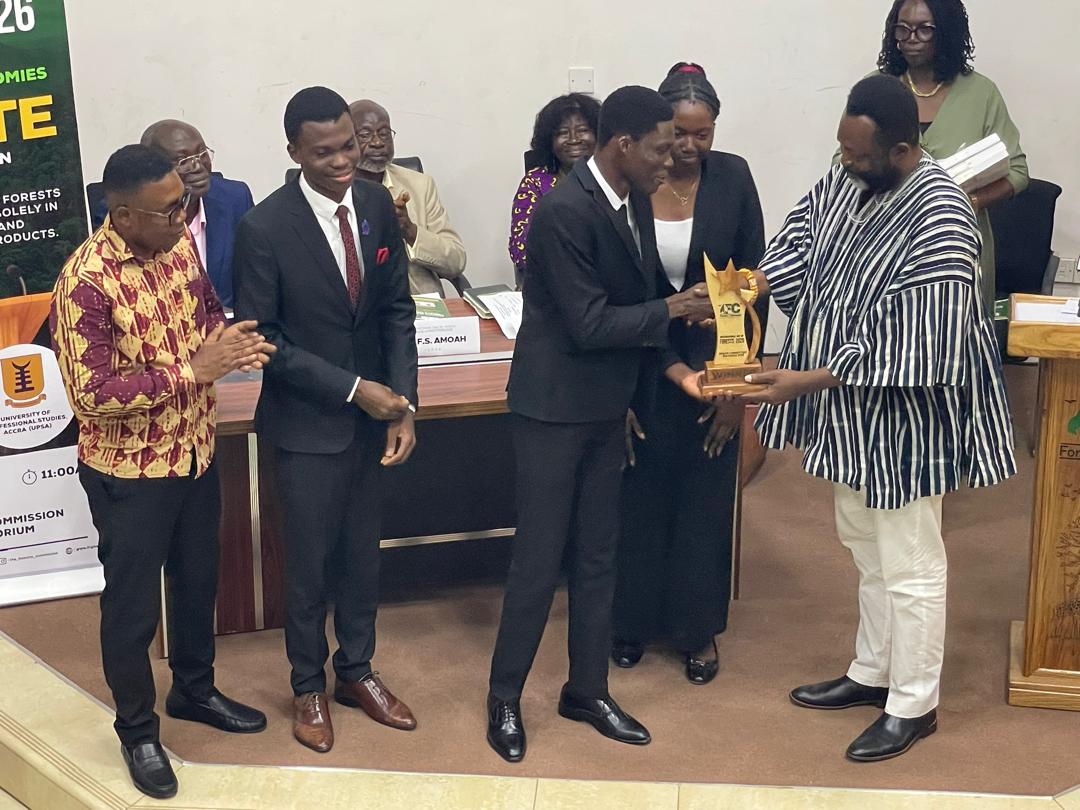
The University of Professional Studies, Accra (UPSA), has emerged winner defeating the University of Ghana in a keenly contested forestry economics debate organised by the Forestry Commission.
The debate formed part of activities marking the International Day of Forests 2026, celebrated under the theme: “Forests and Economies.” It brought together students, academics and policy enthusiasts to interrogate how forests should be valued in modern economic systems.
The motion for the debate. “The economic value of forests should be measured solely in terms of timber and non-timber forest products” sparked a lively and research-driven contest between the two institutions.
UG was represented by Andrew Kwasi Kattah and Deleye Temiloluwa Abundance, while UPSA fielded Richard G. Graham and Kelvin Kwame Ofosu.
Opening the debate for the motion, Andrew Kwasi Kattah of UG argued that economic signals derived from activities such as eco-tourism provided a reliable and measurable framework for valuing forests. He maintained that such metrics offered verifiability and certainty, thereby serving as critical safeguards for policy formulation and planning.
He emphasised that quantifiable outputs, including timber and non-timber forest products, remained the most practical indicators for integrating forest resources into national economic accounting systems.
However, leading the opposition, Richard G. Graham of UPSA challenged the narrow framing of forest valuation. While acknowledging the economic contributions of timber and non-timber products, he argued that relying solely on such measures was fundamentally flawed.
“You cannot separate the economic value of timber and non-timber products from the ecosystem that supports them,” he contended.
He explained that forests function as complex ecological systems that provide indispensable services,such as climate regulation, biodiversity conservation and water cycle maintenance,which form the very foundation of economic productivity.
According to him, reducing forest value to extractive outputs ignores the broader ecosystem services that sustain both livelihoods and long-term economic stability.
The UPSA team’s argument, which emphasised a more holistic valuation framework, ultimately resonated more strongly with the judges.
The panel of judges, chaired by Mr F. S. Amoah, with Prof. Kwame Antwi Oduro and Prof. Mercy Afua A. Derkyi as members, commended both teams for their depth of analysis and high-quality delivery.
In his remarks, the chairperson lauded the debate as a demonstration of strong academic grounding and rigorous research.
He noted that the perspectives advanced by the students provided valuable insights for policymakers, urging them to “think outside the box” when designing future policies on forest governance and economic valuation.
The competition ended with UPSA taking the top prize of GH¢20,000, while UG received GH¢15,000 as the first runner-up. All participants were awarded certificates and tablets in recognition of their efforts.
By DANIEL NONOR, Accra