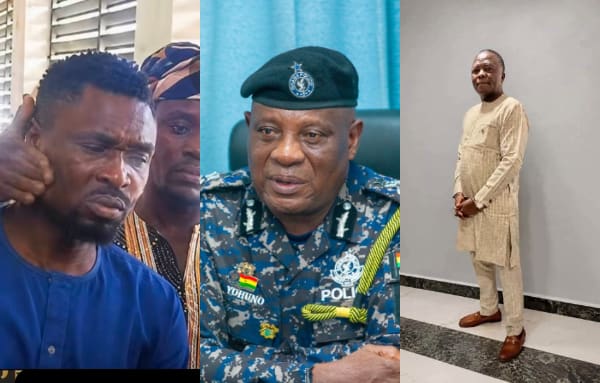
The Ghana Police Service and its leadership under Inspector-General of Police (IGP) Christian Tetteh Yohuno must answer serious questions over how a handcuffed suspect was assaulted by a civilian inside Police Headquarters in Accra.
The incident, involving Pastor Daniel Junior Yaw Adjei, has rightly triggered public outrage because it strikes at the heart of the Police Service’s most basic custodial responsibility: protecting people placed under its control.
A person in handcuffs and police custody is not available for public punishment.
Whatever allegations may have been made against him, he remains entitled to protection from violence and due process.
The central question for the Police is therefore simple: How did a civilian gain access to a handcuffed suspect being escorted by police officers inside the headquarters of the country’s principal law-enforcement institution?
The answer cannot simply be an announcement that an alleged assailant has been arrested.
The Police Service must explain how the security breach occurred, who was responsible for the suspect at the time, which officers were present and whether established custody and access-control procedures were followed.
Pastor Adjei was reportedly arrested on Wednesday, August 12, after a video allegedly showing him making derogatory comments about Prophet Mohammed circulated widely.
If the comments amounted to an offence, the proper response was investigation and prosecution. They did not give anyone the right to physically assault him.
Yet footage circulated on social media appears to show the handcuffed pastor being slapped by a civilian while under police escort.
That is a serious custodial failure. Police Headquarters Must Not Become a Place for Vigilante Justice
The location makes the incident even more disturbing.
Police Headquarters should be among the most secure facilities in Ghana.
Access to a suspect under arrest should be tightly controlled, particularly when that suspect is being escorted in handcuffs.
If a civilian was able to approach and assault a detainee in such circumstances, the Police must establish whether there was a failure of supervision, security, discipline or command.
The issue is therefore much bigger than the alleged slap.
It concerns whether the Police Service can guarantee the safety of people in its custody and whether officers understand that custody carries a duty of care.
The Police cannot credibly demand public confidence while failing to account for an apparent security breach occurring within its own headquarters.
Religion raises the stakes
The religious dimension makes the matter even more sensitive.
The incident reportedly followed alleged comments about the Prophet Mohammed, involved the arrest of a Christian pastor and allegedly resulted in the assault of that pastor by a man believed to be Muslim.
Ghana has a long and valuable tradition of peaceful Christian-Muslim coexistence. That peace must not be taken for granted.
Religious offence cannot become a licence for violence, just as religious identity cannot determine how the law is applied.
If Pastor Adjei committed an offence, he must face the law.
If another person assaulted him, that person must also face the law. There must be no double standards.
Any perception that one group can attack another with impunity would be dangerous for national cohesion.
Police must resolve identity questions
The Police have announced the arrest of a man identified as Sibamay Zakaria, whom they say was captured in the viral video assaulting Pastor Adjei.
However, questions have emerged on social media about whether the person arrested is actually the individual seen in the footage.
Such claims remain unverified and must not be treated as established facts.
But neither should they simply be dismissed. The Police have the resources and authority to establish the truth.
CCTV footage, the original video, witness statements, police reports, duty rosters and accounts from officers present should form part of the investigation.
If the arrested man is the assailant, the evidence should establish that clearly.
If he is not, the Police must explain how the wrong person came to be arrested.
Public confidence depends on getting this right.
Political claims must be investigated, not ignored
There are also allegations that the actual assailant may have political connections and is being protected because of alleged links to the governing National Democratic Congress and supporters of President John Dramani Mahama.
These claims remain unverified and should not be presented as fact.
But their circulation is itself significant. It demonstrates the level of suspicion surrounding the incident.
The best response from the Police is not simply denial. It is transparency.
The Service must show the evidence establishing the identity of the suspect, explain the circumstances of his arrest and account for how the alleged assault occurred inside Police Headquarters.
Interior ministry must hold the police to account
The Ministry of the Interior has directed the IGP to investigate the incident, establish how civilians gained access to the suspect and determine whether any police personnel facilitated, permitted or acquiesced in the breach.
It has also directed the Police to investigate the conduct of supervising officers responsible for the custody and supervision of the persons involved and take appropriate disciplinary action against anyone found culpable.
That directive must be followed through. It would be inadequate to arrest only the person alleged to have delivered the slap and declare the matter resolved.
The investigation must establish whether the incident resulted from individual misconduct or a wider institutional failure.
The Police Professional Standards Bureau must therefore go beyond a routine internal exercise.
Its investigation must be thorough, credible and capable of answering the questions troubling the public.
Among them are: Who authorised access to the suspect? Who was escorting him? Which officers were present? Were restricted-area protocols followed? Was CCTV available? Did any officer see the assault? Did any officer facilitate or fail to prevent it? And was the suspect adequately protected throughout his detention?
The public deserves clear answers.
Yohuno’s leadership is on trial
For IGP Christian Tetteh Yohuno, this is a test of leadership and command responsibility.
The IGP must demonstrate that the Police Service will protect every person in its custody, regardless of religion, politics, social status or the allegations against them.
He must also demonstrate that officers who fail in that duty will face consequences.
The credibility of the Police Service cannot be separated from the actions of officers and commanders responsible for people in custody.
If a civilian can walk up to a handcuffed suspect at Police Headquarters and assault him, the IGP must demand an explanation from those responsible for the suspect’s safety.
No room for religious vigilantism
Ghana cannot allow religious anger to become a justification for vigilantism.
No citizen has the right to punish another person for alleged blasphemy, religious insult or any other offence.
The country has police, prosecutors and courts precisely because criminal justice cannot be administered by mobs or individuals.
The same principle must apply to everyone. The Interior Ministry has rightly condemned calls for violence on religious grounds. That position must be backed by action.
Christian and Muslim leaders must also work to lower tensions and insist that grievances be resolved through lawful institutions.
Political leaders must resist attempts to turn the incident into another partisan confrontation.
Yohuno must get to the bottom of it
The IGP now has an opportunity to restore confidence by ensuring a comprehensive and credible investigation.
Anyone who assaulted Pastor Adjei must be held accountable. Any police officer who facilitated, permitted or negligently allowed the assault must face appropriate disciplinary or legal consequences.
And if the person currently in custody is not the individual captured in the video, the Police must have the courage to correct the record.
The Ghana Police Service cannot afford ambiguity on an incident of this magnitude.
Police Headquarters should be the safest place for a person in police custody—not a place where a handcuffed suspect can be reached by an angry civilian.
This is bigger than one alleged slap. It is about the authority of the State, the integrity of the Police Service, the safety of suspects, the credibility of IGP Christian Tetteh Yohuno and Ghana’s hard-won religious harmony.
The message must be unequivocal: no religious belief, political affiliation, personal grievance or public anger places anyone above the law.
IGP Yohuno must now prove that this principle is not merely a statement, but a standard the Ghana Police Service is prepared to enforce.