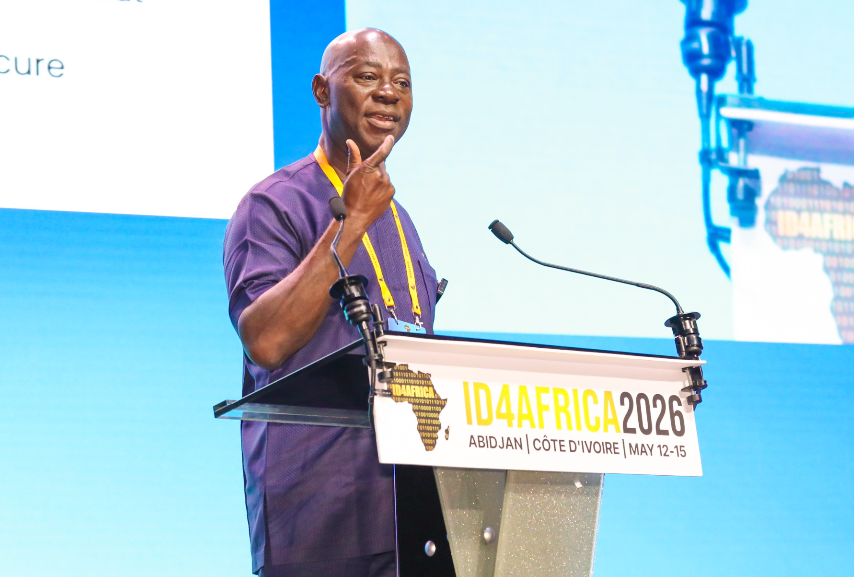
Founder and Chief Executive Officer of Margins ID Group, Moses Kwesi Baiden Jnr., has projected Ghana’s national identification infrastructure as one of the most advanced and fully integrated digital identity ecosystems in the world, arguing that the country has moved far beyond simply issuing national identity cards to building a secure digital public infrastructure supporting nearly every aspect of national life.
Addressing delegates at the 2026 edition of the ID4Africa Annual General Meeting in Abidjan, Côte d’Ivoire, Mr. Baiden said Ghana’s identity ecosystem was deliberately designed from inception to achieve interoperability across institutions, sectors, and public services.
“Most countries stop at the card. Ghana designed interoperability as the objective from day one,” he stated during a keynote presentation on the theme “Achieving Interoperability: Linking the Ghana Card Across National Identity Systems and Platforms.”
His remarks placed Ghana within a relatively small group of countries globally that have succeeded in building deeply integrated identity ecosystems often associated with digitally advanced nations such as Estonia, India, Singapore and the United Arab Emirates.
Globally, more than 170 countries operate some form of national identity programme.
However, experts say only a limited number have managed to create secure and trusted identity infrastructures capable of functioning seamlessly across banking, healthcare, telecommunications, taxation, transport systems, social protection, and broader digital public services.
According to Mr. Baiden, Ghana now firmly belongs within that category.
Ghana Card reaches national scale
The Ghana Card ecosystem has currently enrolled approximately 19.4 million citizens, with adult population coverage exceeding 92 percent nationwide.
More significantly, over 262 institutions have now been integrated into the platform, making the Ghana Card one of the most interconnected identity systems on the African continent.
The integrated institutions span banking, telecommunications, healthcare, taxation, transport regulation, social protection systems, and several other critical sectors.
The rapid expansion of the system has increasingly transformed the Ghana Card from a physical identification document into foundational digital infrastructure supporting service delivery and verification across the economy.
“Every citizen now has a digital version of themselves through which they interact with the world,” Mr. Baiden noted.
Industry observers say the depth of integration achieved within Ghana’s identity architecture increasingly mirrors trends seen in advanced digital economies where national identity systems now serve as gateways to financial services, public administration, digital commerce, healthcare access, and secure online verification.
Strengthening banking and public services
Within Ghana’s financial sector, the Ghana Card has become central to Know Your Customer compliance frameworks, helping banks accelerate customer onboarding processes, improve verification standards, and significantly reduce identity-related fraud.
The identity platform is also integrated with major public institutions including the National Health Insurance Authority, Ghana Revenue Authority and the Driver and Vehicle Licensing Authority.
Analysts say the growing integration of the Ghana Card across national systems is improving efficiency in service delivery while also strengthening transparency, accountability, and data integrity.
The development comes at a time when digital identity systems are increasingly being viewed globally as essential economic infrastructure comparable to roads, electricity, and telecommunications networks.
Countries with mature identity ecosystems often record improvements in financial inclusion, tax administration, healthcare delivery, cybersecurity, and social protection targeting.
According to him, successful interoperability cannot depend on technology alone but must be anchored on legal identity frameworks, cybersecurity protections, institutional coordination, and public trust.
“A trusted identity begins with a legal identity,” he stated.
He warned that countries pursuing digital integration without strong governance safeguards risk exposing themselves to vulnerabilities and cyber threats.
“Interoperability without trust is simply risk exposure,” he added.
The Ghana Card ecosystem operates through a public-private partnership between the National Identification Authority and Margins ID Group through its subsidiary, Identity Management Systems II.
Under the arrangement, the National Identification Authority maintains sovereign oversight over governance, legal compliance, regulation, and data protection, while Margins ID Group conceptualised, designed, financed, integrated, and operationalised the technical infrastructure supporting the system.
Observers at the conference described the model as one of the most significant examples of African-designed, African-financed, and African-operated digital identity infrastructure functioning successfully at national scale.
Africa’s opportunity to leapfrog
Mr. Baiden further argued that Africa possesses a rare opportunity to bypass outdated legacy systems that slowed digital transformation in many advanced economies.
“In Africa, we can leapfrog many of the legacy systems and design identity ecosystems fit for today’s digital realities,” he stated.
His comments reflect a growing sentiment among African technology leaders that the continent can emerge as a global leader in next-generation digital public infrastructure if supported by strong governance frameworks and strategic investments.
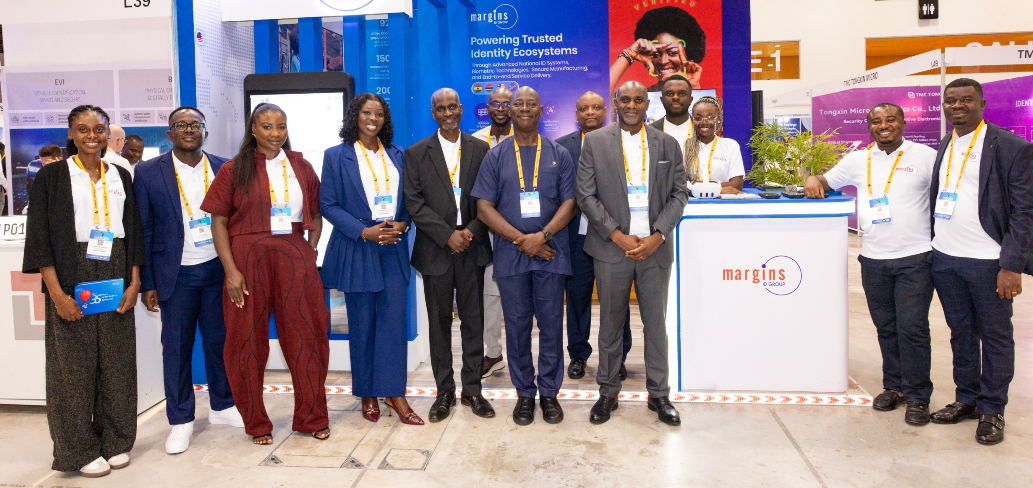
Alongside the keynote presentation, Margins ID Group maintained a major exhibition presence at ID4Africa 2026, showcasing biometric technologies, secure manufacturing capabilities, verification infrastructure, and integrated identity solutions to delegates from governments, technology firms, and development institutions from more than 100 countries.
The company remains one of the very few African exhibitors participating prominently at the annual ID4Africa platform despite Africa becoming one of the world’s fastest-growing deployment regions for national identity systems.
Ghana gaining global recognition
Ghana’s strong visibility at ID4Africa 2026 reinforced what many industry observers now see as the country’s emergence as a continental leader in trusted digital infrastructure.
For decades, African countries largely participated in global identity programmes as technology consumers and implementation markets for foreign firms.
However, Ghana’s model increasingly signals a broader shift where African companies are beginning to emerge as architects, operators, and exporters of complex digital infrastructure solutions.
Analysts say the success of the Ghana Card ecosystem may ultimately become one of the country’s most important digital transformation achievements, with implications extending far beyond identity management alone.
As governments worldwide increasingly invest in digital economies, Ghana’s interoperable identity infrastructure is positioning the country not merely as a participant in global digital transformation, but as one of its emerging leaders.
For many delegates attending ID4Africa 2026, Ghana’s message was unmistakable: the country is no longer simply operating a national ID card programme.
It is building one of the world’s most advanced and trusted digital identity ecosystems.