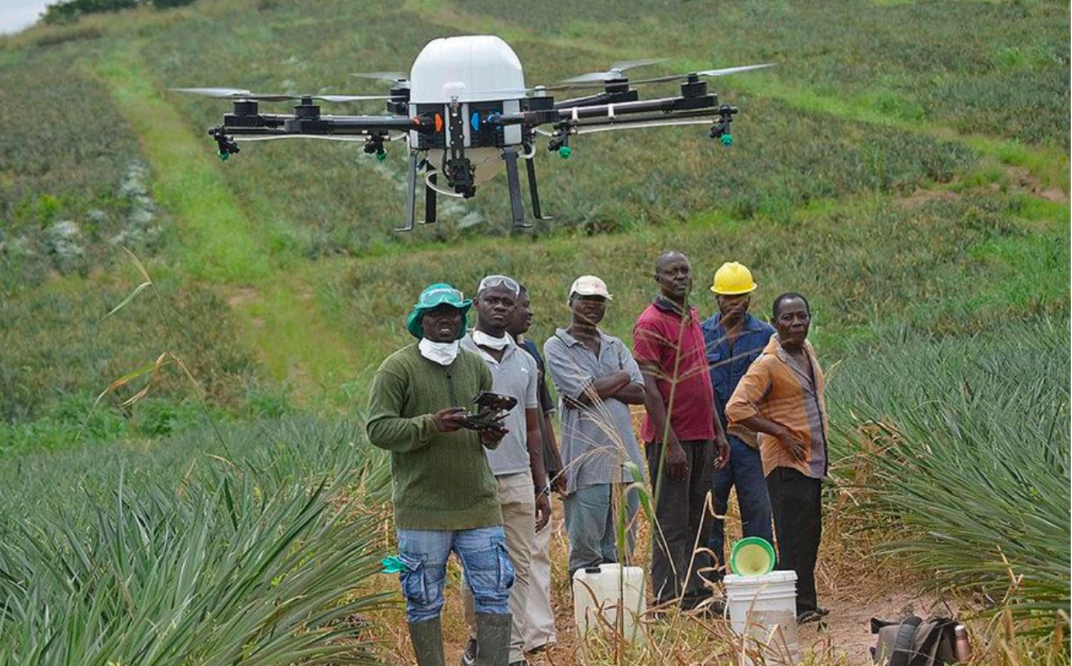
Ghana is positioning itself at the forefront of Africa’s drone revolution, with an ambitious roadmap aimed at transforming the country into West Africa’s premier hub for unmanned aerial systems (UAS) by 2035.
This vision emerged from a high-level strategic review workshop led by the Ghana Civil Aviation Authority (GCAA) in collaboration with international partners, the Korean Transportation safety Authority (KTSA) where stakeholders across government, private sector, academia, and development institutions assessed the current state of the drone ecosystem and mapped out a path forward—not only defining the vision, but also detailing how it will be governed, implemented, and sustained.
Ghana’s journey toward drone leadership is anchored in its globally recognized success in healthcare delivery. Since 2019, medical drone operations—most notably through partnerships like Zipline—have transformed access to essential medical supplies.
Drone services now operate around the clock from four centres, serving over 2,400 health facilities and reaching approximately 12 million citizens.
The results are striking maternal deaths have dropped by more than 56 percent in drone-served areas, while blood wastage and vaccine shortages have significantly declined.
Coupled with political stability, a growing regulatory framework, and its strategic location within the ECOWAS region, Ghana has built a strong foundation for expansion.
Despite these gains, stakeholders identified critical constraints.
Ghana lacks a national unmanned traffic management system, drone corridors, and sufficient maintenance facilities.
At the same time, shortages in skilled professionals—ranging from drone pilots to data analysts—continue to hinder growth.
The urgency to fix these gaps is driven by opportunity. Africa’s drone market is projected to expand from $1 billion in 2024 to over $9 billion by 2033.
In Ghana, drones are expected to transform key sectors:
- Agriculture could serve over 500,000 farmers, boosting yields by up to 25 percent
- Mining operations will benefit from enhanced surveillance and compliance monitoring
- Logistics and healthcare delivery systems will expand nationwide
Strategic partnerships with global institutions and private investors are expected to accelerate growth, positioning Ghana as a regional hub for drone innovation and services.
Vision 2035: Transforming Lives and Economies
At the heart of the roadmap is “Vision 2035,” which envisions a digitally enabled Ghana leveraging drone technology to drive economic growth and improve quality of life.
By 2035 it is expected that 90 percent of the population will have access to emergency medical delivery within 30 minutes.
500,000 farmers will benefit from precision agriculture services, and all mining concessions and forest reserves will be monitored using AI-powered drones.
The vision also emphasizes sustainability, targeting carbon-neutral drone operations by 2030 and promoting inclusivity, with women expected to make up 40 percent of the sector workforce.
Economic transformation and regional leadership
The roadmap projects the drone sector will grow from a $2.7 million market in 2025 to a $500 million industry by 2035, creating up to 15,000 high-skilled jobs.
Ghana also aims to become the central drone hub for ECOWAS by 2030—harmonizing regulations, training over 5,000 professionals, and enabling cross-border trade valued at up to $50 million annually.
What sets this roadmap apart is not just ambition—but a detailed plan for execution. At the core is a Joint Coordinating Committee (JCC), the apex governance body that will oversee implementation from 2026 to 2035.
The committee will be co-chaired by the GCAA Director-General and an international development partner, ensuring both national ownership and global collaboration.
The JCC brings together government agencies, private operators, universities, and development partners, supported by five dedicated working groups aligned with key implementation tracks:
The committee will meet monthly, with quarterly reviews and annual stakeholder forums to ensure continuous coordination and accountability.
Tracking progress and ensuring accountability
To ensure results, the roadmap introduces a comprehensive evaluation system built on real-time monitoring and periodic reviews.
Digital dashboards will track over 50 key performance indicators, while:
Quarterly reviews will assess progress and address bottlenecks.
Annual evaluations will measure outcomes and stakeholder satisfaction
Including a mid-term review in 2029 which will allow for strategic adjustments
Transparency is central to the approach.
Annual reports will be made public, while Parliament, development partners, and ECOWAS institutions will receive regular updates.
Managing risks in a fast-evolving sector
Recognizing the complexity of the drone ecosystem, planners have identified key risks and mitigation strategies. Among the top concerns:
Funding dependency on external partners, regulatory delays slowing approvals, technical integration challenges, particularly with UTM systems, brain drain of trained professionals and political shifts affecting long-term commitment.
To address these, the roadmap adopts a risk-informed approach, combining diversified funding, regulatory reforms, phased technology deployment, and workforce retention strategies.
A strong quality assurance system will underpin implementation, aligned with international standards such as ICAO and ISO frameworks.
It is expected that public trust will be reinforced through: Annual public reporting, media engagement and transparency initiatives and community consultations and grievance mechanisms.
The strategy also includes proactive communication to showcase progress while addressing concerns openly.
Financing the future
Implementation will require an estimated $115 million to $165 million in the near term, supported by a mix of:
- Government funding
- Development partner contributions
- Private sector investment
- Revenue from licensing and services
Financial oversight mechanisms—including audits and transparent reporting—will ensure accountability.
The road ahead
Ultimately, Ghana’s drone roadmap is as much about governance as it is about technology.
Success will depend on sustained political commitment, effective coordination among stakeholders, adequate funding, and the ability to adapt to challenges along the way.
If executed effectively, Ghana could emerge not only as West Africa’s drone hub but also as a global model for how emerging technologies can drive inclusive development.
Ghana’s drone roadmap is more than a technology plan—it is a statement of intent.
It signals a shift in how the country sees its future: not as a passive consumer of innovation, but as a creator, leader, and exporter of solutions.
If successful, Ghana could become a model for other developing nations—demonstrating how emerging technologies can be harnessed to solve real problems, create jobs, and drive inclusive growth.
But the journey will demand discipline, coordination, and resilience.
Because in the end, the question is not whether the drones will fly.
They already are.
The real question is whether Ghana can build the systems, skills, and structures needed to sustain that flight—and lead others along the way.
Clearly the partnership with Korean Transportation Safety Authority is one that stakeholders will be looking forward to and their generosity in applying for a Drone Sector Development Fund for Ghana could be a game changer.
By THOMAS ADOTEI PAPPOE