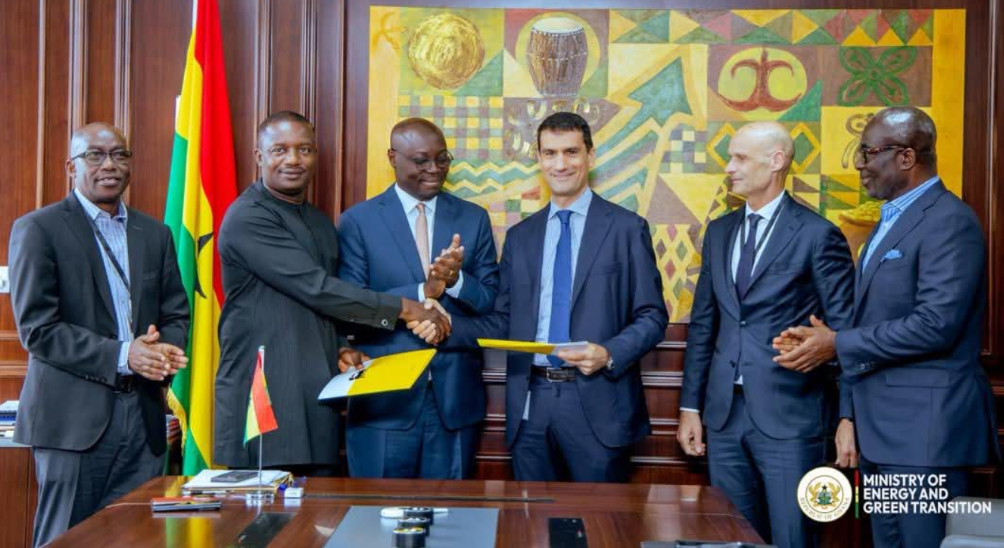
A major expansion of Ghana’s natural gas infrastructure is expected to significantly boost electricity generation and strengthen energy security following a new agreement to advance the next phase of the Offshore Cape Three Points (OCTP) project.
The deal brings together Eni Ghana Exploration & Production Limited, Vitol Upstream Ghana Limited, and the Ghana National Petroleum Corporation, and is designed to unlock additional gas supply to support power generation capacity in the country.
Signed on May 5, 2025, by the Minister of Energy and Green Transition, John Jinapor, the agreement formalises commercial terms for the proposed Non-Associated Gas (NAG) Upgrade Project.
It moves the OCTP development from planning discussions into full execution, setting the stage for a major increase in domestic gas production.
At the core of the project is a plan to increase gas output from the OCTP fields by up to 350 million standard cubic feet per day (MMscfd) by 2028.
Energy sector officials say this additional supply will play a critical role in expanding electricity generation capacity and ensuring a more stable and reliable power system.
The expansion will be driven by the development of the Gye Nyame field, installation of a booster compressor, and the integration of a new non-associated gas system on the project’s floating production storage and offloading (FPSO) vessel.
These upgrades are expected to significantly enhance gas processing and delivery to onshore power plants.
With natural gas serving as a key fuel for Ghana’s thermal power plants, the increased supply is expected to translate directly into improved electricity generation, reduced fuel shortages, and greater stability in the national grid.
According to the Energy Minister, the OCTP project remains central to Ghana’s energy strategy.
He noted that it already supplies a substantial share of gas used in power generation and that the planned expansion will further strengthen the country’s energy base.
“The OCTP project remains a cornerstone of Ghana’s energy mix, supplying a substantial share of the country’s gas for power generation. This planned upgrade will enhance our energy security, reduce reliance on imported fuels, and support growing demand from industry and households,” Mr. Jinapor said.
The project is also expected to reduce Ghana’s dependence on imported liquid fuels used for electricity production, thereby easing pressure on the country’s energy import bill over the medium term.
Energy analysts say this shift could improve foreign exchange stability while lowering generation costs for utilities.
The agreement builds on a Memorandum of Intent signed in September 2025 and reflects what officials describe as growing investor confidence in Ghana’s upstream petroleum sector.
The transition from intent to a structured term sheet is seen as a key step in improving project certainty at a time when global energy investors are becoming increasingly selective in capital deployment.
Eni Ghana Exploration & Production Limited will continue to operate the project, with Vitol Upstream Ghana Limited serving as commercial and investment partner, while the Ghana National Petroleum Corporation maintains state participation in the development.
Officials say this partnership structure is critical to ensuring both technical efficiency and national interest alignment as Ghana seeks to expand domestic energy supply to meet rising demand.
Mr. Jinapor added that the agreement sends a strong signal to global investors that Ghana’s petroleum sector remains open, stable, and competitive.
“Today’s signing sends a strong signal that Ghana’s upstream petroleum sector remains open, stable, and ready for investment. It reflects our commitment to creating a predictable and competitive environment for our partners, while ensuring that our natural resources are developed responsibly for the benefit of all Ghanaians,” he said.
As work advances on the OCTP upgrade, attention will now turn to implementation timelines and financing arrangements, with expectations that the project will play a pivotal role in shaping Ghana’s power generation outlook in the coming years.