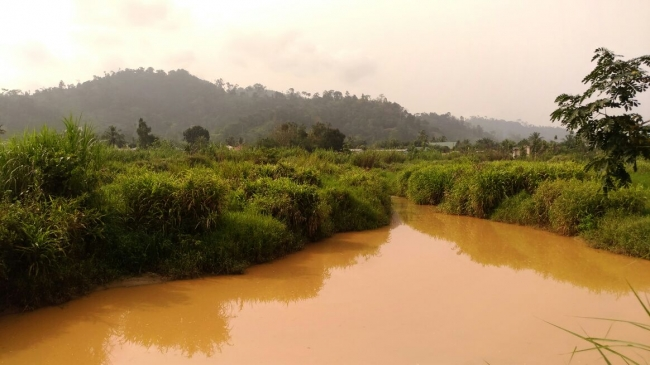
The Chief Executive Officer of the Environmental Protection Authority (EPA), Prof. Nana Ama Brown Klutse, has disclosed that an estimated $35 million will be required to fully restore the heavily polluted Birim River, following years of destruction caused by illegal mining activities, popularly known as galamsey.
Prof. Klutse made the revelation on Tuesday, February 24, 2026, during a pilot application of ionic nano copper technology at Kyebi-Adukrom in the Eastern Region.
She explained that although the pilot intervention has already produced visible improvements in sections of the river that have been treated, scaling the technology to cover the entire stretch of the Birim River would demand substantial financial resources.
According to her, it costs approximately $200,000 to procure sufficient ionic nano copper technology to clean one kilometre of a flowing river.
Given that the Birim River spans about 175 kilometres, she said the total restoration cost is estimated at $35 million.
“It took us about $200,000 to procure an amount that will clean one kilometre of every flowing river body. The Birim River is about 175 kilometres, so you can do the mathematics — we are talking about $35 million,” she stated.
Prof. Klutse noted that while the pilot has delivered promising short-term results, sustained funding and coordinated institutional support will be essential to restore the river to acceptable environmental standards.
The Birim River has suffered extensive degradation in recent years due to illegal mining, leading to deteriorating water quality, destruction of aquatic ecosystems, and reduced access to safe water for communities along its banks.
She added that the adoption of ionic nano copper technology forms part of a broader national strategy to rehabilitate polluted water bodies and strengthen long-term water resource management across the country.
The EPA has officially launched the pilot Water Cleaning Exercise at Adukrom in the Asiakwa area of the Okere District as part of efforts to combat growing pollution of rivers linked to galamsey activities.
The initiative is designed to demonstrate practical, science-based solutions for restoring degraded river systems.
The restoration effort is being undertaken in partnership with the Ghana Water Company Limited (GWCL), the Water Resources Commission, the Council for Scientific and Industrial Research (CSIR) through its Water Research Institute, the Ghana Atomic Energy Commission, the Ghana Standards Authority, SciencePlus, and Eislish Solutions.