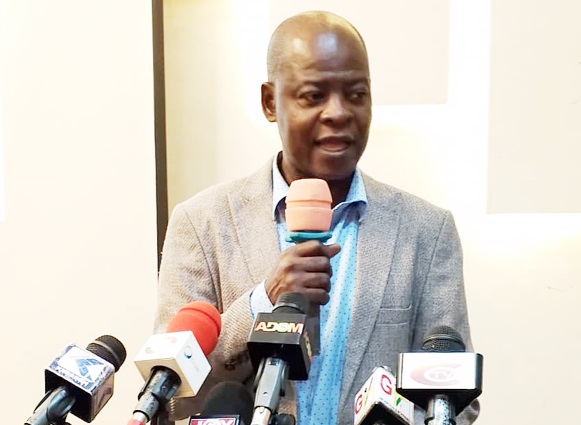
A Policy Analyst and Co-Chair of the Ghana Extractive Industries Transparency Initiative (GHEITI), Steve Manteaw, has strongly challenged claims by Bright Simons regarding the legality of operations and gold sales at the Damang Mine, arguing that the assertions fail to appreciate the historical, legal and operational realities of Ghana’s mining sector.
Dr Manteaw said while the questions raised by Mr Simons about parliamentary ratification of mining leases were legitimate governance concerns, the conclusions drawn were flawed, selective and inconsistent with long-standing precedent within Ghana’s mining industry.
According to him, the issue must be properly situated within the legal and historical context that has governed mining operations in Ghana for decades.
Questions legitimate, but conclusions misleading
The controversy emerged after Mr Simons questioned why Engineers & Planners (E&P) and Damang Gold Mines Limited (DGML) were selling gold before parliamentary ratification of the mining lease.
Mr Simons had argued that until Parliament ratifies a lease, the gold in any concession belongs to the State and not the company operating the mine.
But Dr Manteaw said the argument oversimplified a far more complex legal and governance framework.
“I have read on social media a write-up attributed to Bright Simons in which he raises fundamental questions that go to the heart of resource governance,” Dr Manteaw stated.
According to him, the real issue is not whether parliamentary ratification is important, but whether companies can legally operate while ratification processes are still pending.
Dr Manteaw explained that neither the 1992 Constitution nor the Minerals and Mining Act, 2003 (Act 703) provides a timeline within which parliamentary ratification must occur.
He noted further that the laws do not place any legal obligation on mining companies themselves to secure parliamentary ratification.
Historical practice allowed operations before ratification
Dr Manteaw said historical practice within Ghana’s mining sector clearly shows that many large-scale mining firms operated for years — and in some cases decades — before parliamentary ratification of their leases.
According to him, the established legal practice has largely been guided by Section 13 of Act 703.
He explained that under Section 13(1), once the Minerals Commission recommends approval of an application for a mineral right, the Minister is required to notify the applicant within 60 days and subsequently publish the approval in the Gazette.
Under Section 13(4), the applicant then accepts the offer in writing, after which Section 13(5) empowers the Minister to formally grant the mineral right.
Most critically, Dr Manteaw pointed to Section 13(9), which states that once the mineral right is granted, the holder is entitled to enter the land and begin operations.
According to him, this provision has historically formed the operational basis upon which mining activities commence pending parliamentary ratification.
Every step was complied with
Dr Manteaw stated that in the specific case of Damang Gold Mines Limited, all legal procedures required under Section 13 had been complied with.
“In the particular case of the Damang Gold Mines Limited concession, I am aware that every single step set out in Section 13 has been complied with and there are documents to prove same,” he said.
He stressed that the presence of E&P and DGML at the Damang concession is therefore “well grounded in law.”
According to Dr Manteaw, the companies have also assumed full operational and financial responsibilities at the mine since April 18, 2026.
He disclosed that the companies have paid workers’ salaries and covered all operational costs associated with the running of the mine.
“Some of these payments were made even before the sale of the first gold from the mine,” he added.
Constitution broader than mining lease alone
Addressing arguments surrounding Article 268 of the Constitution, Dr Manteaw argued that mineral rights are not limited strictly to signed mining leases.
According to him, Article 268 contemplates broader arrangements including undertakings, contracts and transactions “howsoever described.”
He explained that the Damang arrangement falls within the broader intention of the framers of the Constitution.
“The exigencies of the Damang situation required the Minister to enter into the transaction to prevent the mine from shutting down from April 18, 2026,” he stated.
Dr Manteaw argued that halting operations entirely while waiting for ratification would have resulted in serious consequences, including job losses, revenue losses and operational disruptions.
State revenue not compromised
Dr Manteaw also rejected suggestions that Ghana’s interest in the gold revenues had been undermined.
“I do not think the stake of the Government of Ghana in the revenue accruing from the sale of the gold has been compromised in any way,” he stated.
According to him, revenues from the gold sales have deliberately been retained within Ghana to facilitate future reconciliation processes after ratification.
The arrangement, he explained, would enable all parties to determine the appropriate share due the Government after Parliament completes the ratification process.
Double standards against indigenous firms?
One of the strongest points raised by Dr Manteaw was what he described as apparent double standards in the criticism directed at DGML and E&P.
He observed that almost all major foreign mining companies operating in Ghana historically commenced operations and exported gold long before parliamentary ratification of their leases.
Yet, according to him, similar arguments were never aggressively pursued against those foreign-owned firms.
“I find it strange that even though almost all the foreign mining companies operating in Ghana did not obtain ratification of their leases before going into operations and selling the bulk of their gold overseas, we saw no reason to argue that the gold did not belong to the companies,” he stated.
“Let not the impression be created that the black man hates his own,” he added.
Companies cannot be blamed
Dr Manteaw argued that companies cannot technically be blamed for commencing operations while ratification remains pending.
He explained that the responsibility for parliamentary ratification lies with the Executive and Parliament — not the mining companies.
“Technically, the answer is no. They couldn’t be blamed because the responsibility for ratification rests not on them, but on the Executive arm of Government and Parliament,” he explained.
He further noted that mining companies often secure massive loans to finance projects and therefore cannot indefinitely delay operations while waiting for bureaucratic processes to be completed.
Any prolonged delay, he argued, would lead to mounting financing costs and economic losses even before production begins.
2019 Court case established precedent
Dr Manteaw also referenced a 2019 legal challenge in which two Members of Parliament sued the Attorney-General and 35 mining companies for operating without parliamentary ratification.
According to him, despite the constitutional concerns raised in that case, Government did not seek sanctions against the companies or demand refunds of proceeds from gold sales made during periods of non-ratification.
Instead, Parliament proceeded to ratify the leases and regularise the situation.
“This is the precedent that has been set,” Dr Manteaw stressed.
He questioned why indigenous Ghanaian-owned firms should now face harsher standards than multinational companies that previously benefited from similar arrangements.
“If we accommodated multinational companies on this score, why not our own indigenous company?” he asked.
He further noted that the Damang Mine is not an entirely new operation and that halting activities would threaten jobs and state revenues.
“It is therefore prudent in this context to continue operations while pursuing parliamentary ratification,” he stated.
Calls for reforms
While defending the legality and practicality of the Damang arrangement, Dr Manteaw acknowledged the need for reforms to close governance gaps within the mining sector.
He urged Government to use ongoing mining sector reforms to amend Act 703 and establish clear timelines for parliamentary ratification of leases.
According to him, Government must also eliminate bureaucratic bottlenecks that force companies into operational uncertainty before ratification is completed.
Finally, Dr Manteaw argued that if strict enforcement of pre-ratification restrictions is to be imposed, then Government must also be prepared to compensate companies for losses resulting from ratification delays.
“Government must provide for the payment of compensation for any loss of potential revenue arising out of delays in ratifying leases,” he stated.
Dr Manteaw maintained that while governance reforms are necessary, the Damang situation must be assessed fairly, consistently and within the full context of Ghana’s mining history, legal framework and economic realities.