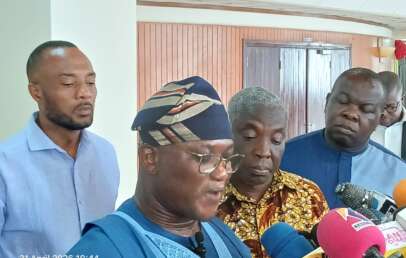
The Member of Parliament for Ofoase-Ayirebi and Ranking Member on Parliament’s Economy and Development Committee, Kojo Oppong Nkrumah, has challenged the government’s celebration of Ghana’s completion of the International Monetary Fund (IMF) Extended Credit Facility (ECF) programme, arguing that economic stability alone means little to ordinary Ghanaians if it fails to create jobs and improve living standards.
Contributing to a debate in Parliament following a statement by the Finance Minister on Ghana’s economic outlook after the IMF programme, Mr Oppong Nkrumah contended that government was placing excessive emphasis on macroeconomic indicators while overlooking the realities confronting millions of citizens, particularly rising youth unemployment and the high cost of living.
According to him, while policymakers may celebrate improvements in inflation, exchange rate stability and fiscal indicators, the average Ghanaian is more concerned about whether they can find a job, pay rent, afford food and meet the rising cost of essential services.
“The numbers that the Ghanaian people are watching in their day-to-day lives are actually getting worse,” he told Parliament.
Questions over IMF exit narrative
Mr Oppong Nkrumah began by questioning the government’s description of Ghana’s completion of the IMF programme as an “exit” from the Fund.
He argued that such characterisation could mislead the public since Ghana remains a member of the IMF and continues to engage with the institution.
According to him, Ghana has merely completed one specific arrangement—the Extended Credit Facility programme—which was approved in 2023 to help restore macroeconomic stability following the country’s economic crisis.
He noted that government is already pursuing another IMF-supported arrangement known as the Policy Coordination Instrument (PCI), making it inaccurate to suggest that Ghana has entirely severed ties with the Bretton Woods institution.
The former Information Minister therefore urged government to be transparent with Ghanaians about the country’s continuing engagement with the IMF.
Stability achieved, but where are the jobs?
While acknowledging that the IMF programme succeeded in restoring a measure of macroeconomic stability, Mr Oppong Nkrumah argued that the real test of economic recovery lies in whether citizens are experiencing tangible improvements in their lives.
He said the two most pressing concerns among Ghanaians remain employment and the cost of living.
According to him, available labour market data suggests that economic stability has yet to translate into meaningful job creation, particularly for young people.
Citing figures from the Ghana Statistical Service’s Quarterly Labour Force Survey for the third quarter of 2025, he noted that youth unemployment among persons aged between 15 and 24 increased from 32% in December 2024 to 32.5% by the third quarter of 2025.
The increase, though marginal, he said, demonstrates that economic growth and stability are not automatically creating opportunities for the country’s young population.
For many unemployed graduates and young job seekers, he argued, improvements in macroeconomic indicators offer little comfort when employment opportunities remain scarce.
Nearly half of Accra’s youth unemployed
The Ranking Member expressed particular concern about the unemployment situation in Greater Accra.
According to him, youth unemployment in the region has reached 49.3%, meaning nearly one out of every two young people is without work.
He described the figure as alarming and warned that persistent unemployment among the youth poses significant economic and social risks.
Mr Oppong Nkrumah further cited Ghana Statistical Service data indicating that seven out of every ten unemployed persons in the country are below the age of 35.
He argued that these figures should serve as a wake-up call for policymakers and should feature more prominently in discussions about economic recovery.
“If young people cannot find jobs, then the benefits of stability remain largely theoretical,” he suggested.
Cost of living still hurting households
Beyond unemployment, Mr Oppong Nkrumah argued that many households continue to face severe cost-of-living pressures despite improvements in headline inflation figures.
Although inflation has declined significantly from the elevated levels recorded during the economic crisis, he maintained that many essential services remain expensive.
He pointed to rising rents, electricity charges and the cost of other services as examples of expenses that continue to strain household budgets.
According to him, headline inflation figures often fail to capture the daily financial pressures confronting families.
The average citizen, he argued, does not assess economic performance based on statistical reports released by economists and government officials but rather through the prices they pay in markets and the affordability of basic necessities.
“People judge the economy by what they spend every day and whether their income can meet their needs,” he implied.
Tax relief claims questioned
Mr Oppong Nkrumah also challenged government claims regarding tax relief measures.
While acknowledging the removal of some taxes, he noted that Parliament had simultaneously approved several new revenue measures introduced by the administration.
He argued that despite these additional tax measures, government has struggled to meet its revenue mobilisation targets and has consequently fallen short in fulfilling some expenditure commitments.
According to him, this raises questions about the sustainability of the government’s fiscal strategy and weakens claims that significant relief has been provided to taxpayers.
Growth must be felt by citizens
The Ofoase-Ayirebi MP maintained that economic management should ultimately be judged by its impact on citizens rather than by improvements in macroeconomic indicators alone.
He argued that stability should be viewed as a means to an end rather than an end in itself.
For him, the ultimate objectives of economic policy must be job creation, rising incomes, improved living standards and greater opportunities for ordinary citizens.
Without these outcomes, he said, the celebration of macroeconomic gains risks appearing disconnected from the realities facing many households.
His comments underscore a growing debate over whether Ghana’s post-IMF recovery is sufficiently translating into broad-based economic benefits for citizens.
While government continues to highlight declining inflation, a stabilising currency and improved fiscal performance as evidence of economic recovery, critics insist that the true measure of success lies in whether Ghanaians can secure decent jobs, earn sustainable incomes and experience a meaningful improvement in their quality of life.
For many households still grappling with unemployment and high living costs, Mr Oppong Nkrumah argues, economic stability that does not put food on the table or create opportunities remains an achievement that exists more in economic reports than in everyday reality.