Ecobank Ghana PLC recorded a strong financial performance in 2025, posting a 28% increase in profit before tax to GH¢3 billion as Ghana’s banking sector continued its recovery from recent economic challenges.
The bank declared a dividend of GH¢1.21 per share for the 2025 financial year, representing more than a 200% increase over the GH¢0.34 paid in the previous year and the highest dividend in the bank’s history.
The dividend is being paid from a net profit of more than GH¢1.82 billion.
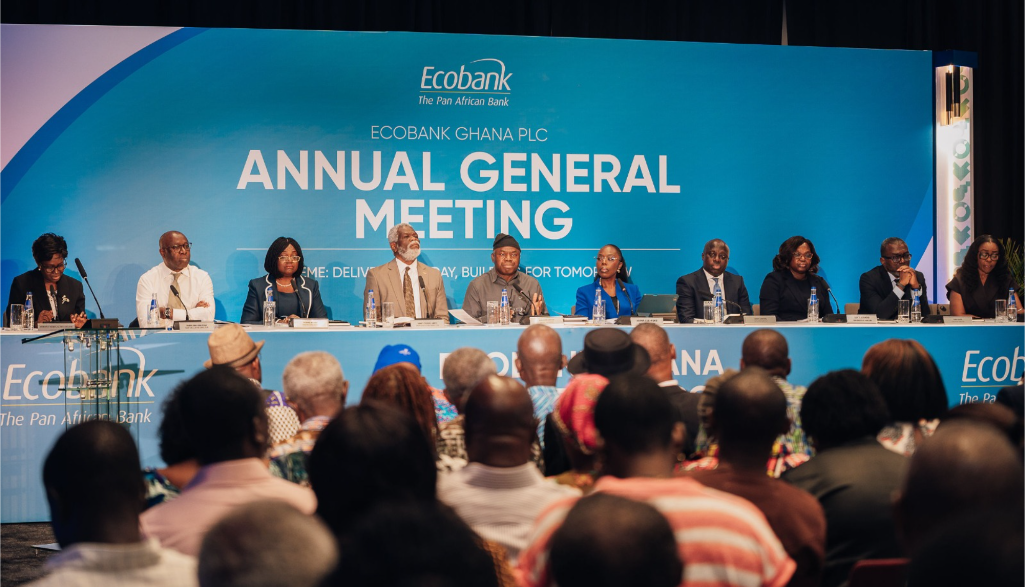
Speaking at the bank’s Annual General Meeting (AGM) in Accra, the Managing Director, Mrs Abena Osei-Poku, said the impressive performance reflected the bank’s resilience, disciplined execution of its strategy and commitment to sustainable growth despite an evolving regulatory and competitive environment.
She said the bank’s revenue increased to GH¢5.2 billion during the year, strengthening its position as one of the leading financial institutions in the country.
Ecobank ranked second in both revenue generation and profit before tax within the banking industry.
“Ecobank Ghana PLC delivered strong results in 2025 as the economy recovered and the regulatory landscape evolved. Revenue rose to GH¢5.2 billion, while profit before tax increased by 28% to GH¢3 billion, up from GH¢2.4 billion in 2024,” she said.
Balance sheet growth
The bank’s lending portfolio also expanded significantly. Loans and advances increased by 24% from GH¢10 billion to GH¢13 billion.
Total assets rose to GH¢47 billion, while shareholders’ equity grew by 33% to GH¢7.2 billion.
Mrs Osei-Poku said the bank maintained a strong capital position, which continues to support its growth ambitions.
“We closed the year with a Capital Adequacy Ratio of 21.23%, without regulatory reliefs, comfortably above the regulatory minimum and positioning us strongly for growth,” she stated.
Banking sector recovery
On the outlook for the banking industry, Mrs Osei-Poku said the sector recorded notable improvements in 2025, driven by stronger capital buffers, improved liquidity and renewed public confidence.
According to her, the industry’s Capital Adequacy Ratio improved from 11.3% in December 2024 to 17.5% at the end of 2025.
Industry assets expanded from GH¢367 billion to GH¢423 billion, while deposits increased from GH¢277 billion to GH¢302 billion.
Furthermore, the sector’s Non-Performing Loan (NPL) ratio declined from 22.7% to 19.5%, indicating gradual improvement in asset quality.
Focus on asset quality
She, however, noted that asset quality remains a concern across the industry and within Ecobank’s own portfolio.
“Although our NPL ratio of 17.92% remains elevated, it continues to receive focused attention. We have intensified recovery efforts and strengthened early-warning and loan life-cycle monitoring. Reducing the NPL ratio to below 10% by December 2026 remains a strategic priority,” she said.
Digital transformation drive
Mrs Osei-Poku said rapid technological changes continue to reshape the banking industry as fintech companies, mobile money operators and other digital service providers intensify competition.
She explained that transaction volumes across Ecobank’s mobile and online banking platforms grew strongly during the year as more customers embraced digital channels.
“We continued to invest strategically in our digital banking platforms. Transaction volumes across our mobile and online banking channels grew strongly, reflecting changing customer behaviour and the impact of these investments,” she said.
She added that strengthening digital capabilities would remain a major priority in 2026 to improve operational resilience and customer experience.
Sustainability and climate finance
Beyond its financial performance, Ecobank deepened its sustainability agenda during the year.
A major milestone was its accreditation by the Green Climate Fund, making Ecobank Ghana the first institution in Ghana and the first commercial bank in Sub-Saharan Africa to receive the accreditation.
The accreditation gives the bank access to up to US$250 million in funding for climate-related projects.
Mrs Osei-Poku said the bank advanced its sustainability agenda by launching the Accelerating Solar Action Programme and training about 150 licensed solar vendors and installers to expand access to clean energy.
The bank also expanded its social impact initiatives through education, environmental and health programmes.
As part of the 13th Ecobank Day celebrations, the bank commissioned digital learning centres for hearing-impaired and visually impaired learners in Accra, Takoradi and Wa.
It also supported nationwide tree-planting exercises and assisted small and medium-sized enterprises to participate in international trade forums.
Investment in staff and recognition
Mrs Osei-Poku paid tribute to staff for their contribution to the bank’s performance during a year characterised by intense competition and regulatory reforms.
“In 2025, our people rose to the demands of a challenging year, navigating regulatory change and increasing competition with focus, professionalism and a strong sense of purpose. I am profoundly proud of every one of them,” she said.
She explained that the bank invested heavily in staff development through training in credit risk management, digital financial services, customer experience, artificial intelligence and ESG integration.
Ecobank’s performance earned it 16 awards during the year across sustainable finance, SME banking, customer experience, marketing excellence and workplace sustainability.
Among the honours were Best Bank for Sustainable Finance and Best SME Bank from Global Finance, as well as Bank of the Year from the Chartered Institute of Marketing Ghana.
Outlook remains positive
Looking ahead, Mrs Osei-Poku expressed confidence in Ghana’s economic prospects, citing improving macroeconomic indicators.
“There is reason for optimism, balanced with the discipline required for sustainable progress. Ghana’s macroeconomic fundamentals are stronger than they have been in several years,” she said.
She cautioned that risks remain, including commodity price volatility, climate-related financial challenges, asset quality concerns and geopolitical uncertainties.
Despite these challenges, she reaffirmed Ecobank Ghana’s commitment to supporting economic growth through innovation, responsible banking and sustainable financing.
“We remain clear-eyed about the risks ahead, but equally committed to building a stronger, more resilient bank for our customers, shareholders and the wider economy,” she said.
Consumer banking records strong growth
The Board Chairman of Ecobank Ghana, Chief Alhassan Andani, said the bank’s Consumer Banking business also made significant progress during the year through a strategy centred on personalised financial solutions, digital innovation and financial inclusion.
He said the bank continued to simplify banking and improve accessibility through customer-focused initiatives aimed at helping individuals and households achieve financial independence and long-term financial security.
Chief Andani said a key intervention was the relaunch of the bank’s Premier Banking segment, which introduced a more personalised and relationship-driven service model for high-net-worth clients.
The upgraded offering included the Ecobank Visa Infinite Card, which provides premium travel, lifestyle and protection benefits. It also introduced a new annuity product in partnership with Old Mutual Ghana.
According to him, the enhanced proposition contributed to growth in deposits, loan assets, revenue and customer loyalty.
Driving financial inclusion
He also pointed to the success of the bank’s Digital Account Opening Solution, which enables customers to open accounts through mobile, online and partner channels using real-time Ghana Card verification and automated Know-Your-Customer (KYC) processes.
The platform has reduced paperwork, accelerated account activation and improved access to banking services, particularly for Ghanaians living abroad.
Furthermore, Ecobank expanded financial inclusion through its Xpress Loan digital micro-lending platform, operated in partnership with MTN Mobile Money Ltd. and Jumo Ghana Ltd.
During the year, the platform disbursed more than GH¢5.43 billion through over 8.49 million loans to 7.31 million customers across the country.
The Board Chairman said women accounted for 35% of beneficiaries, while customers below the age of 35 represented 67% of users.
Rural customers constituted 48% of the platform’s user base, demonstrating the bank’s commitment to extending access to credit and supporting underserved communities.