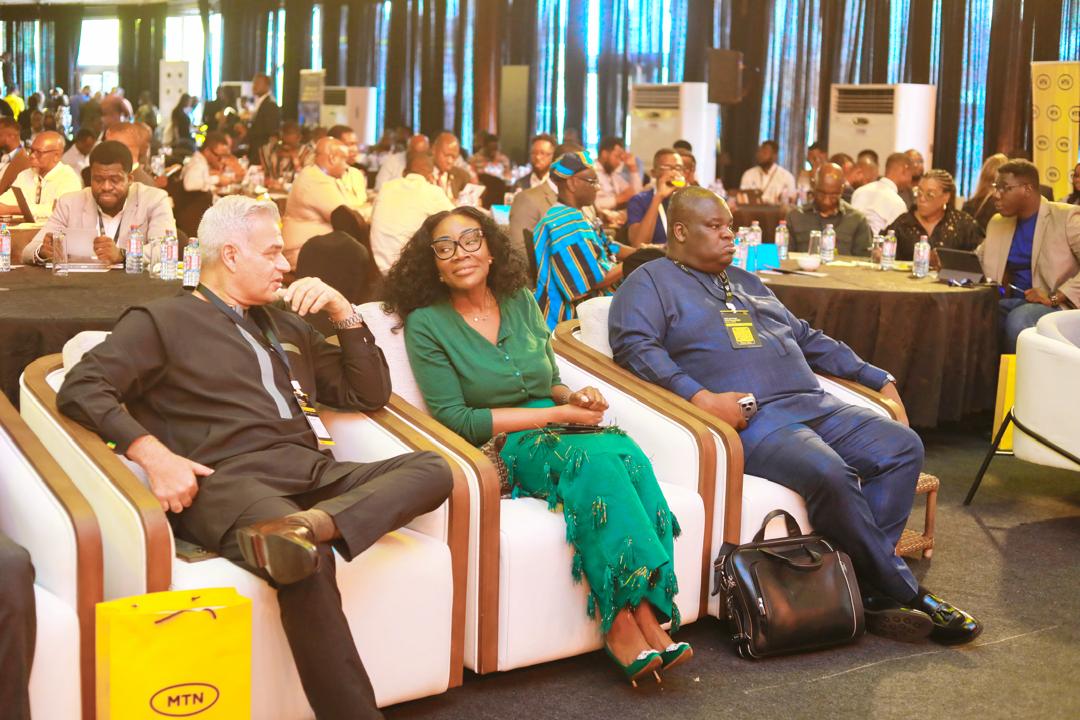
The Chief Information Officer of MTN Ghana, Bernard Acquah, has called on businesses to treat Artificial Intelligence (AI) as a core part of their operations, stressing that the decisions taken today will shape the competitiveness of their businesses in the near future.
Delivering the keynote address at the MTN Business CTIO Roundtable Africa 2026 in Accra on Wednesday , he said artificial intelligence was not just another technology trend but a fundamental shift that is transforming industries across the world.
“Throughout history, certain technologies do not just improve industries, they rewrite all of them,” he said adding that AI is a horizontal technology reshaping everything in todays business ecosystem.
The event which was on the theme “AI and the Future of Business.” It brought together business leaders, technology experts and policymakers to discuss how AI can drive growth, inclusion and sustainability.
Mr Acquah said investment in AI must remain a priority even in times of economic uncertainty. He explained that businesses that invest strategically in AI stand to benefit from improved productivity, cost savings and smarter decision-making.
“AI investment remains a top priority. The key drivers of success are productivity gains, saving and making money, and smarter decisions.”, he said.
He, however, cautioned that businesses must not ignore the risks that come with AI adoption. He pointed to the growing threat of cyber attacks and urged organisations to strengthen their security systems.
“Businesses of the future must be aware of cybersecurity threats. We must develop proactive strategies to defend against AI-driven attacks.”
On the issue of jobs, Mr Acquah sought to allay fears that AI would lead to massive job losses. He said AI should be seen as a tool that supports human work rather than replaces it.
“AI is about guiding and not replacing. It is a tool, not a co-worker.”
He cited projections by the World Economic Forum to support his argument. According to him, “AI is expected to create some 170 million new jobs, while 92 million jobs may be eliminated by 2030.” He added that this represents “a significant net gain for the global workforce.”
Mr Acquah explained that routine and repetitive tasks were the most at risk, while new opportunities were emerging in areas that require human oversight and innovation.
“Routine-heavy junior tasks are disappearing fastest. But demand is increasing for roles that design, supervise and improve AI systems.”, he stressed.
He also drew attention to what he described as a critical skills gap. He warned that many organisations were not adequately prepared for the rapid pace of AI adoption.
“The pace of AI adoption is outrunning the pace of workforce preparation” , adding that Over 90 per cent of global enterprises will face critical skills shortages by 2026.
He noted further that only about one-third of organisations and employees were ready for AI-driven work.
“Only one-third of organisations are fully ready, and only one-third of employees have received meaningful AI training,” he said.
Mr Acquah warned that the skills gap could have serious economic consequences. “AI-related gaps alone put up to $5.5 trillion of economic value at risk,” he said.
He, therefore, urged businesses to take deliberate steps to build capacity and strengthen governance systems. He outlined key areas that organisations must focus on to succeed in the AI era.
“We must prioritise strategic investment. We must build trust and robust governance. We must scale beyond pilot projects, and we must mitigate AI-driven cyber risks.”
He also encouraged businesses to embrace emerging innovations such as agentic AI, which allows systems to operate more autonomously while working alongside humans.
“The organisations that act decisively today will define the competitive landscape of tomorrow,” he said.
Chief Enterprise Officer of MTN Ghana, Angela Mensah-Poku, on her part said the world was experiencing a major technological shift that demands bold action from business leaders.
“Look around the room, the people seated here today are not spectators of change, you are its architects.”
She described the current moment as one of the most important in modern history. “We are living through what many economists and technologists are calling the most consequential technological shift since the industrial revolution,” she said.
She cited global estimates to emphasis the scale of change. “The IMF estimates that AI could affect up to 40 per cent of jobs globally, not destroy them, but reshape them,” she said.
She also pointed to the economic potential of AI. “PWC says AI will contribute trillions of dollars to the global economy by 2030,” she said.
Focusing on Africa, she stressed that the continent must take an active role in shaping the future of AI. “Africa is not a footnote in this story,Africa is a chapter still being written, and we are the ones who will hold the pen.”
She challenged participants to take responsibility and act on the opportunities before them.
“AI does not reward legacy. It rewards those bold enough to adapt.”, she stressed.
She added that inclusion and sustainability must be central to AI strategies.
“Inclusion is not our charity, it is our strategy.Sustainability is no longer a box to tick.”
She explained that technology can be used to address real challenges such as healthcare delivery, emissions reduction and access to financial services.
“The technology exists,the only question is whether we have the will to deploy it.”
Other speakers at the event shared insights on the opportunities and challenges of AI adoption in Africa. The Head of Digital Transformation at Stanbic Bank Ghana, Estelle Jacqueline Asare, said AI was already improving credit assessment and customer experience in the financial sector.
Afia Gyamera, Co-founder of 40 Analytics, highlighted the challenge of fragmented data systems across the continent. She said many organisations lacked structured data and skilled teams to support AI initiatives.
Darlington Akogo, Chief Executive Officer of minoHealth AI Labs, said AI was already saving lives through improved healthcare solutions.
“AI is not futuristic,” he said. “We are using it today to deliver healthcare beyond our limits.”
Foster Akugri, Managing Director of Apex Advisory, called for stronger collaboration to build a vibrant AI ecosystem in Africa.
“Innovators will continue to innovate if the market exists. Africa must take advantage and create the ecosystem with AI strategy in mind.”
The roundtable formed part of ongoing efforts by MTN Ghana to promote digital transformation and support businesses to harness emerging technologies.