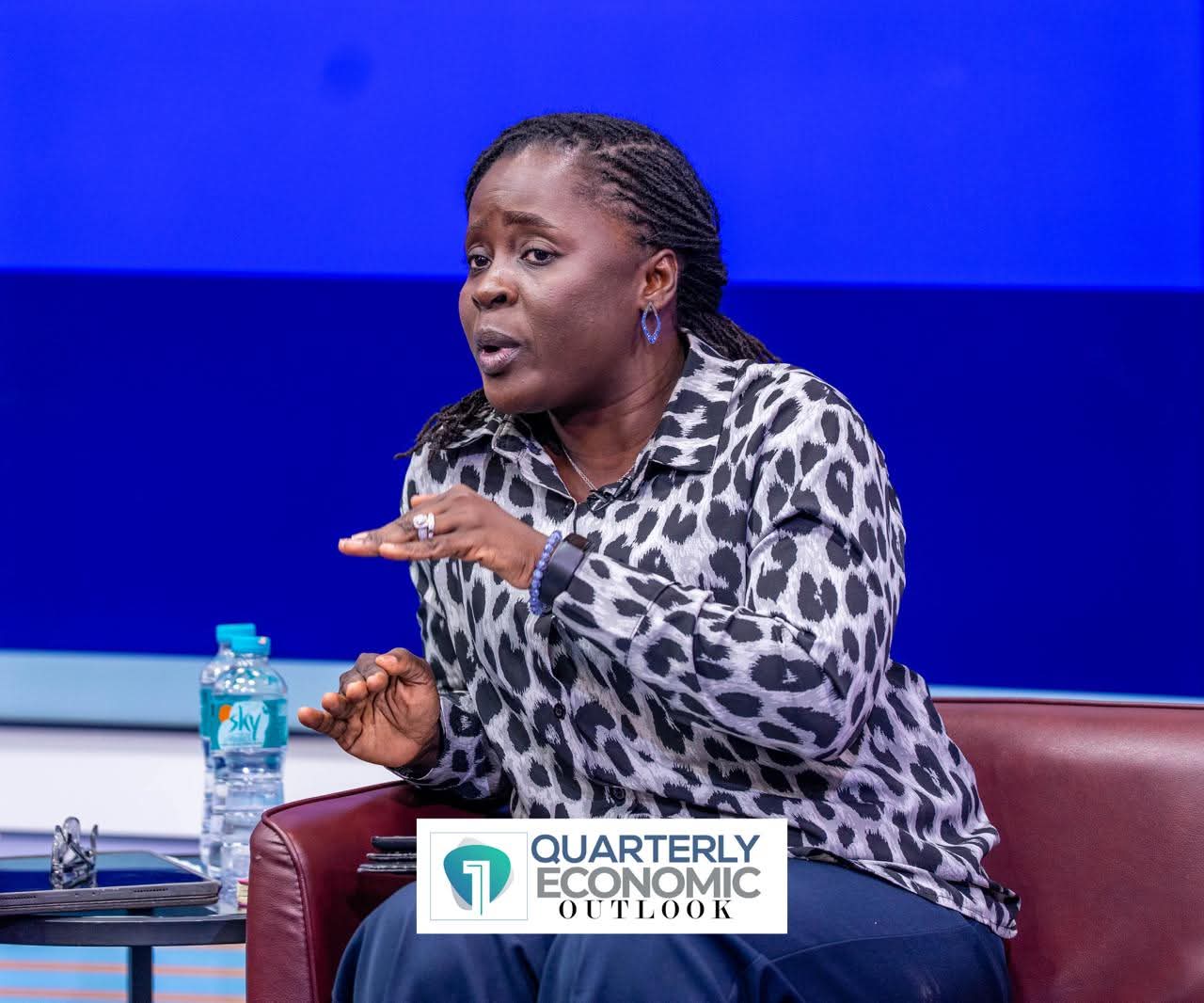
An economist and lecturer at the University of Ghana, Dr. Gloria Afful-Mensah, has mounted a strong defence of the financial losses incurred by the Bank of Ghana (BoG), arguing that the costs represent necessary policy trade-offs that ultimately shielded Ghana’s economy from a far more severe crisis.
She explained that Ghana’s return to macroeconomic stability following the 2022–2023 economic turmoil did not come without sacrifice, stressing that the central bank’s losses must be understood within the broader context of economic rescue and stabilisation.
According to her, while inflation has declined sharply, the cedi has stabilised, and confidence is gradually returning to the financial system, these gains were achieved through deliberate interventions that imposed significant financial costs on the central bank’s balance sheet.
“These are not losses arising from mismanagement or policy failure,” she emphasised.
“They are correction losses—costs incurred intentionally to restore stability and protect the broader economy”, she during a Quarterly Economic Outlook discussion organised by Channel 1 TV.
Crisis demanded extraordinary policy response
Dr Afful-Mensah noted that at the peak of the crisis, Ghana faced a combination of macroeconomic shocks that required urgent and decisive action.
Inflation surged beyond 54% in 2022, the cedi depreciated sharply, and external reserves came under intense pressure.
Under such conditions, she explained, the central bank had little choice but to deploy aggressive policy tools that extended beyond traditional monetary operations.
“These were not normal times,” she said. “The BoG had to step in as a stabiliser of last resort to prevent systemic breakdown.”
She outlined four key objectives that guided the central bank’s interventions: reducing inflation, stabilising the exchange rate, rebuilding foreign exchange reserves, and preserving confidence in the financial system.
Each of these objectives, she pointed out, came with inherent financial costs.
Inflation control came at a high price
A central plank of the stabilisation effort was the aggressive tightening of monetary policy to rein in inflation.
This involved mopping up excess liquidity in the banking system, an exercise that reportedly cost the Bank over GH₵17 billion.
Dr Afful-Mensah explained that under Ghana’s inflation-targeting framework—which operates within a medium-term band of 8 percent plus or minus 2 percent—anchoring inflation expectations is critical.
“When inflation rises to such extreme levels, the central bank must act decisively, even if the cost is high,” she noted.
The Bank achieved a dramatic reduction in inflation, bringing it down from over 54% in 2022 to about 5.4% by the end of 2025, with more recent figures suggesting further moderation to around 3.2%.
However, this success came at a financial cost. By issuing its own securities to absorb liquidity, the Bank pays market interest rates, often without earning equivalent returns on its assets.
Currency stabilisation required costly interventions
Beyond inflation control, stabilising the cedi was another critical priority.
The central bank, together with government, injected over $11 billion into the foreign exchange market to support the currency.
These interventions contributed to a significant appreciation of the cedi—from about GH₵14.70 to the US dollar in December 2024 to around GH₵10.45 by the end of 2025.
Unconventional tools and their trade-offs
The use of unconventional policy tools, such as the gold-for-forex initiative implemented in collaboration with the Ghana Gold Board (GoldBod) also helped.
While the programme supported exchange rate stability and helped conserve foreign exchange, it reportedly resulted in losses estimated at about $300 million.
Similarly, the Gold-for-Oil programme, introduced to stabilise fuel prices, generated losses from transactions that extended into 2025 despite its suspension.
Central bank as shock absorber
A key argument advanced by Dr Afful-Mensah is that the Bank of Ghana effectively acted as the economy’s shock absorber during the crisis.
Rather than allowing the full cost of stabilisation to pass through the government’s fiscal accounts or directly to citizens, the central bank absorbed much of the burden within its own balance sheet.
“This approach helped avoid immediate fiscal distress and prevented additional hardship for households and businesses,” she said.
However, she acknowledged that this strategy has implications for the Bank’s financial position, with losses eroding its balance sheet strength.
Preventing a deeper economic collapse
Dr Afful-Mensah stressed that the true value of the central bank’s interventions lies in what they prevented.
Without decisive action, Ghana could have faced hyperinflation, which would have severely eroded incomes and savings.
A disorderly collapse of the cedi could have triggered a sharp increase in the cost of living, while instability in the financial system might have led to bank runs.
“These were real risks,” she warned. “The interventions prevented a much worse outcome.”
Weakened balance sheet, stronger economy
While acknowledging that BoG’s balance sheet has been weakened by these interventions, Dr Afful-Mensah argued that this should not be viewed negatively.
“The central bank essentially traded its financial strength for macroeconomic stability,” she said. “It prioritised national welfare over institutional profitability.”
She described the losses as the “opportunity cost” of stabilisation—costs that were necessary to restore confidence and lay the foundation for recovery.
As Ghana consolidates its recovery, Dr Afful-Mensah noted that attention will gradually shift to rebuilding the central bank’s balance sheet and ensuring long-term sustainability.
However, she emphasised that the immediate priority remains maintaining stability and preventing a relapse into economic instability.
“Stability is the foundation upon which growth is built,” she said. “Without it, everything else is at risk.”
The hidden cost of recovery
In her assessment, Ghana’s experience highlights a broader lesson in economic management: macroeconomic stability often comes with hidden costs that are not immediately visible to the public.
“In this case, instead of being borne through higher inflation, a weaker currency, or financial instability, much of the cost was absorbed quietly by the central bank,” she explained.
She concluded that the losses recorded by the Bank of Ghana should be understood not as a sign of weakness, but as evidence of the institution’s role in safeguarding the economy during a period of exceptional stress.
“The Bank of Ghana stood at the centre of the crisis response,” she said.
“Its balance sheet may have taken the hit, but the economy is stronger for it.”