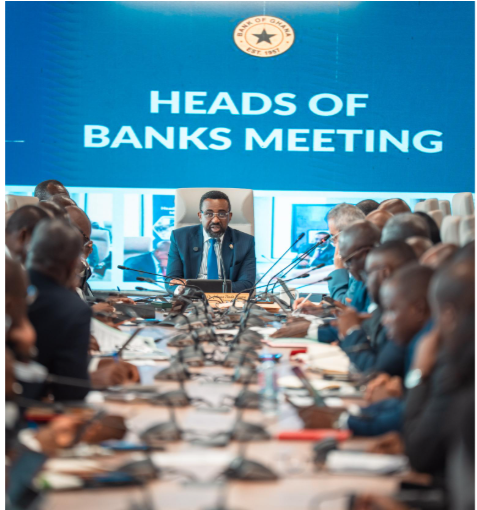
Dr Johnson Asiama, Governor of the Bank of Ghana (BoG), has urged a structural overhaul of the banking sector to consolidate macroeconomic gains, following the restoration of stability and improved growth prospects.
He noted that both global and domestic conditions had improved, with inflation declining faster than expected and expectations firmly anchored, and that attention must now turn to strengthening banking structures to sustain and deepen macroeconomic stability
Dr Asiama was speaking at an engagement with Heads of Banks after the 128th Monetary Policy Committee (MPC) meeting in Accra.
The Committee, by majority decision, reduced the Monetary Policy Rate by 250 basis points to 15.5 per cent, noting that monetary conditions remained sufficiently tight relative to prevailing inflation dynamics.
Dr Asiama said global growth in 2025 proved more resilient than expected, supported by easing inflation, improving real incomes and strong investment, with the outlook for 2026 pointing to steady, though uneven, expansion.
On the domestic front, he said Ghana’s macroeconomic conditions had strengthened significantly.
“Real Gross Domestic Product grew by 6.1 per cent in the first three quarters of 2025, driven mainly by the services and agriculture sectors,” he said.
Dr Asiama said inflation declined from 23.8 per cent in December 2024 to 5.4 per cent in December 2025, and further to 3.8 per cent in January 2026, the lowest level recorded since the adoption of inflation targeting.
He said fiscal consolidation, exchange rate stability, strong export earnings and improved reserves had supported overall stability.
“With stability restored, the focus must now shift from resilience to structural strengthening of the banking sector,” he said.
Dr Asiama noted that although banks remained viable and profitable, financial intermediation was modest, with high concentration in sovereign assets and heavy reliance on net interest income.
He urged banks to diversify into fee-based services and strengthen credit risk management as lending expands.
Dr Asiama said there had been improvements in cybersecurity monitoring across the sector and called for enhanced vigilance to address emerging threats.
He referenced key reforms, including the passage of the Bank of Ghana Amendment Act, 2025, which strengthens the Bank’s operational independence and accountability, and the Virtual Asset Service Providers Act, which establishes a regulatory framework for digital assets.
Dr Asiama said the Bank was collaborating with stakeholders such as the Ghana Stock Exchange to encourage more banks to list on the bourse to broaden ownership, strengthen governance and deepen transparency.
He emphasised that the next phase of financial sector development required stronger business models, disciplined innovation, broader ownership and sound governance to build a durable and resilient banking system capable of supporting Ghana’s long-term transformation.