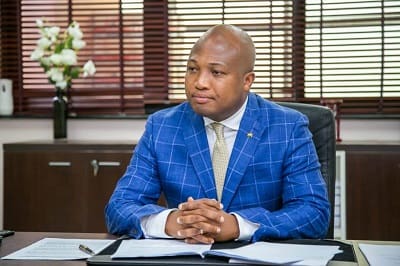
Ghana’s Foreign Affairs Minister, Samuel Okudzeto Ablakwa, has put Ghana in harm’s way by publicly revealing that Ghana cooperated with the United States and Nigeria in a military operation targeting Islamist militants in northern Nigeria.
Speaking during a security discussion at Chatham House in London on March 9, the minister disclosed that Ghana had been invited by both Washington and Abuja to support the Christmas Day operation against ISIS-linked militants in Sokoto State.
The revelation has triggered intense debate in Ghana’s security and diplomatic circles, with critics warning that publicly acknowledging participation in a counter-terrorism strike could unnecessarily expose Ghana to retaliation from extremist groups operating across the Sahel.
Security doctrine of silence
For decades, Ghana’s approach to counter-terrorism cooperation with foreign partners has largely been conducted quietly. Intelligence sharing, logistical cooperation and regional security coordination have often been handled discreetly to avoid drawing the attention of terrorist networks.
Security analysts argue that such “strategic ambiguity” has helped Ghana maintain relative stability even as violent extremism spread across the Sahel and parts of West Africa.
Groups such as Boko Haram, Islamic State West Africa Province, and Jama’at Nusrat al‑Islam wal‑Muslimin have expanded their activities across the region in recent years, frequently targeting governments they perceive as collaborating with Western military operations.
By publicly confirming Ghana’s role in a strike targeting militants in Nigeria, security experts say the minister may have inadvertently shifted Ghana’s profile from a quiet partner in regional security to a visible participant in combat operations.
Terror groups thrive on propaganda
Security researchers note that extremist groups often use narratives of foreign intervention to justify attacks and recruit fighters.
In the Lake Chad basin and wider Sahel region, militant groups frequently portray governments cooperating with Western militaries as enemies of Islam or agents of foreign powers.
The insurgency in northern Nigeria demonstrates how complex and persistent such conflicts can become.
Nigerian forces have repeatedly faced large-scale attacks from Boko Haram fighters, including incidents where hundreds of militants have launched coordinated assaults on towns and military positions.
These groups operate across porous borders that stretch into Niger, Chad, Cameroon and parts of the Sahel—regions not far from Ghana’s northern frontier.
Security experts warn that public declarations of involvement in counter-terrorism strikes could provide propaganda material for extremists seeking to expand operations southwards into the Gulf of Guinea.
Questions over legal authority
Beyond security concerns, the minister’s remarks have also raised constitutional questions within Ghana.
Opposition lawmakers argue that if Ghana indeed played an operational role in a foreign military strike, such involvement should have been subjected to parliamentary oversight.
Under Ghana’s 1992 Constitution, significant international agreements with security implications typically require parliamentary approval.
Some lawmakers say Parliament was not informed of any arrangement that allowed Ghana to participate in an overseas military operation.
Critics contend that if Ghana’s territory, intelligence infrastructure or logistical systems were used in such an operation, the government may have bypassed established oversight mechanisms.
Diplomatic balancing act
The disclosure also comes at a delicate moment in West African geopolitics.
Relations between some Sahelian governments and Western military powers have deteriorated sharply in recent years. Military-led governments in Mali, Burkina Faso, and Niger have expelled Western troops and formed the Alliance of Sahel States, partly in response to dissatisfaction with foreign counter-terrorism operations.
In this fragile environment, Ghana has attempted to position itself as a stabilising diplomatic actor within the Economic Community of West African States and the regional Accra Initiative, which seeks to prevent the spillover of jihadist violence into coastal West Africa.
Experts warn that public declarations of participation in Western-backed military strikes could complicate Ghana’s role as a neutral broker in regional security diplomacy.
Lessons from past operations
Counter-terrorism operations in northern Nigeria have also been controversial due to the risk of civilian casualties.
For instance, Nigerian authorities apologised after an airstrike targeting militants in Sokoto State inadvertently killed 10 civilians, illustrating the complex humanitarian risks associated with such military campaigns.
Such incidents often fuel anti-government sentiment and provide recruitment narratives for extremist groups.
Critics argue that publicly associating Ghana with these operations could expose the country to backlash from groups seeking revenge against governments involved in anti-terror campaigns.
A delicate security moment
Ghana has so far avoided the large-scale terrorist attacks seen in neighbouring countries.
However, the spread of jihadist violence across the Sahel has already reached parts of Burkina Faso, just across Ghana’s northern border.
Security agencies have repeatedly warned that extremist groups are attempting to infiltrate coastal West African states.
Against this backdrop, some analysts believe Ghana’s long-standing policy of quiet cooperation and strategic discretion may have been more prudent than public disclosure.
While the minister’s comments may have been intended to highlight Ghana’s commitment to regional security cooperation, critics say the decision to reveal such sensitive information at a public forum in London raises an uncomfortable question.
In the complex theatre of counter-terrorism, where secrecy often protects both operations and nations, was the revelation a diplomatic achievement—or a strategic misstep that could place Ghana closer to the front line of a dangerous regional conflict?