
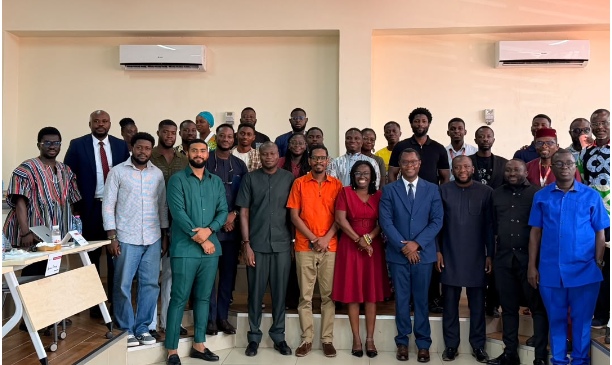
MobileMoney FinTech LTD (MMFL) has called for increased investment in artificial intelligence (AI) fraud detection and continued customer education to protect Ghana’s growing digital financial sector.
The call came at a cybersecurity roundtable organised by Academic City University in partnership with the Bank of Ghana, the Cyber Security Authority, MMFL and the Institute of ICT Professionals Ghana.
Regulators, academics and industry experts discussed emerging threats, including mobile money fraud, social engineering and risks linked to technology providers.
Bank of Ghana: protect customers before and after fraud
Eric Afanu, Head of the Offensive and Defensive Unit at the Bank of Ghana, said fraud can erode public trust in digital finance, especially when victims cannot recover their money.
He urged financial institutions to improve complaint handling and ensure timely investigations and support for affected customers.
Consumer protection, he said, must cover not only preventing attacks but also how institutions respond when fraud occurs.
He also warned that outsourcing technology services does not transfer responsibility for customer protection.
Financial institutions should strengthen vendor oversight, test their incident-response plans and establish clear governance for AI.
Afanu called for continuous public education in local languages to help market traders, farmers, older people and other customers recognise and avoid scams.
MMFL: combine education with detection technology
Doreen Ayensu Aidoo, MMFL’s Information Security Manager, said the company uses community outreach, radio, digital platforms and its Shine Your Eye campaign to educate customers.
Yet scammers continue to refine their methods.
She identified social engineering as a major threat, with criminals tricking customers into revealing PINs or approving transactions. Common schemes include fake transaction alerts followed by calls claiming that money was sent by mistake, fraudulent promotions, suspicious links and fabricated emergencies.
Aidoo advised customers to verify alerts independently, keep PINs private and treat unsolicited calls and messages with caution.
She also urged financial institutions to invest in AI and behavioural analysis that can flag unusual transactions and pause or block suspicious activity before money is lost.
Academic City: build resilience through collaboration
Dr Muhammad Suraj, Director of Graduate and Continuous Education at Academic City University’s Faculty of Computational Sciences and Informatics, said the roundtable reflected the close link between financial innovation and cybersecurity.
He said discussions focused on infrastructure protection and cyber resilience, fraud prevention, and governance of emerging technologies.
While AI could help criminals create more sophisticated attacks, financial institutions could use it to improve intrusion detection, anti-malware systems and security operations.
Suraj said a proposed white paper would document the challenges discussed, existing interventions and policy recommendations, offering practical guidance for strengthening Ghana’s cybersecurity framework.
Shared responsibility for preventing fraud
Dr Mark Tampuri, Head of the Department of Business and Entrepreneurship at Academic City, said fraud prevention requires coordinated action by regulators, financial institutions and consumers.
Social engineering exploits gaps in financial literacy, he said, allowing criminals to obtain sensitive information through deception.
Tampuri called on regulators to enforce clear accountability rules and service providers to invest in strong security systems and sustained education.
Consumers should remain vigilant, he said, but institutions must not place the entire burden of fraud prevention on them.
Participants’ recommendations will be compiled into a publicly available white paper for policymakers, regulators and industry stakeholders.
The roundtable concluded with a call for greater collaboration, responsible use of technology and stronger consumer protection to sustain trust and financial inclusion.

