The Chief Executive Officer of the Ghana Chamber of Telecommunications, Sylvia Owusu-Ankomah, has called for a review of fiscal and regulatory policies governing the telecommunications sector to ensure that taxation and revenue mobilisation do not undermine investment and long-term growth.
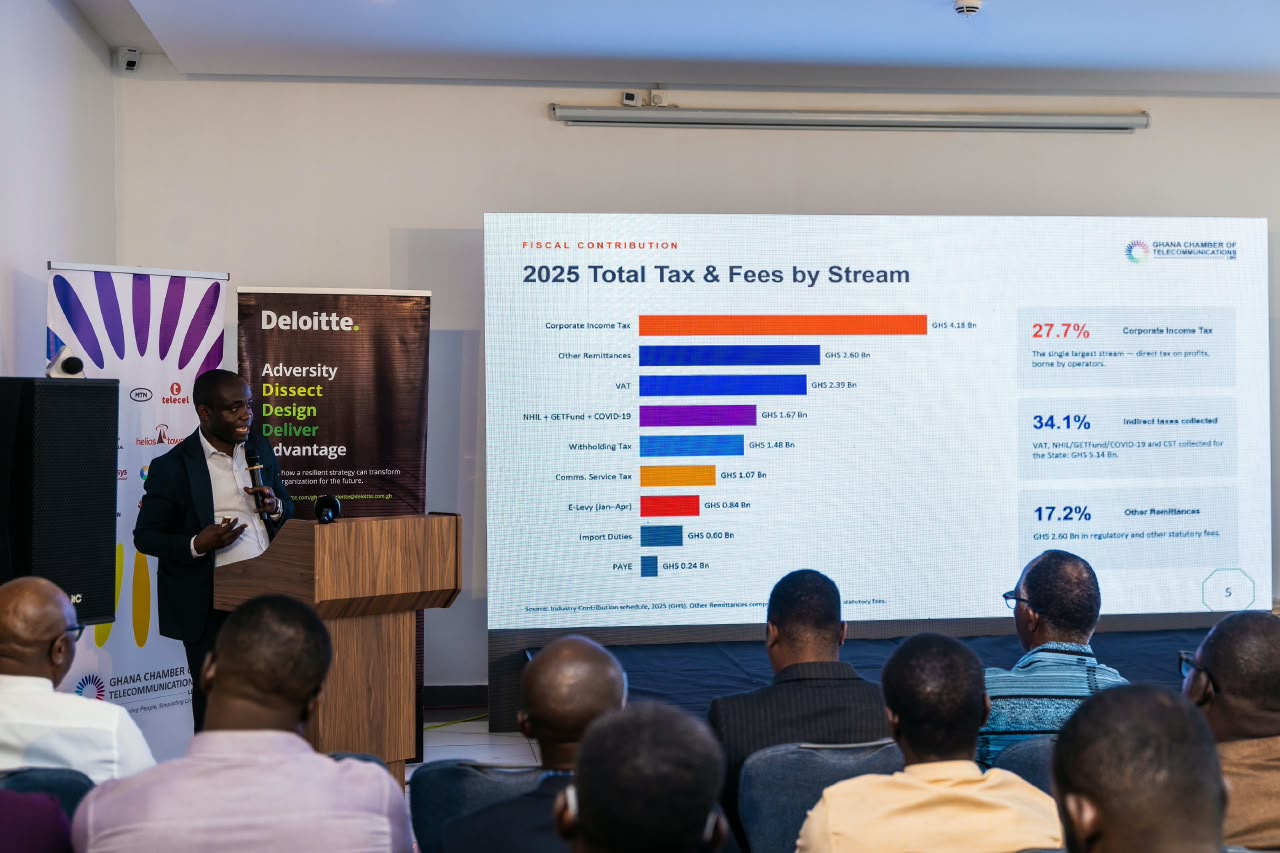
The call comes as the sector’s contribution to government revenue more than doubled between 2022 and 2025, rising from GH¢6.07 billion to GH¢15.07 billion, representing a 148 per cent increase.
The GH¢15.07 billion contributed in 2025 accounted for 6.8 per cent of Ghana’s total domestic revenue of GH¢223.06 billion and represented a 34 per cent increase over the previous year.
The figures are contained in the 2025 Total Tax Contribution Report of the Ghana Chamber of Telecommunications, based on
submissions from eight of the Chamber’s 10 operators.
Speaking at an accountability forum on the performance of the telecommunications sector in Accra on Wednesday, Madam Sylvia Owusu-Ankomah said the industry’s contribution should be assessed not only by the taxes it paid but also by its wider role in supporting economic activity.
“Beyond its direct contributions or fiscal contributions, the industry enables our economic activities across virtually every
other sector,” she said.
“It supports financial inclusion; it creates direct and indirect employment; it connects businesses in markets; it enables government revenue mobilisation; and provides infrastructure for Ghana’s digital transformation.”
Despite the sector’s substantial fiscal contribution, operators invested GH¢5.09 billion in capital expenditure in 2025 to expand and maintain network infrastructure.
The report indicated that 4G coverage had reached 99 per cent of the population. However, mobile internet usage remained constrained by a 57 per cent usage gap, while smartphone adoption stood at only 42 per cent, pointing to affordability and device access as major barriers to digital inclusion.
Madam Owusu-Ankomah said the figures raised important questions about whether fiscal and regulatory policies were encouraging the investment needed to deepen digital access.
“Are the fiscal and regulatory policies designed for our telecom sector, maximising immediate revenue from the sector, or do we need to design it to expand investment?” she asked.
She said telecommunications was a highly capital-intensive industry requiring continuous investment in spectrum, fibre, towers, data centres, cybersecurity, energy and technology upgrades.
“Our networks require continuous investment in spectrum, fibre, towers, data centres, cybersecurity, energy, technology upgrades, and service quality improvements,” she said.
She cautioned that additional taxes, levies and regulatory charges could reduce the capital available for network expansion and modernisation and ultimately affect consumers.
“For every additional tax, every levy, every regulatory charge affecting the industry and the capital available for network expansion or modernisation, it also becomes very difficult and affects the cost for digital service ultimately delivered to our consumers,” she said.
The Chamber is therefore advocating targeted incentives for rural infrastructure, 5G deployment, spectrum acquisition, energy efficiency, device affordability and emerging technologies.
Madam Owusu-Ankomah said the next phase of the sector’s growth should focus not only on network expansion but also on enabling citizens and businesses to use digital infrastructure meaningfully and productively.
The Commissioner of the Domestic Tax Revenue Division of the Ghana Revenue Authority, Dr Martin Yamborigya, said taxation of the telecommunications industry required a balance between protecting the tax base and creating conditions for investment.
“The telecom sector is both a taxpayer and also a tax ecosystem,” he said, explaining that operators were subject to corporate income tax, VAT, employment-related taxes and the Communications Service Tax.
He said the sector’s importance extended beyond taxes paid directly by operators because telecommunications infrastructure now supported mobile money, digital payments, e-commerce, digital advertising, cloud services and fintech.
Dr Yamborigya said tax incentives should be linked to clearly defined economic objectives and should be “targeted, transparent, time bound, and, where appropriate, subject to periodic evaluation.”
He also stressed the importance of tax certainty and predictability for investors, saying businesses needed clarity on tax rates, deductions, documentation requirements and dispute resolution.
“Ultimately, the objective is not to maximize taxation of the telecom industry. The objective is to maximize sustainable economic growth while ensuring that the system receives a fair and appropriate share of that value,” he said.
The Chairman of Parliament’s Select Committee on Telecommunications, Dr Abednego Bandim, also called for greater reinvestment of telecommunications revenue into the sector, particularly to improve connectivity in rural and underserved communities.
“Whatever is collected by government has to be re-invested into the sector for the sector to continue to grow so that it will touch everybody in the ecosystem, particularly in the rural areas,” he said.
He disclosed that about GH¢30 million had been earmarked for rural telephony in the 2026 Budget, alongside allocations for digital youth hubs and the One Million Coders programme.
However, he described the overall allocation of about GH¢200 million as inadequate for holistic development of the sector.
Dr Bandim also cautioned against setting excessive fees for 5G spectrum, saying high acquisition costs could ultimately increase the cost of services to consumers.
“The National Communications Authority must ensure that the 5G is not auctioned at an exorbitant fee for operators,” he said. “Because when they buy it high, they will sell it high.”
He further called for reforms to the regulatory approval process for telecommunications infrastructure, saying multiple permits could delay network expansion.
“We have a thousand and one regulators in the sector,” he said, describing the process of obtaining permits for telecommunications towers as “a very, very, very tedious process.”