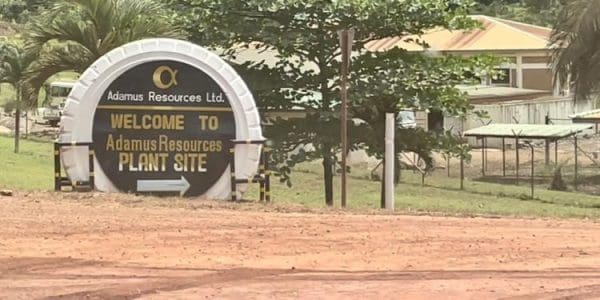
The Ministry of Lands and Natural Resources, the Minerals Commission and Adamus Resources have been directed to prepare and submit a comprehensive 12-month roadmap for turning around the operations of the indigenous large-scale mining company.
The roadmap will be supervised by a six-member management team comprising three representatives from Adamus and three from government.
The two sides are expected to present the roadmap to the Presidency within two weeks.
The development gives Adamus a fresh opportunity to address the concerns that triggered the revocation of its Nkroful, Akango and Salman mining leases, despite findings by a Ministerial Review Committee which recommended that the revocation be upheld.
Roadmap to tackle liabilities
The government’s intervention is aimed at salvaging Adamus as one of Ghana’s few operating indigenous large-scale mining companies while addressing concerns surrounding its financial position and regulatory compliance.
Under the proposed roadmap, Adamus is expected to develop a plan for settling its outstanding liabilities to the Ghana Revenue Authority (GRA), the Minerals Income Investment Fund (MIIF), financial institutions and suppliers.
The plan will also explore ways of injecting fresh capital into the mining operation, including the possibility of bringing in additional investors to acquire equity in the company.
The six-member management arrangement is expected to provide joint oversight of the turnaround process and ensure that both government and the company participate directly in decisions concerning the mine’s recovery.
The intervention follows a meeting at the Presidency convened to resolve the dispute between government and Adamus and protect the future of the mining operation.
However, the reprieve comes against the backdrop of serious findings by a Ministerial Review Committee, which identified what it described as significant financial, production-reporting and environmental compliance breaches.
GH¢205m statutory arrears
At the heart of the controversy are more than GH¢205.83 million in statutory arrears, comprising GH¢86.78 million in royalties owed to MIIF from 2020 and GH¢119.04 million in tax arrears owed to the GRA dating from 2023.
Adamus was also found to owe the Minerals Commission US$2.56 million in annual payments.
The scale of the arrears has raised questions about whether the state has received the full financial benefits due from the extraction of gold at the company’s concessions.
The concerns become more significant when placed against the company’s reported production.
Records from the GRA indicate that Adamus produced approximately 8.8 tonnes of gold valued at more than US$1 billion between 2020 and January-March 2026.
Despite that level of production, the company accumulated substantial arrears to state institutions.
The committee therefore questioned the explanation that the outstanding obligations were simply the result of temporary cash-flow difficulties, particularly in light of other financial transactions identified during its review.
US$224m transferred to related parties
One of the most significant findings concerns transfers of funds to companies and entities related to Adamus.
The committee found that more than US$224.61 million was transferred to related parties between 2020 and 2024.
Of that amount, approximately US$123.14 million was transferred to Segala Mining Corporation SA, Semico 1 and Semico 2 in Mali.
The transactions became a major concern because they occurred during a period in which Adamus had accumulated substantial outstanding obligations to the Ghanaian state.
The committee did not suggest that related-party transactions were inherently unlawful. Its concern centred on their timing and scale in relation to the company’s unpaid statutory obligations.
The findings raised a fundamental question over why substantial funds were available for transactions within the corporate group while royalties, taxes and regulatory payments remained outstanding.
The situation weakened the argument that Adamus’ defaults were solely attributable to a shortage of funds.
Gold production figures under scrutiny
The committee also identified major discrepancies in Adamus’ gold production and export records.
A particularly important issue was the company’s failure to produce its statutory Gold Production Book, which could have enabled the committee to independently reconcile production, processing, inventory and shipment figures.
Instead, the committee relied on Form 16A monthly returns and royalty returns submitted to the GRA.
Those records themselves contained discrepancies.
Between 2020 and January-March 2026, differences between the Form 16A records and GRA royalty returns amounted to 6,580.04 ounces of gold, with the committee estimating the associated revenue variance at approximately US$27.13 million, using the Bank of Ghana exchange rate of July 12, 2026.
Further discrepancies emerged when the company’s declarations to different government institutions were compared with its own shipment records.
For 2024 to January-March 2026, Adamus reported 72,194.94 ounces of gold to the GRA and 71,553 ounces to the Minerals Commission.
Its own shipment records, however, showed 74,375.14 ounces.
The differences have raised fundamental questions about the actual volume of gold produced and exported and, consequently, the royalties and taxes properly due to the state.
Missing production book deepens concerns
The absence of the Gold Production Book further complicated the committee’s work.
The statutory document would ordinarily have provided an important basis for reconciling production, inventory and shipment records.
Without it, the committee had to reconstruct production figures from documents submitted to different state agencies, exposing inconsistencies that it considered serious.
It identified additional variances valued at approximately US$12.02 million and US$21.30 million.
The committee described the cumulative inconsistencies as “suspicious” and concluded that the records appeared to have been prepared with the purpose of evading statutory liabilities.
Such a conclusion, if established through the appropriate enforcement and legal processes, could elevate the matter beyond ordinary accounting discrepancies to possible deliberate under-declaration of mineral production and revenue.
Gold smuggling questions
The discrepancies have also raised questions about possible diversion of gold from formal channels.
The review questioned whether the unexplained differences could point to gold being diverted or whether the records were intended to conceal the actual volume of gold produced and shipped.
The concern is significant because production declarations directly influence the royalties, taxes and other revenues payable to the state.
Under-declaration of production could therefore result in revenue losses to Ghana while actual gold volumes move outside the official accounting system.
The committee’s concerns consequently extend beyond paperwork to the integrity of Ghana’s mineral production monitoring and revenue-collection systems.
Other debts and community concerns
The financial difficulties identified by the committee also extend to debts owed to institutions including GOIL and GRIDCo, with further details expected to be released
The Eastern Nzema Traditional Area, which hosts the mining operations, also raised concerns over the company’s obligations to the host community.
The Traditional Council alleged that Adamus owed approximately US$2.5 million from a US$10 million Community Development Fund and had failed to pay mineral royalties due to the traditional area for eight years.
It also complained about inadequate infrastructure, deteriorating roads, flooding and problems associated with the Salman Resettlement Project.
Those concerns add a social dimension to the dispute, raising broader questions about whether mining communities receive the benefits and development support expected from mineral extraction in their areas.
Environmental permits questioned
Environmental compliance also formed part of the concerns surrounding Adamus.
The committee examined two Environmental Protection Agency (EPA) permits covering the company’s operations in the Ellembelle District of the Western Region and identified unusual timelines in their issuance.
The first permit, covering operations at Salman, stated a validity period from July 20, 2017, to July 19, 2020, but the certificate was officially issued on December 19, 2024—more than four years after the stated validity period had expired.
A second permit covering the Nzema Gold Mining and Processing Operation was stated to be valid from December 21, 2023, to December 20, 2026, but was issued on December 16, 2024.
The unusual chronology raised questions about whether the company operated during periods when the required environmental authorisation had not been formally issued.
The committee consequently raised broader concerns about the effectiveness of regulatory oversight during those periods.
Ghanaian ownership no exemption
The Adamus case has also generated arguments that the company should receive special consideration because it is Ghanaian-owned.
However, the review raises the principle that local ownership cannot exempt a mining company from compliance with Ghanaian law.
Indigenous companies, like foreign-owned operators, are expected to meet statutory obligations relating to royalties, taxes, environmental permits, production records, regulatory payments and community commitments.
The central question, therefore, is not the nationality of the company but whether Adamus complied with the conditions attached to its mining leases.
Committee recommended revocation
The Ministerial Review Committee was established by Lands and Natural Resources Minister Emmanuel Armah-Kofi Buah after Adamus petitioned against the revocation of its Nkroful, Akango and Salman leases.
Chaired by Prof. Jerry Samuel Yaw Kuma, the committee was tasked with independently examining the circumstances surrounding the revocation.
Its conclusion was that the breaches identified were serious and fundamental to the integrity of the company’s mining leases.
It consequently recommended that the revocation be upheld and called for additional regulatory, environmental and financial enforcement measures, including a comprehensive audit of Adamus’ activities.
Reprieve comes with heavy responsibility
The government’s latest decision does not erase those findings. Rather, it creates an opportunity for Adamus to address them under a structured government-supervised turnaround process.
The 12-month roadmap will have to demonstrate how the company intends to settle its substantial liabilities, strengthen production and financial reporting, address environmental and community concerns and attract the fresh capital required to sustain operations.
For government, the challenge will be to ensure that the reprieve does not become an indefinite extension without measurable results.
For Adamus, the opportunity comes with an equally demanding responsibility to demonstrate that it can restore financial discipline, regulatory compliance and confidence in its operations.
The case has broader implications for Ghana’s mining sector because it touches on the state’s ability to track gold production, collect royalties and taxes, enforce environmental standards and protect the interests of host communities.
The committee’s findings identified statutory arrears of more than GH¢205 million, additional regulatory liabilities, substantial related-party transfers, unexplained production discrepancies, environmental permitting questions and community-development concerns.
The 12-month roadmap must therefore be more than a rescue plan. It must become a test of whether Adamus can rebuild itself on a foundation of transparency, accountability, regulatory compliance and sustainable investment.
The immediate task is clear: save a strategically important indigenous mine while ensuring that Ghana’s mineral resources and the revenues they generate are properly protected.