The Institute of Economic Affairs (IEA) has called on the government not to extend the mining lease of Gold Fields Ghana for the Tarkwa Mine, urging the state to pursue full Ghanaian ownership and strategic control of the country’s mineral resources.
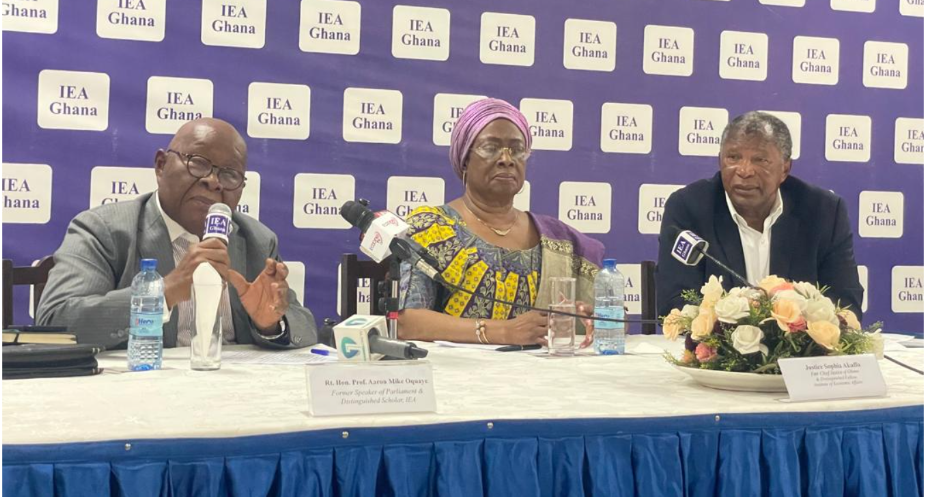
At a press conference jointly addressed by Sophia Akuffo, former Chief Justice; Mike Oquaye, former Speaker of Parliament; and Dr Charles Mensah, Board Chairman of the IEA, the institute made a strong case for the state to take full ownership and strategic control of the mine when the current lease expires in April 2027.
The institute argued that Ghana must seize the opportunity to secure lasting economic benefits for both present and future generations.
“The IEA considers the requested lease renewal deeply inimical to Ghana’s long-term economic and strategic interests and therefore calls on government to reject it decisively, while prioritising a framework that secures meaningful Ghanaian ownership and control of the Tarkwa Mine,” the statement said.
Gold Fields Limited is seeking the renewal of five key mining leases covering the operations of the Tarkwa Mine, as the current lease approaches expiration in April 2027.
The renewal process, which is central to the future of one of Ghana’s most important gold-producing assets, is drawing significant attention from industry stakeholders and government authorities because of its implications for investment continuity, production stability, and national revenue.
Push for 20-year extension
At the heart of the discussions is a formal application submitted by Gold Fields requesting the Government of Ghana to extend the Tarkwa lease by at least 20 years.
The company has described the proposed extension as a long-term strategic commitment to Ghana, positioning Tarkwa as a cornerstone of its global portfolio and one of its most productive operations in Africa.
According to the IEA, the Tarkwa Mine, acquired by Gold Fields in 1993, remains the largest open-pit gold mine in Africa and the flagship operation of the company.
The institute stated that the mine currently produces about 500,000 ounces of gold annually, with an estimated market value exceeding US$2.3 billion at prevailing global prices.
“By the company’s own admission, Ghanaian operations account for nearly 25 per cent of Gold Fields’ global production portfolio, underscoring the immense strategic importance of the Tarkwa Mine to the corporation.
“It is therefore unsurprising that the company would deploy every available avenue, including high-level lobbying, to preserve its hold over the concession,” the institute noted.
Concerns over foreign control
The IEA argued that after more than a century of foreign exploitation of Ghana’s mineral resources under concession arrangements rooted in the colonial era, the country had little transformative development to show for its mineral wealth.
It stated that many mining communities continue to grapple with poor roads, weak health infrastructure, inadequate educational facilities, and widespread poverty despite decades of mining activity.
“The operations of Gold Fields in Tarkwa exemplify the enduring consequences of extractive concession arrangements that overwhelmingly favour foreign corporations at the expense of host communities and the national economy,” the statement said.
“While local residents bear the severe environmental and social costs associated with large-scale mining, the overwhelming economic benefits are exported abroad, enriching foreign economies while leaving host communities marginalised and environmentally burdened,” it added.
Ghana has the expertise
The IEA further argued that Ghana now possesses sufficient technical expertise and operational capacity to successfully manage the Tarkwa Mine if the government declines the lease extension.
It cited the role of the University of Mines and Technology in producing highly skilled mining engineers, geologists, and managers over the years.
“Ghana today possesses a highly experienced pool of mining professionals with the technical expertise and operational competence required to manage the Tarkwa Mine successfully should government decline Gold Fields’ proposed lease extension,” the institute stated.
It added that many mining operations in the country are already being managed largely by Ghanaians, while indigenous companies such as Engineers & Planners and Rocksure International are undertaking major mining activities on behalf of foreign firms.
“Indeed, major operational activities at Gold Fields’ Tarkwa Mine itself are presently executed by Ghanaian mining service providers,” the statement added.
International law and economic sovereignty
The institute also based its argument on international legal instruments that support the sovereign right of nations to control their natural resources.
It cited United Nations General Assembly Resolutions 1803 and 3281, as well as the African Commission on Human and Peoples’ Rights framework under the African Charter on Human and Peoples’ Rights.
“Article 21(1) of the African Charter expressly provides that under no circumstances shall a people be deprived of the right to freely dispose of their wealth and natural resources in their exclusive interest,” the statement said.
The IEA linked Ghana’s recurring economic difficulties to the country’s inability to generate sufficient domestic revenue to finance national development.
According to the institute, excessive dependence on domestic and external borrowing has contributed to repeated economic crises since independence.
It added that despite Ghana undertaking about 17 programmes supported by the International Monetary Fund, including structural adjustment programmes and credit facilities, the country’s fundamental challenge of inadequate domestic revenue mobilisation remains unresolved.
“To unlock the full developmental potential of these resources, Ghana must pursue a model based on national ownership, responsible extraction, local value addition, and the export of finished or semi-finished products capable of generating significantly higher revenues and foreign exchange earnings,” the statement said.
The institute therefore called on government, Parliament, traditional authorities, labour groups, civil society organisations, and all Ghanaians to oppose any attempt to renew the Gold Fields lease.